
Should I start Current Electricity practice with chapter MCQs or a full mock?
Start with explained Current Electricity practice questions for NEET to repair understanding. Use authenticated chapter-wise PYQs next to practise actual exam framing, then full mocks to test execution across subjects. A full paper is inefficient for repeatedly repairing one weak chapter.
An original, free six-question Current Electricity mini-set with explanations appears below the comparison. If you already solve unfamiliar chapter questions without hints and can defend your method, skip elementary drills. Prioritise PYQs and mixed-paper application instead.
How do chapter MCQs, Current Electricity PYQs and full mocks compare?
Use chapter MCQs to isolate concepts, PYQs to study past-paper framing and full mocks to test whole-paper execution. Choose by the mistake you need to expose, not by the size of the question bank.
- Best use
- Original explained chapter MCQs: Isolate a concept or circuit-reading error.
- Authenticated chapter-wise NEET PYQs: Practise actual past-paper wording and framing.
- Full-length NEET mocks: Test subject switching, question selection and whole-paper execution.
- Main limitation
- Chapter MCQs: Original questions do not establish past-paper difficulty.
- PYQs: Familiar questions can reward answer memory.
- Mocks: Inefficient for repeatedly practising one weak chapter.
- Explanation requirement
- Chapter MCQs: Reasoning that identifies the controlling condition.
- PYQs: Reasoning plus an identifiable original paper and the official key.
- Mocks: Follow-up review, because a score alone cannot explain a chapter misconception.
- Access
- Chapter MCQs: This article’s original mini-set is free below.
- PYQs: No particular external collection is verified here. Check questions against original papers and official keys.
- Mocks: For whole-paper practice, NEET JEEnius AI provides 30 free full-length mocks a month.
- Scope
- Chapter MCQs: The selected concepts only.
- PYQs: The questions included in the authenticated collection.
- Mocks: 180 compulsory questions, 720 marks and 180 minutes. The Current Electricity question count is not specified or guaranteed.
Which practice format fits my current problem?
Use explained drills for weak chapter reasoning and full mocks for errors that appear in mixed papers. If familiar PYQs feel easy, test the method on unfamiliar questions before deciding that the chapter is secure.
- Class 11 students studying ahead: First check algebra, units and simple circuit diagrams. Use explained chapter questions. A full-mock score on an unfinished syllabus should not become a judgement on your ability.
- Class 12 students who just finished the chapter: Attempt the mini-set closed-book. Move to authenticated PYQs once you can explain both the correct choice and why the other options fail.
- Droppers who recognise PYQ answers: Cover the options and reconstruct the reasoning first. Add unfamiliar original questions to separate understanding from memory.
- Students who succeed in chapter drills but struggle in mixed papers: Choose a full mock. Review whether each failure came from interpretation, arithmetic, question selection or subject switching.
For parents: Choose the resource that addresses the student’s error pattern, not the one advertising the largest bank. Look for explanations that correct the student’s wrong assumption, not just supply an answer.
Where can I practise free Current Electricity questions for NEET?
Attempt these six original, single-correct MCQs before reading the key below. They are not NEET PYQs and do not provide comprehensive chapter coverage. This set checks conceptual choices rather than lengthy numerical calculation.
Write one reason beside each answer. A correct guess still needs review.
Original practice Q1: Current and drift speed
A conductor has narrow and wide sections with the same charge-carrier density. A steady current flows without branching. Which statement is correct?
- A. Current is the same; drift speed is greater in the narrow section.
- B. Current is greater in the narrow section; drift speed is the same.
- C. Current and drift speed are both greater in the narrow section.
- D. Current and drift speed are both the same.
Original practice Q2: Reading graph axes
Two ohmic resistors have straight-line graphs through the origin, with current on the vertical axis and voltage on the horizontal axis, using identical scales. Line P is steeper than line Q. Which is correct?
- A. P represents greater resistance.
- B. P represents lower resistance.
- C. Both represent equal resistance because both lines are straight.
- D. Their resistances cannot be compared.
Original practice Q3: Adding a parallel branch
A resistor is connected across an ideal constant-voltage source. A second, finite positive resistor is added in parallel. What happens?
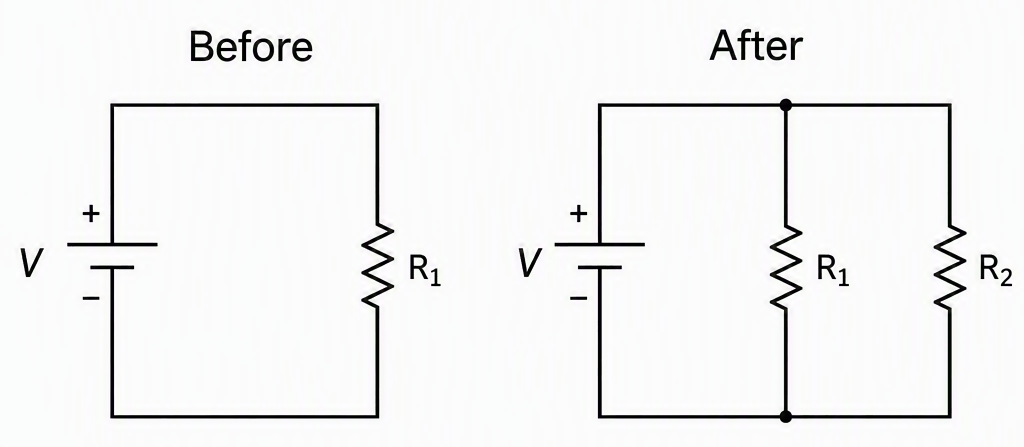
- A. Equivalent resistance rises; total current falls; original current falls.
- B. Equivalent resistance falls; total current stays unchanged; original current falls.
- C. Equivalent resistance falls; total current rises; original current stays unchanged.
- D. Equivalent resistance falls; total current rises; original current rises.
Original practice Q4: Cell terminal voltage
A cell with fixed emf and nonzero, constant internal resistance supplies an external resistor. The external resistance is reduced but remains positive. What happens?
- A. Current decreases; terminal voltage increases.
- B. Current increases; terminal voltage decreases.
- C. Current increases; terminal voltage stays equal to the emf.
- D. Current decreases; terminal voltage decreases.
Original practice Q5: Negative branch current
You assign a branch-current direction before applying Kirchhoff’s laws. Solving consistent equations gives a negative value for that current. What does it mean?
- A. Kirchhoff’s laws are invalid for this circuit.
- B. The branch carries no current.
- C. Current actually flows opposite to the assigned direction.
- D. Current changes direction repeatedly.
Original practice Q6: Power in series
Two unequal, positive resistors are connected in series across a source supplying nonzero steady current. Which dissipates more power?
- A. The smaller resistor, because smaller resistance always means greater power.
- B. Both dissipate equal power because their currents are equal.
- C. The larger resistor, because both carry the same current.
- D. Neither dissipates power unless connected in parallel.
What are the answers, and which condition decides each one?
The key is 1-A, 2-B, 3-C, 4-B, 5-C and 6-C. Check the condition behind each result, not just the letter. Each explanation identifies why a tempting alternative is wrong.
1. A: Steady flow without branching fixes the current. Charge cannot keep accumulating at the narrow section. With equal carrier density, smaller area requires greater drift speed.
Carrier density, charge magnitude, area and drift speed determine current. Option D confuses equal current with equal carrier speed; current density is also greater in the narrow section.
2. B: The axes determine what the slope means. With current vertical and voltage horizontal, the slope is conductance:
The steeper line therefore means lower resistance. Option A would fit a voltage-versus-current graph, whose slope is resistance, not this graph.
3. C: An ideal source keeps the branch voltage unchanged. The original resistor therefore keeps its original current. The added branch draws extra current, so total current rises and equivalent resistance falls.
Option D mistakes total current for original-branch current. The ideal-source assumption matters: internal resistance in a real source can cause terminal voltage to fall when extra current is drawn.
4. B: Fixed emf does not mean fixed terminal voltage. Reducing external resistance increases current, increasing the voltage drop inside the cell.
Terminal voltage therefore decreases. Option C ignores the nonzero internal resistance and treats emf as the loaded terminal voltage.
5. C: The assigned direction is a reference, not a physical constraint. A negative result means the actual current flows opposite to that reference direction. It does not, by itself, invalidate Kirchhoff’s equations or imply alternating current.
6. C: Series connection fixes equal current through both resistors. Under that condition, greater resistance means greater power.
Option A incorrectly imports the parallel condition. Across the same voltage, power instead follows:
How should I use my wrong answers to choose the next set?
Choose your next questions from the wrong assumption, not simply the question number. Use explained drills for concept errors and unfamiliar circuit arrangements for interpretation errors. Correct guesses remain unresolved until you can justify them unaided.
- Q1 error: Separate current, current density and carrier motion. Revisit every variable in the drift-current relation before another narrow-versus-wide conductor question.
- Q2 error: Write the slope’s units before interpreting it. Ampere per volt indicates conductance; volt per ampere indicates resistance.
- Q3 or Q6 error: State what stays constant first: branch voltage, series current or neither. Then choose the power or current relation.
- Q4 error: Distinguish emf from terminal voltage under load. Include the internal voltage drop.
- Q5 error: Separate an assumed arrow from the physical current direction.
Keep a compact error log:
- Wrong assumption: “Adding a branch increases current in every resistor.”
- Corrected rule: “An ideal source keeps the original branch voltage unchanged.”
- Next retry: Solve an unfamiliar parallel circuit and explain each branch current before calculating.
Use NEET Score Improvement: Fix Errors Before Your Next Mock to extend that review process. These six original questions cannot support a predicted NEET score, percentile or readiness cutoff.
When does a full mock become the right next step?
Move to a full mock when you can solve unfamiliar chapter questions and justify the method without consulting a solution. Then test time allocation across the paper, not another elementary Current Electricity drill. Review how interpretation and calculation hold up alongside Chemistry and Biology.
The current full-paper pattern contains 180 compulsory questions for 720 marks in 180 minutes:
- Physics: 45 questions.
- Chemistry: 45 questions.
- Biology: 90 questions.
There is no optional Section B. The marking scheme is:
During review, separate circuit-reading errors from rushed arithmetic, poor question selection and subject switching. Use the full mock to check execution after chapter repair, not to replace chapter practice.
What should I check before trusting free Current Electricity questions?
Check the reasoning; for a claimed PYQ, also check the original paper and official key. An answer letter alone does not show whether the solution used the right circuit condition.
Are PYQs enough if I remember their answers?
Remembering an option does not demonstrate the method. PYQs are valuable for actual exam framing, but reconstruct the reasoning before viewing options and test it on unfamiliar questions.
Do I need numerical questions alongside this set?
Yes. This mini-set is conceptual, not a complete numerical workbook. Add calculation-based Current Electricity questions on resistance combinations, internal resistance and circuit equations.
How many questions should I solve daily?
There is no universal quota. Select the next set from unresolved errors and review it fully before adding more questions.
Are these questions actual NEET PYQs?
All six are original single-correct practice questions, not authenticated NEET PYQs. Use authenticated past papers separately for actual exam framing.
Once chapter reasoning is secure, use a NEET JEEnius AI full-length mock as an execution check: 30 free a month, each with 180 questions, 720 marks and 180 minutes, split into 45 Physics, 45 Chemistry and 90 Biology, with a scored per-subject breakdown. Review the errors before taking the next one.
Next step: full-length mock tests on NEET JEEnius AI and sit a full 180-question, 720-mark, 180-minute paper, 45 Physics, 45 Chemistry and 90 Biology, and get a scored per-subject breakdown (30 free a month).
Frequently asked questions
Should I practise Current Electricity chapter MCQs or full mocks first?
Start with explained chapter MCQs if your Current Electricity reasoning is weak, then use authenticated PYQs to practise actual exam framing. Move to full mocks when you can solve unfamiliar chapter questions and justify your method without hints.
Are these Current Electricity questions actual NEET PYQs?
No. All six questions are original, single-correct practice MCQs, not authenticated NEET PYQs. For actual past-paper practice, check claimed PYQs against the original papers and official answer keys.
Are Current Electricity PYQs enough if I remember the answers?
Remembering an option does not establish that you understand the method. Cover the options and reconstruct the reasoning, then test it on unfamiliar questions. Use PYQs for actual exam framing, not as proof of mastery through answer recall.
Do I need numerical questions alongside this Current Electricity set?
Yes, the six-question mini-set checks conceptual choices and is not a complete numerical workbook. Add calculation-based questions on resistance combinations, internal resistance and circuit equations.