
Should I start Cell Cycle practice with chapter questions or a full mock?
Explained NCERT-aligned chapter MCQs are the best Cell Cycle practice questions for NEET when you need to repair concepts. Use authenticated previous-year questions (PYQs) to check how concepts were examined, then full mocks to test performance across subjects.
Below are eight original, free, single-correct questions, with answers and explanations after the complete set. They are original NEET-style practice, not actual NEET PYQs or official NCERT questions.
How do chapter MCQs, authenticated PYQs and full-length mocks compare?
Chapter MCQs diagnose concept errors, authenticated PYQs show what was actually asked, and full mocks test whole-paper performance. Pick the format that addresses your mistake, rather than treating all question practice as interchangeable.
- Best use
- Original explained chapter MCQs: Learn or repair concepts.
- Authenticated NEET PYQs: Check how concepts were examined.
- Full-length mocks: Practise time allocation across subjects.
- Cell Cycle focus
- Chapter MCQs: Every question below targets Cell Cycle and Cell Division.
- PYQs: Select relevant questions from authenticated papers.
- Mocks: No guaranteed number of Cell Cycle questions.
- What answers can diagnose
- Chapter MCQs: Explanations identify specific misconceptions.
- PYQs: A matching key confirms the answer but may not explain it.
- Mocks: Subject scores show where whole-paper performance differs.
- Exam-condition practice
- Chapter MCQs: No whole-paper pressure.
- PYQs: Isolated chapter questions do not reproduce a complete sitting.
- Mocks: A full timed paper supports pacing practice.
- Free-access evidence
- Chapter MCQs: All eight questions and explanations are here.
- PYQs: Authenticate using actual papers and matching official keys from neet.nta.nic.in. No free chapter catalogue is verified here.
- Mocks: For whole-paper practice, NEET JEEnius AI offers 30 free mocks a month: 180 questions, 720 marks, 180 minutes, with 45 Physics, 45 Chemistry and 90 Biology questions, plus a scored per-subject breakdown.
- Main limitation
- Chapter MCQs: This small set is not comprehensive chapter coverage.
- PYQs: Remembered options can conceal weak reasoning.
- Mocks: The verified feature does not establish a Cell Cycle-only test or chapter-level diagnostic.
What should Class 11, Class 12 students and droppers choose?
Choose by what you can explain without notes, not by your class label. A dropper who remembers options but cannot explain chromosome counting needs concept repair, not another attempt at familiar questions.
- Class 11, first reading: Read the relevant NCERT material, then attempt the original set below. Do not make full-paper testing your main tool for learning this chapter.
- Class 12, returning after a gap: Attempt without notes. Repair stage-sequence and DNA-content errors before moving to authenticated PYQs.
- Dropper, familiar options: Prioritise fresh questions and explain each choice aloud before repeating familiar PYQs.
- Accurate chapter solver, weak whole-paper performance: Use full-length mocks for time allocation, then review the available per-subject breakdown.
For parents: more questions are not automatically better practice. Repeated conceptual mistakes call for revision of the same concept, not another question source.
Can I attempt eight free Cell Cycle MCQs now?
Attempt all eight questions below before checking the next section. Choose one option per question and mark every guessed or uncertain answer. Keep notes closed so the set identifies what you can explain unaided.
1. Which statement correctly describes a cell in G0?
A cell has left active cell-cycle progression and entered the quiescent stage. Which description is correct?
- A. It has permanently stopped all metabolic activity.
- B. It remains metabolically active but is not actively proliferating.
- C. It must be replicating DNA before entering mitosis.
- D. It has entered the interval between meiosis I and meiosis II.
2. What changes during S phase in an initially diploid cell?
Compare the whole cell at G1 with the same cell immediately after S phase, before division. Which statement correctly describes chromosome number and nuclear DNA content?
- A. Both chromosome number and DNA content double.
- B. Chromosome number doubles, but DNA content remains unchanged.
- C. DNA content doubles, but chromosome number remains unchanged.
- D. Both chromosome number and DNA content remain unchanged.
3. Which stage involves centromere division and sister-chromatid separation?
A dividing somatic cell shows centromere division, followed by sister chromatids moving towards opposite poles. Which stage is being observed?
- A. Anaphase of mitosis.
- B. Metaphase of mitosis.
- C. Anaphase I of meiosis.
- D. Prophase of mitosis.
4. When does crossing over occur in prophase I?
Which pairing correctly identifies the stage and the chromatids involved in crossing over?
- A. Zygotene, between non-sister chromatids of homologous chromosomes.
- B. Pachytene, between sister chromatids of one chromosome.
- C. Diplotene, between chromatids of non-homologous chromosomes.
- D. Pachytene, between non-sister chromatids of homologous chromosomes.
5. What separates during anaphase I?
During normal meiosis I, chromosomes move towards opposite poles. Which description correctly identifies what separates and what remains joined?
- A. Sister chromatids separate after centromeres divide.
- B. Homologous chromosomes separate while sister chromatids remain joined.
- C. Homologous chromosomes pair through synapsis.
- D. Both homologues and their sister chromatids separate simultaneously.
6. What is the state of each daughter nucleus after meiosis I?
An initially diploid cell completes meiosis I normally. Choose the chromosome-set and DNA-content state of each daughter nucleus, not the combined contents of both nuclei.
Use these definitions:
- A.
- B.
- C.
- D.
7. Is DNA replicated again before meiosis II?
A cell has completed meiosis I and is preparing for meiosis II. Which statement correctly describes DNA replication and the next division?
- A. Another S phase must double the DNA before meiosis II.
- B. Meiosis II separates homologous chromosomes for the first time.
- C. No intervening S phase occurs; sister chromatids separate during meiosis II.
- D. Meiosis II restores the diploid chromosome-set number.
8. How does cytokinesis differ in typical plant and animal cells?
Which statement correctly contrasts the usual mechanism of cytoplasmic division?
- A. Plant cells form a cleavage furrow; animal cells form a cell plate.
- B. Both cell types divide through a cell plate growing from the centre.
- C. Both cell types divide through an inward-growing cleavage furrow.
- D. Plant cells form a central cell plate; animal cells form an inward-growing cleavage furrow.
What do the answers reveal about my mistakes?
Answer key: 1 B, 2 C, 3 A, 4 D, 5 B, 6 A, 7 C, 8 D.
Review a guessed-correct answer exactly as you would a mistake. Recognising an option is not the same as explaining it, and this small set cannot predict NEET readiness or a score increase.
- 1. B, G0 is quiescence, not metabolic shutdown. Cells remain metabolically active without actively proliferating. Option A confuses absence of division with absence of life processes.
- 2. C, DNA doubles without chromosome number doubling. S phase produces sister chromatids; it does not separate their centromeres. Option A wrongly counts each newly formed chromatid as an independent chromosome.
- 3. A, mitotic anaphase separates sister chromatids. Centromeres divide, and the separated chromatids become daughter chromosomes. Option C also involves movement to poles, but anaphase I separates homologues.
- 4. D, crossing over occurs in pachytene. It involves non-sister chromatids of homologous chromosomes. Option A confuses crossing over with synapsis, the pairing of homologues during zygotene.
- 5. B, anaphase I separates homologous chromosomes. Sister chromatids remain joined at their centromeres. Option A describes mitotic anaphase and anaphase II.
- 6. A, each daughter nucleus has one chromosome set but duplicated chromosomes. Homologues have separated, while sister chromatids remain joined. Option C removes the extra DNA too early: that state follows meiosis II.
- 7. C, there is no intervening S phase. Meiosis II separates chromatids produced by the earlier replication. Option A incorrectly inserts a second round of DNA replication.
- 8. D, plant cells form a cell plate; animal cells form a cleavage furrow. The plate grows outward from the centre; the furrow progresses inward. Option A reverses the processes.
Chromosome sets and DNA content are separate quantities. Follow the same starting diploid cell through replication and meiosis, counting each daughter nucleus separately after division.
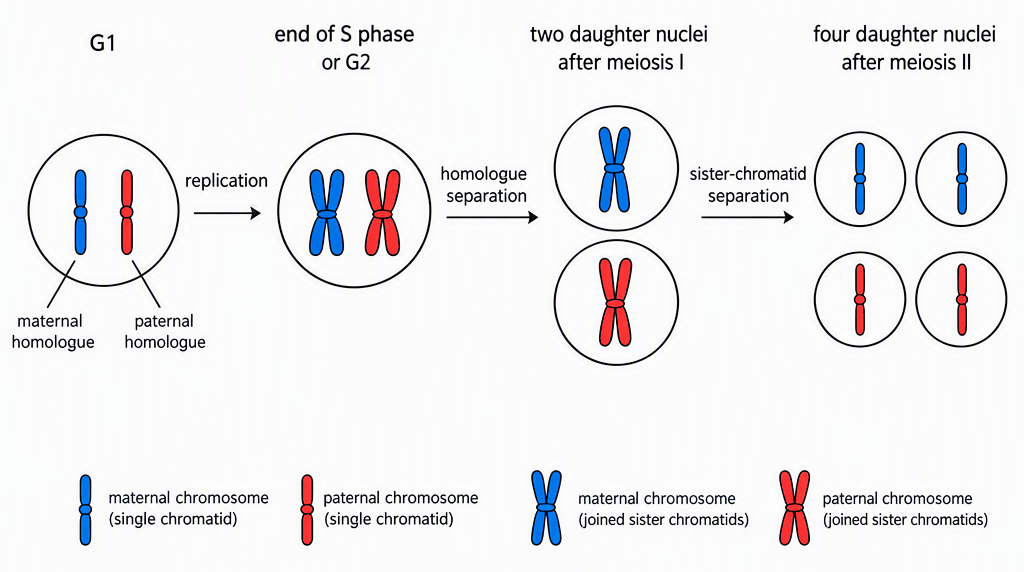
These are biological counting states, not chapter weightage or expected exam marks. Use wrong or uncertain answers to select a revision target:
- Question 1: G0 and interphase.
- Questions 2 and 6: Chromosome number versus DNA content.
- Questions 3, 5 and 7: Mitosis versus meiosis.
- Question 4: Prophase I events.
- Question 8: Cytokinesis.
What should I practise after this diagnostic set?
Repair the reasoning before increasing the question count. Once you can explain the answers without looking, attempt authenticated chapter PYQs with the key hidden. Use whole-paper mocks for cross-subject performance, not to repair confusion between homologues and sister chromatids.
- Attempt the set without notes.
- Mark uncertain answers alongside definite mistakes.
- Review the matching NCERT concept.
- Explain the corrected reasoning aloud, including why the tempting distractor fails.
- Reattempt later without seeing the key.
If chromosome and DNA states remain confused, redraw the same starting cell through replication and division before collecting more MCQs. Label every stage and specify whether you are counting a whole cell or each daughter nucleus.
Authenticate PYQs using the actual paper and its matching official key. Never infer a paper year from an unsourced worksheet label.
Use the official marking scheme when scoring practice:
- Correct: 4 marks.
- Wrong: minus 1 mark.
- Unattempted: 0 marks.
A chapter-set score is not a projected NEET score. For broader revision, continue with Cell Biology Practice Questions NEET: 6 MCQs Explained.
What else should I know about free Cell Cycle practice?
All eight questions and explanations are available here without payment. Completing them does not prove that you have finished the chapter.
Are all eight questions and explanations free?
Yes, the complete set, answer key and reasoning are above. No payment is needed to read them.
Can I download these questions as a PDF?
Use the questions directly in this article. No downloadable PDF or separate chapter-test product is offered here.
Does a “cell cycle practice questions neet” label mean these are PYQs?
No, these are original practice questions, not previous-year NEET questions. Do not cite them as PYQs.
How many questions prove that I have finished the chapter?
No fixed count does. Check whether you can justify stage identification and chromosome-versus-DNA reasoning on unfamiliar questions.
When those explanations are secure, take a NEET JEEnius AI full-length mock for whole-paper practice, then review its scored per-subject breakdown before choosing what to revise next.
Next step: full-length mock tests on NEET JEEnius AI and sit a full 180-question, 720-mark, 180-minute paper, 45 Physics, 45 Chemistry and 90 Biology, and get a scored per-subject breakdown (30 free a month).
Frequently asked questions
Are these Cell Cycle questions free NEET PYQs?
All eight questions, the answer key and explanations are free to read. They are original NEET-style practice questions, not actual NEET PYQs or official NCERT questions.
Should I practise Cell Cycle chapter questions or full mocks first?
Start with explained chapter MCQs if you need to repair concepts. Once you can explain the answers without notes, attempt authenticated PYQs. Use full-length mocks to practise time allocation and performance across subjects.
Does chromosome number double during S phase?
No. In an initially diploid cell, S phase doubles DNA content from 2C to 4C while chromosome number remains 2n. Sister chromatids form, but their centromeres have not separated.
What are the chromosome number and DNA content after meiosis I?
Each daughter nucleus has one chromosome set, n, and DNA content of 2C after normal meiosis I in an initially diploid cell. Homologous chromosomes have separated, but sister chromatids remain joined. Count each daughter nucleus separately, not the combined contents of both nuclei.
How many Cell Cycle MCQs should I solve to finish the chapter?
No fixed question count proves chapter completion. Check whether you can identify stages and explain chromosome number versus DNA content on unfamiliar questions. Review guessed-correct answers as carefully as mistakes before increasing the question count.