
Should I start cell biology practice with chapter questions or a full mock?
Start with topic-wise, NCERT-aligned MCQs, not a full mock. Use these cell biology practice questions for NEET to learn and repair concepts, authentic previous-year questions (PYQs) to check how concepts have been examined, and full-length mocks to test whole-paper performance.
Free original questions with explanations appear below. A full mock is not an efficient substitute for targeted cell biology practice.
Which free cell biology practice format should I choose?
Choose topic-wise questions for concept gaps, PYQs for exam wording and full mocks for whole-paper performance. Compare coverage and answer-review methods before choosing, not just the number of questions available.
- Best use
- Article MCQs: Learn concepts and identify misunderstandings.
- Cell-related PYQs: Check how concepts appeared in original NEET papers.
- NEET JEEnius AI mocks: Test mixed-subject recall and pacing.
- Control over chapter coverage
- Article MCQs: Six selected concepts, not exhaustive coverage.
- Cell-related PYQs: Select relevant questions, but past papers do not guarantee complete topic coverage.
- Full mocks: Complete-paper practice, with no guaranteed cell biology question count.
- Evidence of actual exam wording
- Article MCQs: Original practice items, not official questions or PYQs.
- Cell-related PYQs: Original papers establish wording. A coaching-site label alone does not establish authenticity.
- Full mocks: Practice papers, not evidence of past exam wording.
- Answer-review method
- Article MCQs: Explanations of the answer and conceptual trap.
- Cell-related PYQs: Official final keys establish accepted answers; NCERT supports concept review.
- Full mocks: Scored per-subject breakdown.
- Whole-paper stamina practice
- Article MCQs: No.
- Cell-related PYQs: Not as a cell-only selection.
- Full mocks: Yes, with 30 free a month.
- Main limitation
- Article MCQs: Too short to establish chapter mastery.
- Cell-related PYQs: Past coverage does not establish full syllabus coverage.
- Full mocks: Less focused for repairing one concept.
Which option suits Class 11, Class 12 and droppers?
Your demonstrated weakness matters more than your class or attempt number. A dropper who confuses organelles needs targeted questions, while a Class 11 student may use PYQs after understanding a topic. None of these formats belongs exclusively to one student group.
- Class 11, recently studied organelles: Choose topic-wise questions if functions still blur together. After each error, read the relevant NCERT passage and explain why your selected organelle does not match the function asked.
- Class 12, definitions remembered but statement options difficult: Briefly revise the chapter, then attempt authentic PYQs. Judge each statement separately before looking at the option combinations.
- Dropper, strong chapter scores but weaker mixed-subject performance: Choose full mocks to test recall and pacing. Keep targeted cell biology correction sessions rather than replacing them with more full papers.
- Any student repeatedly missing one concept: Return to the underlying text or diagram. A larger question bank does not replace that review.
For each answer, explain why the other options are wrong. If you cannot reject a distractor, record that uncertainty even when your answer is correct.
For parents, completed-question totals are a poor measure on their own. Ask which mistake the student corrected and how they checked the correction.
Can I try free cell biology MCQs with explanations now?
Attempt these six author-created, single-correct questions before reading the key. Each has four options and tests selected concepts from Cell: The Unit of Life and Cell Cycle and Cell Division. They are original practice, not PYQs or official NTA items.
This set does not provide complete coverage of either chapter or of Biomolecules. Record your chosen letter and mark any answer you guessed.
1. Which statement correctly identifies the selectively permeable boundary of a typical plant cell?
- A. The cell wall selectively regulates movement into and out of the cytoplasm.
- B. The plasma membrane selectively regulates movement between the cell and its surroundings.
- C. The nuclear envelope forms the outer boundary of the entire cell.
- D. The middle lamella controls all exchange between the cytoplasm and the surroundings.
2. A typical bacterial cell lacks a membrane-bound nucleus. Which conclusion is correct?
- A. It contains no genetic material.
- B. Its DNA is enclosed inside mitochondria.
- C. Its genetic material is present without a surrounding nuclear envelope.
- D. Its genetic information is stored only in ribosomal proteins.
3. A cell is producing a protein for secretion. Which pairing correctly assigns the two processes?
- A. Protein synthesis: Golgi apparatus; modification and packaging: ribosomes.
- B. Protein synthesis: ribosomes; modification and packaging: Golgi apparatus.
- C. Protein synthesis: lysosomes; modification and packaging: ribosomes.
- D. Protein synthesis: Golgi apparatus; modification and packaging: lysosomes.
4. Which organelle is most directly associated with enzyme-mediated digestion of worn-out cellular components?
- A. Mitochondrion.
- B. Ribosome.
- C. Golgi apparatus.
- D. Lysosome.
5. In a typical animal cell undergoing mitosis, chromosomes are aligned at the equatorial plate, while sister chromatids remain joined at their centromeres. Which stage is described?
- A. Prophase.
- B. Metaphase.
- C. Anaphase.
- D. Telophase.
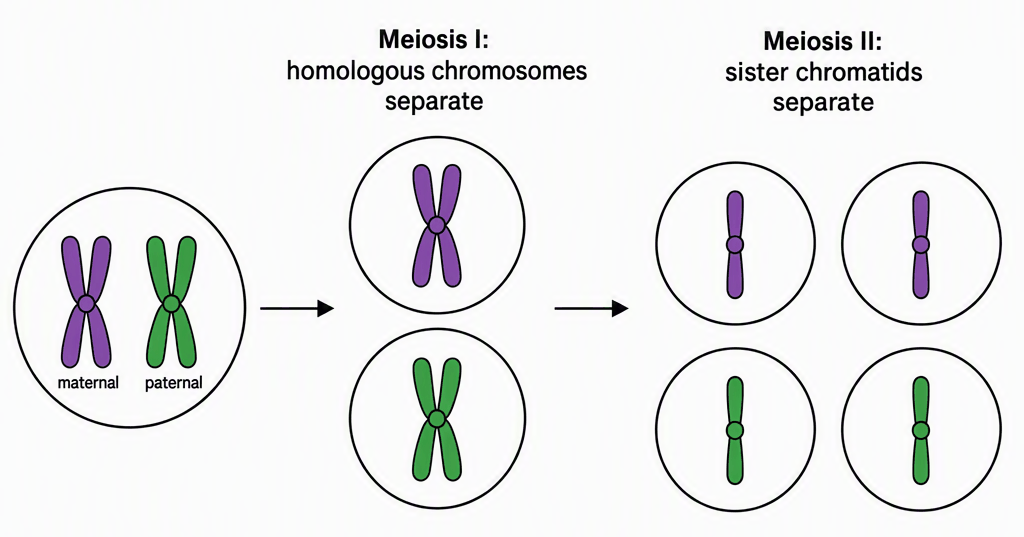
6. Which statement correctly compares chromosome separation in meiosis I and meiosis II?
- A. Sister chromatids separate in anaphase I; homologous chromosomes separate in anaphase II.
- B. Homologous chromosomes separate during both anaphase I and anaphase II.
- C. Homologous chromosomes separate in anaphase I; sister chromatids separate in anaphase II.
- D. Sister chromatids separate during both anaphase I and anaphase II.
What are the correct answers and the traps?
The key is 1 B, 2 C, 3 B, 4 D, 5 B and 6 C. Review the reason behind each choice, including correct answers reached by guessing. Identify whether you confused a structure, a function or an event in cell division.
1. B, plasma membrane. Selective permeability allows regulated movement across the plasma membrane. The tempting distractor is A: the plant cell wall provides structural support, but it is not the selectively permeable membrane controlling exchange with the cytoplasm. Review Cell: The Unit of Life, plasma membrane and cell wall.
2. C, genetic material without a nuclear envelope. Prokaryotic organisation means the absence of a membrane-bound nucleus, not the absence of DNA. Option A turns “no true nucleus” into “no genetic material”, which is the central trap. Review Cell: The Unit of Life, prokaryotic cells and the nucleoid.
3. B, ribosomes followed by Golgi processing. Ribosomes synthesise proteins; the Golgi apparatus participates in modification and packaging. Option A reverses those roles: involvement in secretion does not mean both structures synthesise proteins. Review Cell: The Unit of Life, ribosomes and the endomembrane system.
4. D, lysosome. Lysosomes contain hydrolytic enzymes involved in intracellular digestion. Mitochondria, the tempting choice in A, are associated with aerobic respiration and ATP production, not lysosomal digestion; ribosomes synthesise proteins. Review Cell: The Unit of Life, lysosomal function.
5. B, metaphase. Chromosome alignment at the equatorial plate identifies mitotic metaphase. Option C describes the next stage: during anaphase, centromeres split and sister chromatids move towards opposite poles. Review Cell Cycle and Cell Division, especially the event that separates metaphase from anaphase.
6. C, homologues first and sister chromatids second. Anaphase I separates homologous chromosomes while sister chromatids remain joined; anaphase II separates sister chromatids. Option A reverses the order. Review Cell Cycle and Cell Division, focusing on what separates rather than memorising stage names alone.
How should I use my mistakes to choose the next practice session?
Choose your next task from the error, not just the total score. A missing fact needs a different repair from a misread option. Treat a guessed correct answer as needing review, and do not use this short, selected set to predict NEET rank, total Biology marks or chapter mastery.
If scoring, use NEET marking: 4 marks for correct, a deduction of 1 for wrong and 0 for unattempted. Calculate it as:
- Missing fact: reread the relevant NCERT passage. Close the book and state the fact in your own words.
- Confused organelle functions: make a contrast table. Put each organelle beside its actual function and the function you wrongly assigned.
- Confused division stages: reconstruct the sequence. State what aligns, what separates and whether centromeres split.
- Misread qualifier: identify the word that changed the answer. Check words such as “not”, “only” and “incorrect”.
For another division-focused explanation, use Meiosis NEET 2026 Assertion-Reason Question Solved. Explain the underlying events before relying on the answer letter.
Revisit the concept later with a fresh question. Immediately repeating a memorised option tests recognition, not whether the misunderstanding has been repaired.
Where can I get free cell biology practice questions with answers?
The six questions above are free cell biology practice questions for NEET, with explanations for the answers and traps. They are original items, not authentic PYQs or full-length mocks. The complete-paper option and its verified free allowance appear below.
Are previous-year questions enough for cell biology?
No. PYQs show past examination style, not complete syllabus coverage or a guarantee of future questions. Check wording against original papers and accepted answers against official final keys, then use NCERT to resolve conceptual gaps.
Does this set cover the complete cell biology syllabus?
No. It samples Cell: The Unit of Life and Cell Cycle and Cell Division and does not cover Biomolecules. Check the official syllabus for your exam year at neet.nta.nic.in rather than treating a question-bank label as a syllabus.
How many cell biology questions should I solve daily?
There is no universal daily target. Choose a workload that leaves time to explain errors and revisit weak concepts. Before adding another batch, revise one mistake’s source concept and schedule a fresh question for later.
When is a full mock better than more cell biology questions?
Choose a full mock when the problem is mixed-subject recall, pacing or endurance, rather than one chapter. It is the better tool when you can explain cell concepts in isolation but struggle to retrieve them among Physics and Chemistry questions. Keep a separate correction session for mistakes identified in the paper.
The current paper contains 180 compulsory questions and no optional Section B. Practise the complete paper rather than planning to leave an optional subsection unanswered.
There is no guaranteed cell biology question count in a full mock. For broader revision planning, use NEET Biology Important Chapters: A 14-Day Study Plan, then reserve a session to correct the mistakes you find.
When ready to test whole-paper performance, use NEET JEEnius AI’s 30 free full-length mocks a month. Each has 180 questions, 720 marks and 180 minutes, comprising 45 Physics, 45 Chemistry and 90 Biology questions, with a scored per-subject breakdown.
Frequently asked questions
Should I start cell biology practice with chapter questions or full mocks?
Start with topic-wise, NCERT-aligned MCQs to identify and repair concept gaps. Use authentic previous-year questions to study exam wording, then full mocks to test mixed-subject recall, pacing and endurance.
Where can I get free cell biology practice questions for NEET with answers?
This article provides six free, original MCQs with answer explanations and conceptual traps. They sample Cell: The Unit of Life and Cell Cycle and Cell Division, but do not cover Biomolecules or establish complete chapter mastery. They are not official NTA questions or PYQs.
Are PYQs enough for NEET cell biology preparation?
No. PYQs show how concepts were examined, but do not guarantee complete syllabus coverage or future questions. Verify wording against original papers and answers against official final keys, then use NCERT to resolve conceptual gaps.
How many cell biology questions should I solve daily for NEET?
There is no universal daily target. Choose a workload that leaves time to explain mistakes, review guessed answers and revisit weak concepts. Before adding another batch, revise the source concept behind one mistake and schedule a fresh question for later.
When should I take a full mock instead of more cell biology MCQs?
Choose a full mock when your main difficulty is mixed-subject recall, pacing or endurance rather than an isolated cell biology concept. Keep a separate correction session for mistakes found in the paper. NEET JEEnius AI offers 30 free full-length mocks a month, with scored per-subject breakdowns.