
Which NEET Biology chapters should you do first?
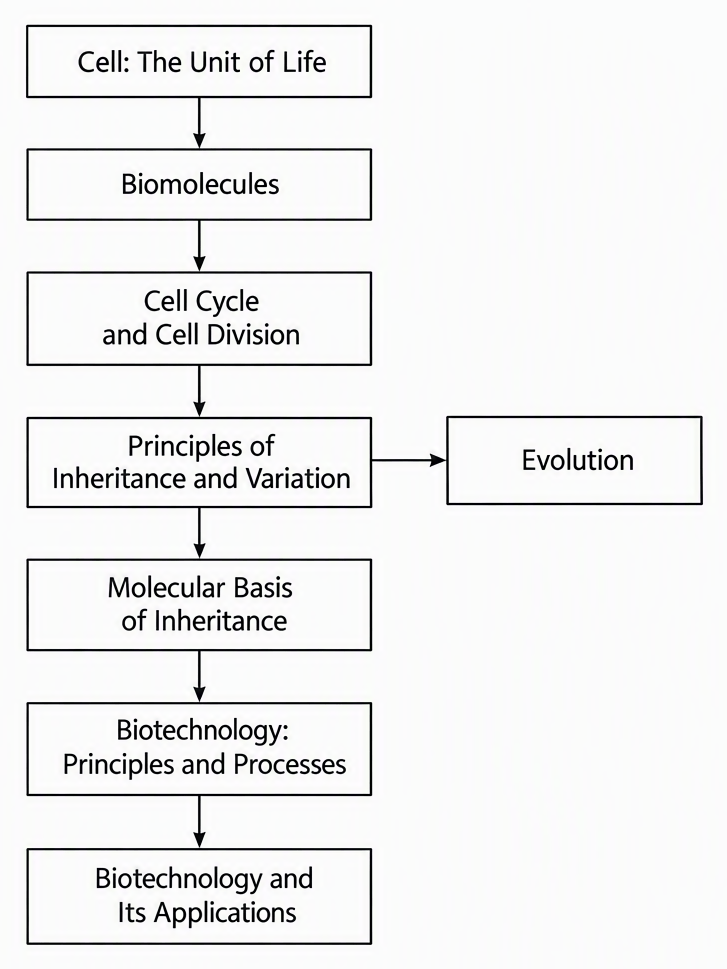
For a beginner choosing neet biology important chapters, start with Cell: The Unit of Life → Biomolecules → Cell Cycle and Cell Division → Principles of Inheritance and Variation → Molecular Basis of Inheritance. This order builds the prerequisites needed to understand genetics instead of memorising answers. It is a learning sequence, not a prediction of which chapters will carry the most marks.
If you are revising, begin with weak chapters and missed questions, then repair whichever prerequisite caused the mistake. Important chapters decide starting priority, not what you can skip: keep the remaining syllabus on a separate checklist.
What should your first 14 days of Biology study look like?
Use four focused self-study hours daily: one for Physics, one for Chemistry and two for Biology. Every time, day allocation and practice target below is a suggested planning choice, not a research finding or official requirement. This schedule excludes school, coaching, meals and breaks.
Daily timetable: time, subject and task
- 06:00–07:00 | Physics: Solve problems from the current chapter and correct mistakes.
- 17:00–18:00 | Chemistry: Revise the current concept, reaction or calculation method, then practise it.
- 19:00–21:00 | Biology: Complete recall, NCERT study, questions and error correction.
- Total | Four hours: Focused self-study only.
Biology timetable: days, chapter and task
- Days 1–2 | Cell: The Unit of Life: Study cell organisation and organelle functions; reproduce relevant labelled diagrams.
- Day 3 | Biomolecules: Make a first pass through molecular groups, enzymes and links to cell function.
- Days 4–5 | Cell Cycle and Cell Division: Explain mitosis, meiosis and chromosome behaviour.
- Day 6 | Mixed cell-unit practice: Attempt questions across the three chapters and correct errors.
- Day 7 | Catch-up and closed-book recall: Repair unfinished concepts and test what you can recall.
- Days 8–10 | Principles of Inheritance and Variation: Connect inheritance problems to gamete formation.
- Days 11–13 | Molecular Basis of Inheritance: Study how genetic information is stored, copied and expressed.
- Day 14 | Mixed review: Recheck errors and decide what needs extension or comes next.
Move the clock times around school or coaching. Preserve the starting allocation of one hour Physics, one hour Chemistry and two hours Biology rather than forcing an unsuitable early-morning routine.
Split the Biology block into:
- 20 minutes: Due recall without notes.
- 50 minutes: NCERT reading and concept work.
- 30 minutes: Questions, with 10–15 as a suggested starting target, not a quota.
- 20 minutes: Error correction and unresolved concepts.
These blocks total 120 minutes. Over 14 days, the plan allocates 28 Biology hours and 14 hours each for Physics and Chemistry.
This is a foundation starter, not a promise to master five chapters in two weeks. A difficult chapter can use the catch-up buffer or extend beyond day 14. Count labelled diagrams reproduced from memory, corrected question errors and a short unresolved-concept list as outputs, not merely pages read.
How should you divide time between Biology, Physics and Chemistry?
Give Biology two of the four hours initially because it carries half the paper’s marks. That is a starting allocation, not a compulsory ratio imposed by the exam. Use corrected test errors to decide where extra time goes, while protecting daily work in all three subjects.
The official paper pattern is:
- Biology: 90 questions, 360 marks.
- Physics: 45 questions, 180 marks.
- Chemistry: 45 questions, 180 marks.
Biology contains 45 Botany questions and 45 Zoology questions. The cell-to-genetics sequence must not become long-term neglect of either half.
Protect daily Physics problem-solving and Chemistry work. Do not borrow both blocks to finish a Biology reading target.
When corrected tests show that non-Biology errors dominate, temporarily use:
- Biology: 90 minutes.
- Weaker non-Biology subject: 90 minutes.
- Other subject: 60 minutes.
That still totals four hours. Within the shorter Biology block, preserve recall and correction and reduce new reading first. Review the adjustment at the next weekly check; do not move time simply because one subject feels more comfortable.
What mistakes can make this chapter-first plan fail?
The main mistakes are treating calendar completion as learning, skipping prerequisites and leaving errors unchecked. Keep chapter tasks small enough to test, protect correction time and extend difficult prerequisites when needed. Check what you can explain and solve before moving on.
- Treating units as chapters: Human Physiology and Genetics and Evolution each contain several chapters. Replace “finish physiology” with a named chapter and a checkable task.
- Turning priorities into exclusions: Maintain a whole-syllabus checklist. At each weekly review, identify the next uncovered chapter, not just another revision of a favourite.
- Rereading highlighted NCERT for two hours: Stop reading when its block ends. Protect recall, questions and correction, even if some pages remain.
- Starting inheritance without meiosis: Repair chromosome pairing, separation and gamete formation before memorising problem solutions.
- Compressing concepts to preserve the timetable: Use day 7 or extend beyond day 14. A first reading is not completed learning.
- Converting question-bank percentages into expected marks: Use the supplied counts only as context. The next section explains why their denominator and year labels prevent a marks forecast.
- Chasing attempts without checking errors: Correct answers earn 4 marks, incorrect answers lose 1 mark, and unattempted answers earn 0. Track whether you can now solve questions on previously missed concepts, not just how many questions you attempted.
- Double-counting time or cutting sleep: School and coaching are not completed self-study blocks. Move the schedule or reduce that day’s new-content target instead of cutting sleep.
For parents, the useful check is what was corrected and recalled. Hours seated at a desk cannot show that by themselves.
Which important Biology units should guide your chapter order?
Use the supplied counts for unit-level context, but use prerequisites to decide tomorrow’s chapter. Cell Structure and Function comes first for beginners despite its lower count than Genetics and Evolution, because cell organisation, biomolecules and meiosis support later genetics. Question-bank frequency and learning order answer different questions.
The roadmap names entry chapters, not complete unit coverage. Check each chapter and subtopic against the official syllabus for your attempt year at neet.nta.nic.in before assigning work. NCERT contents alone are not proof of current examinability.
Data note: The source labels its aggregate “last 5 years”, but its breakdown lists 2021–2026, six years. These are supplied tagged-question counts, not a verified five-year paper analysis.
Roadmap: unit, supplied tagged-question count, chapter entry points and scheduling advice
- Genetics and Evolution | 104: Principles of Inheritance and Variation; Molecular Basis of Inheritance; Evolution. Repair meiosis before inheritance. Place Evolution after inheritance concepts.
- Cell Structure and Function | 92: Cell: The Unit of Life; Biomolecules; Cell Cycle and Cell Division. Start here when learning from scratch; revisit biomolecules when molecular genetics exposes gaps.
- Diversity in Living World | 90: Biological Classification; Plant Kingdom; Animal Kingdom. Use recurring comparison-and-recall sessions for distinguishing features and examples instead of one final memorisation week.
- Human Physiology | 87: Breathing and Exchange of Gases; Body Fluids and Circulation. These provide a connected entry through gas exchange and transport. Schedule the other physiology chapters separately.
- Ecology and Environment | 77: Biodiversity and Conservation is an accessible parallel revision choice. Give other ecology chapters their own tasks rather than treating this entry point as the whole unit.
- Plant Physiology | 75: Photosynthesis in Higher Plants; Respiration in Plants. Use cell and biomolecule knowledge to explain where processes happen and what they produce.
- Reproduction | 72: Human Reproduction; Sexual Reproduction in Flowering Plants. Reproductive Health can serve as a parallel revision chapter. Link gamete formation back to meiosis.
- Biotechnology and Its Applications | 63: Biotechnology: Principles and Processes; Biotechnology and Its Applications. Study them in that order after molecular genetics so that techniques have a biological explanation.
- Structural Organisation in Animals and Plants | 63: Morphology of Flowering Plants; Anatomy of Flowering Plants. Revisit comparisons and labelled structures regularly; these entry points do not cover every part of the unit.
- Biology and Human Welfare | 40: Human Health and Disease is an accessible parallel revision option. Practise distinctions between causes, transmission, prevention and immune responses rather than relying on familiarity.
Follow Cell: The Unit of Life → Biomolecules → Cell Cycle and Cell Division → Principles of Inheritance and Variation → Molecular Basis of Inheritance when starting from scratch. After molecular genetics, continue to Biotechnology: Principles and Processes and then Biotechnology and Its Applications; place Evolution after inheritance concepts.
Meiosis connects chromosome behaviour to inheritance problems. If you cannot explain what separates at each division, Work through a meiosis question before moving ahead.
Reproductive Health, Human Health and Disease, and Biodiversity and Conservation offer parallel revision without waiting for the full genetics chain. They are not guaranteed easy marks. Keep classification and morphology recall active alongside conceptual chapters.
The 1,505-question aggregate includes non-Biology tags. Its reported 6.9% for Genetics and Evolution is therefore not a Biology-paper weightage. Percentages are excluded from the roadmap.
The corpus also contains 537 entries for 2026, an unequal annual volume that cannot be treated as one exam paper. Comparing it directly with smaller years does not establish a rising trend.
These figures support cautious unit-level context only. They do not establish exact chapter frequency, unique-paper frequency, marks per study hour or next-exam question counts.
How should Class 11 students, Class 12 students and droppers adapt this order?
Enter the plan where your gaps begin: Class 11 students should keep pace with school, Class 12 students should repair specific prerequisites, and droppers should start with a mixed check. Keep the prerequisite logic without automatically restarting five chapters because a priority list places them first.
- Class 11: Use the cell foundations where they fit school teaching, while maintaining the chapter currently being taught. If school is covering classification, keep its comparison-and-recall work active alongside foundations instead of abandoning it for an online ranking.
- Class 12: Repair meiosis, biomolecules and cell basics where they obstruct genetics. Address the specific misunderstanding, then return to the current chapter. Do not repeat all Class 11 Biology when only a specific prerequisite needs repair.
- Droppers: Begin with a closed-book mixed check. Classify wrong answers as knowledge gaps, retrieval failures or reading errors. Relearn missing concepts, schedule recall for forgotten facts and identify misread qualifiers rather than replaying every lecture.
Before building on a prerequisite, explain the main process without notes, reproduce the relevant diagram and solve fresh questions on concepts previously missed. If one part fails, schedule a repair block. There is no universal accuracy threshold that proves mastery across every chapter.
On day 7 and day 14, decide what needs extension, which errors have recurred and which chapter comes next. Record the cause of repeated errors so the next revision addresses more than the answer.
NEET JEEnius AI’s free mistake notebook automatically saves wrong answers and returns them at 1, 3, 7 and 14 days until marked mastered. Put those reviews inside the timetable’s recall and correction blocks, rather than adding another late-night session.
For a longer horizon, use the NEET one-year study plan from Class 11. Place this starter within broader syllabus coverage, not in place of it.
What should you check before choosing your first Biology chapter?
Check prerequisites, current weaknesses and the time you can sustain. The largest supplied count is not an instruction to begin there, and completing a two-week schedule is not evidence of mastery.
Must I study the highest-count unit first?
No. Genetics and Evolution has the highest supplied count, but a beginner should build cell foundations first. A revising student can start elsewhere if corrected questions reveal a more urgent weakness.
Can I study only important chapters?
No dependable score can be promised from selected-unit coverage. Use priorities to decide order while keeping every examinable chapter on your checklist. Each weekly review should identify the next uncovered chapter.
Can I start Class 12 Biology before finishing Class 11?
Yes, with targeted prerequisite repair. Continue Class 12 work and revisit meiosis, biomolecules or cell basics when they block understanding. An indiscriminate Class 11 restart is not required.
Are two Biology hours a day enough?
They are the sample allocation, not a guarantee. Pace depends on starting knowledge, available months and demonstrated recall. Start with today’s block, record unresolved concepts, and use the day 7 check to decide whether the chapter needs more time.
Next step: daily practice problems on NEET JEEnius AI and get a fresh set on a topic every day (20 free attempts a month).
Frequently asked questions
Which NEET Biology chapters should I study first?
For beginners, follow this order: Cell: The Unit of Life → Biomolecules → Cell Cycle and Cell Division → Principles of Inheritance and Variation → Molecular Basis of Inheritance. This sequence builds prerequisites; it does not predict chapter-wise marks. If you are revising, start with weaknesses revealed by missed questions and repair the relevant prerequisites.
Can I study only important chapters for NEET Biology?
No dependable score can be promised from selected-chapter coverage. Use important chapters to decide your starting order, not what to skip. Keep every examinable chapter on a checklist verified against the official syllabus for your attempt year.
Are two hours a day enough for NEET Biology?
Two daily Biology hours are the article's suggested starting allocation, not a guarantee of readiness. Split the block into 20 minutes of recall, 50 minutes of NCERT study, 30 minutes of questions and 20 minutes of error correction. Review progress on days 7 and 14, and extend difficult chapters when recall and fresh questions expose gaps.
Can I start Class 12 Biology before finishing Class 11?
Yes, provided you repair prerequisites when they block understanding. Continue Class 12 work and revisit meiosis, biomolecules or cell basics where needed. You do not need to restart all of Class 11 Biology to fix a specific gap.