
What is a realistic 1-year NEET study plan from Class 11?
A realistic one-year plan from Class 11 is possible if you treat it as foundation building toward NEET 2027 (expected 2 May). Commit 6–8 focused self-study hours daily using 50% time on Biology (90 questions, 360 marks). Embed daily practice problems (20 free attempts a month) and the automatic mistake notebook (1-3-7-14 day revision cycle). Total weekly target: 42–48 hours including school/coaching.
Expect to finish the Class 11 NCERT syllabus by December with this split. The built-in revisions and school alignment deliver 70% of Class 11 material on your fingertips by April. The 50-25-25 ratio follows the official paper pattern instead of equal division.
What does a sample daily and weekly timetable for a NEET 1-year study plan from Class 11 look like?
Weekday structure: 5:30 am–7:00 am (Physics theory), 7:30 am–3:00 pm (school/coaching), 4:00–6:00 pm (Biology), 6:30–7:30 pm (Chemistry), 8:30–9:00 pm (mistake notebook review). Sleep by 10:00 pm after a 30-minute evening walk.
Weekend block: 8:00 am–1:00 pm (Biology plus practice sets with a break every 90 minutes), 2:00–5:00 pm (Physics plus Chemistry), 1 hour DPP. Include the daily 30-minute mistake notebook slot using the 1-3-7-14 day cycle.
Monthly total: 4–5 full syllabus revision days using practice mode (60 free sets/month). Regular school weeks deliver 42 hours of self-study. Summer vacation weeks replace school with two extra 90-minute slots (one Biology, one Physics) and raise daily self-study to 8 hours.
Print this timetable. Shift 30 minutes from Chemistry to Physics if accuracy stays below 60% in practice mode without touching Biology time.
How should I divide study time between Biology, Physics and Chemistry in a 1-year NEET plan?
Official split is Physics 45 questions (180 marks), Chemistry 45 questions (180 marks), Biology 90 questions (360 marks) = exactly 50% of both questions and marks. Recommended weekly split: 50% time on Biology, 25% Physics, 25% Chemistry.
Biology delivers highest ROI because it is NCERT-heavy and remains scoring even for average students. Physics demands more conceptual time despite matching 180 marks. Protect the Biology block every day.
If Physics accuracy stays below 60% in practice mode, shift 30 minutes from Chemistry to Physics without touching Biology share. Equal time across subjects wastes hours on a paper where one subject carries half the marks. Track weekly Biology hours against the 50% target and adjust the next month.
What pitfalls cause most Class 11 students to abandon NEET preparation by December?
Pitfall 1: equal time to all subjects ignoring that Biology is half the paper (360/720 marks). Prevention: lock the 50-25-25 ratio from day one and never negotiate the Biology block.
Pitfall 2: skipping daily mistake notebook reviews so concepts are forgotten before 14-day cycle completes. Prevention: treat the 30-minute evening slot as non-negotiable and mark each card mastered only after correct recall on day 14.
Pitfall 3: irregular sleep or zero exercise leading to burnout by October of Class 11. Prevention: fix bedtime at 10:00 pm and add 30 minutes of walking or sports every evening after the mistake notebook slot.
Pitfall 4: treating school Class 11 exams as separate from NEET and losing 2–3 months every year. Prevention: use the same NCERT pages for both and revise NEET-style questions from those chapters in the week before each school test.
Pitfall 5: using guesswork despite –1 negative marking on 180 compulsory questions. Prevention: attempt only when accuracy in that topic exceeds 80 percent in practice mode sets and leave the rest unattempted during full tests.
Pitfall 6: never practising full 3-hour OMR sheets in offline pen-and-paper mode (valid till 2026). Prevention: solve one complete previous-year paper every month under exact timed conditions and scan the OMR for marking practice.
Build the timetable around these systems. Review the list at the start of every month.
How do NEET JEEnius tools fit into the NEET 1-year study plan timetable?
Use 20 free daily practice problem attempts every month for fresh topic-wise sets instead of random questions. Place them in the weekend 1-hour afternoon slot.
Practice mode (60 free sets/month) automatically skips already-seen questions for efficient revision. Map this to a 45-minute weekend slot after the main subject blocks on high-weightage chapters.
The mistake notebook automatically resurfaces every wrong question at 1, 3, 7, and 14 days until marked mastered. Use the fixed 30-minute evening slot for this review and mark mastered on correct 14-day recall.
These placements turn the timetable into a retention machine without adding extra hours. The tools handle spaced repetition so the notebook fills only with genuine weak areas after three months.
What are the phase-wise milestones to finish the Class 11 syllabus on time while managing school exams?
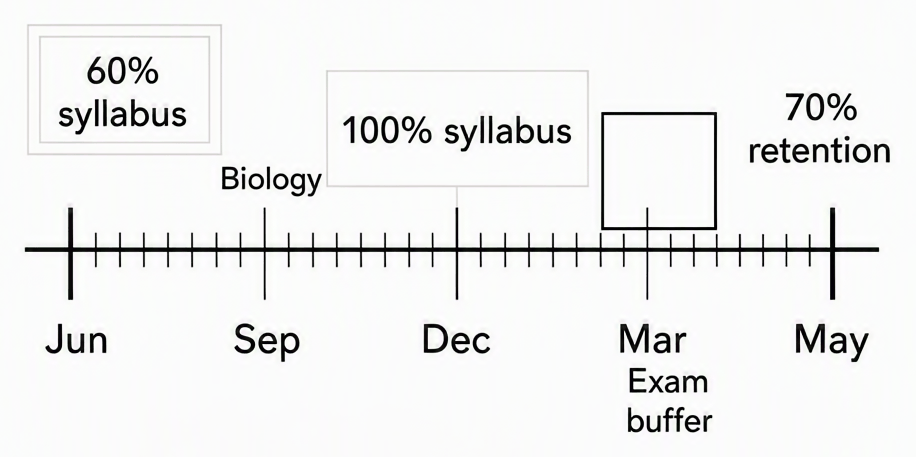
Jun–Sep: finish 60% Class 11 NCERT Biology plus 40% Physics and Chemistry with weekly topic tests. Cover all Botany and Zoology units that appear in the first two school terms. Take one 3-hour offline OMR test every Sunday on covered portions only.
Oct–Dec: complete remaining syllabus plus first full revision of high-weightage chapters before school finals. Prioritise Human Physiology, Genetics, Mechanics, and Chemical Bonding. Run two full-syllabus revision days per month using practice mode to cover gaps before December board exams.
Jan–Mar: school exam buffer with only 4 hours NEET self-study plus focused mistake notebook work on weak topics. Limit new learning to zero. Use these months to raise accuracy in already-covered chapters.
Apr–May: reach 70% Class 11 syllabus on fingertips before summer vacation bridge to Class 12. Solve mixed question sets daily from all units. Spend the final two weeks on pure revision and two complete 3-hour offline papers.
Next step: daily practice problems on NEET JEEnius AI and get a fresh set on a topic every day (20 free attempts a month).
Read next: Chromosomal Disorders NEET 2026: Both Statements Incorrect.
Frequently asked questions
Is a 1 year NEET study plan from Class 11 realistic?
Yes, a realistic NEET 1 year study plan from Class 11 requires 6-8 hours of daily self-study with 50% time on Biology. Complete the syllabus by December using the 1-3-7-14 day mistake notebook cycle and aim for 70% retention by April. Align preparation with school exams using the same NCERT content.
How to divide time between Biology Physics and Chemistry for NEET?
Follow the 50-25-25 time split with 50% weekly hours on Biology, 25% on Physics and 25% on Chemistry to match the official NEET paper pattern of 360 Biology marks out of 720. Biology offers highest ROI as it is NCERT-based. Shift 30 minutes from Chemistry to Physics only if Physics accuracy is below 60% but never reduce Biology time.
What are common pitfalls in NEET 1 year preparation from Class 11?
Most students fail by giving equal time to all subjects instead of 50% to Biology, skipping daily mistake notebook reviews and suffering burnout from poor sleep. Treat school exams as NEET preparation by using identical NCERT pages. Practise full 3-hour offline OMR tests monthly and attempt questions only when topic accuracy exceeds 80% due to negative marking.
How many hours should I study daily for NEET from Class 11?
Commit to 6-8 focused self-study hours daily in addition to school or coaching. A sample weekday has morning Physics, post-school Biology and Chemistry blocks plus 30-minute evening mistake notebook review. Weekends feature longer Biology practice and one hour of DPP. Maintain 10 pm bedtime and 30-minute evening walk to prevent burnout.
What milestones should I achieve in a NEET 1 year study plan?
By September finish 60% Class 11 Biology and 40% Physics-Chemistry with weekly tests. Complete full syllabus and first revision of high-weightage chapters by December. Use Jan-Mar as school buffer with only revision and mistake notebook work. Reach 70% Class 11 syllabus on fingertips by May before starting Class 12.