
How do I start analysing my NEET mock test?
- Audit each subject, not just the total. Start NEET mock test analysis by recording correct, wrong and unattempted counts separately for Physics, Chemistry and Biology. Calculate score and attempted accuracy:
For a full-pattern mock, check these totals:
- Physics: 45 questions.
- Chemistry: 45 questions.
- Biology: 90 questions.
Together, that is 180 questions, 720 marks and 180 minutes. There is no optional Section B, but you can still leave answers unattempted. Never divide attempted accuracy by all 180 questions.
- Flag insecure answers as well as lost marks. Include every wrong answer, every blank, every correct guess or shaky solution, and any correct answer that clearly disrupted pacing. Secure marks require reasoning you can reproduce, not just a matching option.
Copy this log header:
question/topic | result and confidence | closed-book retry | root cause | repair | retest result
Use recorded timings where available. Without question-level times, label notes “qualitative pacing observation”, such as “kept returning to this calculation”. Do not invent precise timings from memory.
How do I find out why an answer went wrong?
- Retry before reading explanations. After scoring, hide the key and solutions, then retry flagged questions on a blank page. Record whether you already saw the answer, because remembering it weakens the diagnostic.
For Biology, retrieve the relevant NCERT fact and explain why competing options fail. For numerical questions, write the governing relation and necessary working. Recognising a solution is not the same as producing one.
- Assign one primary cause. Choose the explanation that determines the repair:
- Concept gap: you cannot explain the principle or apply it.
- Recall gap: you understand the idea but cannot retrieve the fact or relation.
- Reading/calculation error: the original work shows a specific execution failure.
- Time/question-selection error: earlier decisions prevented a reasonable attempt.
- OMR transfer error: the marked response differs from the intended answer.
Add a secondary cause only when it changes your repair. A correct retry does not automatically prove a “silly mistake”: identify the original failure, such as “missed NOT in the stem” or “used the wrong power of distance”, not “careless”.
A correct guess retains its four marks but enters the repair queue as insecure, not wrong. For Class 11 or partial-syllabus preparation, separate topics not yet studied from material already taught: the former needs coverage, not revision.
How do I choose what to repair before the next mock?
- Choose three priorities from your evidence. Three is a practical starting rule, not a research-backed optimum. Prefer recurring errors, prerequisite gaps and repairs you can test before the next mock. One wrong answer does not justify making an entire chapter a priority.
Keep score arithmetic separate from diagnosis:
The last change reduces a penalty but does not demonstrate mastery. Shaky correct answers have not lost marks, so do not add their repair value to a projected score.
- Give every repair an action and a test. Match the practice to the cause:
- Concept: explain the principle, then solve fresh applications.
- Recall: retrieve NCERT facts, then attempt unseen MCQs.
- Reading/calculation: use a specific checklist during timed practice.
- Question selection: test a skip-and-return rule in a mixed set.
- OMR: practise a transfer routine in a paper drill.
Close a repair only after an independent solution and successful fresh-question performance. “The explanation makes sense” is not enough.
How would I analyse a 490-mark mock?
Use the subject counts to locate lost marks, then closed-book retries to choose repairs. These are constructed teaching-example counts and findings, not a real student result or platform performance statistic.
- Physics: 25 correct, 12 wrong, 8 blank; score 88.
- Chemistry: 30 correct, 10 wrong, 5 blank; score 110.
- Biology: 75 correct, 8 wrong, 7 blank; score 292.
The subject counts total 45, 45 and 90 respectively. Overall:
Suppose the retries reveal these repeated failures. Choose three repairs from those findings:
- Physics formula-recall failures: retrieve and apply the missed relations.
- Chemistry errors involving negative wording: practise marking negative words before choosing options.
- Biology NCERT recall gaps: rebuild the specific facts through closed-book recall.
I would use these findings to allocate study time, not split it equally across subjects. Counts alone cannot identify the cause.
If four wrong answers became correct and three blanks became correct, with everything else unchanged:
This is a conditional comparison, not a promised next-mock score. It assumes those exact conversions and no other changes.
Should I analyse a correct Biology guess?
Yes: retain the four marks, but check whether the answer came from knowledge. Consider this illustrative cell-biology MCQ: “Which structure occurs in both prokaryotic and eukaryotic cells?”
- A. Ribosomes
- B. Mitochondria
- C. Golgi apparatus
- D. Membrane-bound nucleus
The student selects A correctly but cannot explain it without the key. During closed-book retrieval, they cannot recall that both cell types have ribosomes or explain why the other options fail. This exposes a recall gap, despite the correct result.
Repair it with targeted NCERT reading on prokaryotic cell structure, followed by closed-book recall. Mitochondria, Golgi apparatus and a membrane-bound nucleus are absent from prokaryotic cells.
Justifying the rejection of those alternatives provides stronger evidence than a blind guess. Retest with a fresh question about protein synthesis in bacteria without membrane-bound organelles, not memory of the original option letter.
Use Cell Biology Practice Questions NEET: 6 MCQs Explained for further practice. Attempt each question before reading its explanation.
Was my unanswered Physics question really a time problem?
Retry it before accepting “ran out of time”. In this illustrative electrostatics question, both charges remain unchanged while their separation doubles. Coulomb’s inverse-square relation makes the new force one-quarter of the original.
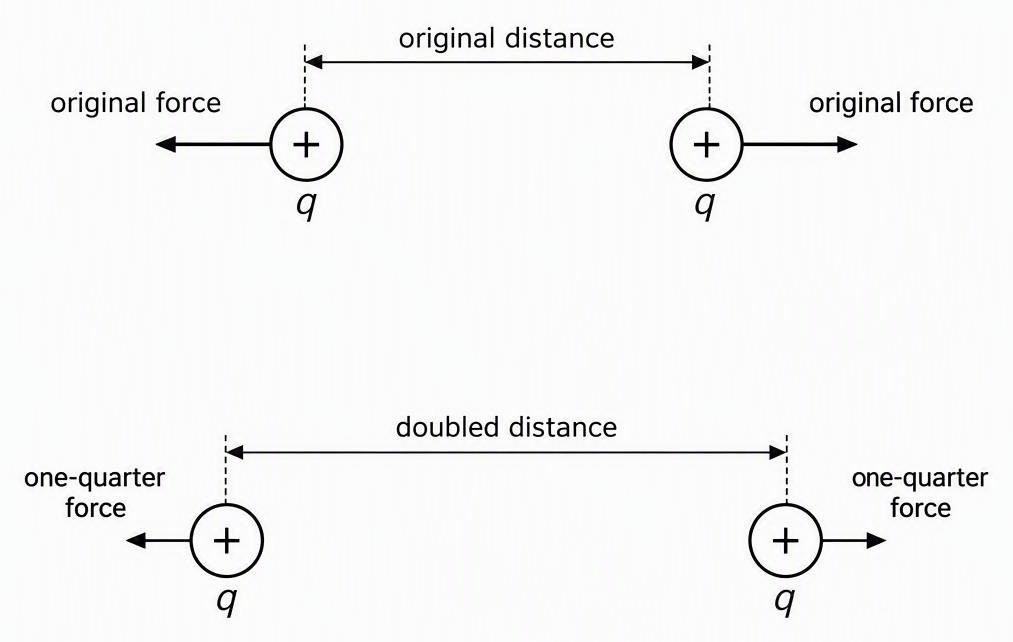
Branch A: The student cannot state the inverse-square relation during a closed-book retry. This is a knowledge gap, not an established pacing problem. Repair the formula’s meaning, then test fresh distance-scaling questions.
Branch B: The student independently obtains the answer but never reached the question after spending too long earlier. Use paper notes or timing records to support a question-selection diagnosis.
For Branch B, practise a timed mixed set with this rule: if no viable setup emerges after one careful read, mark and move; return after the first pass. Do not impose one universal seconds-per-question limit or infer exam-speed competence from an untimed retry.
Blank to correct gains four marks. Solving this exact question after reading its explanation does not establish recovery.
What should I practise before taking another mock?
Repair the three chosen issues, then test them on fresh questions. As a starter routine, not a validated optimum, attempt 5–10 fresh questions per issue, revisit after 24–48 hours, and check recurrence after about a week.
Use this cause-to-practice checklist:
- Concept gaps: explain the principle and test changed conditions.
- Recall gaps: retrieve NCERT facts, then answer unseen MCQs.
- Execution errors: apply the exact reading or calculation check you missed.
- Pacing: practise mixed questions with your skip-and-return rule.
- OMR transfer: match question number and chosen option during a paper drill.
Keep one row per priority:
topic | exact failure | next action | retest date | fresh-question result
Schedule an actual retest date; record independently correct answers and repeated causes, not “done”. If the same cause persists, revisit the explanation or prerequisite instead of increasing question volume.
In the next comparable mock, track repeat-error counts, insecure correct answers, solvable blanks and attempted accuracy alongside total score. Changing paper difficulty limits score-only comparisons.
There is no universal analysis-time quota. Analysis is complete when flagged questions are triaged and the repair queue is scheduled, not when every solution has been copied.
NEET JEEnius AI practice mode can supply topic sets that skip questions already seen, with 60 free sets a month.
Choose one recurring error from your latest mock and write its repair and retest before opening another full paper.
Next step: daily practice problems on NEET JEEnius AI and get a fresh set on a topic every day (20 free attempts a month).
Frequently asked questions
How do I analyse my NEET mock test?
Record correct, wrong and unattempted counts separately for Physics, Chemistry and Biology, then calculate each subject's score and attempted accuracy. Flag wrong answers, blanks, correct guesses, shaky solutions and correct answers that disrupted pacing. Retry flagged questions without the key or solutions, identify the primary cause and schedule a targeted repair with a fresh-question retest.
How do I calculate accuracy in a NEET mock test?
Attempted accuracy is correct answers divided by the sum of correct and wrong answers, multiplied by 100. For 130 correct and 30 wrong answers, it is 130/160 × 100 = 81.25%. Exclude unattempted questions from the denominator; do not divide by all 180 questions.
Should I analyse correct guesses in a NEET mock?
Yes: keep the four marks, but flag a correct guess as insecure rather than wrong. Retry without the key and explain the reasoning; for Biology, retrieve the relevant NCERT fact and justify rejecting the alternatives. Repair any exposed gap and retest on fresh questions rather than relying on memory of the original option.
What should I revise before my next NEET mock?
Start with three priorities drawn from recurring errors, prerequisite gaps and repairs you can test before the next mock. Three is a practical starting rule, not a proven optimum. Match each repair to its cause and check independent performance on fresh questions before closing it.
How much time should I spend analysing a NEET mock test?
There is no universal analysis-time quota. Analysis is complete when flagged questions have been triaged and the repair queue has been scheduled, not when every solution has been copied.