
How should I start preparing Physics for NEET?
Start NEET Physics preparation with 90 focused minutes within a four-hour self-study day if Physics is currently your weak subject. This is a sample prescription, not a universal requirement. Retrieve concepts and formulas, solve questions without help, diagnose errors, then revisit those errors. Use NCERT and one consistent question source, without removing daily Biology or Chemistry.
A lecture explains a method; a closed-solution attempt shows whether you can choose and use it yourself. Make that independent attempt the centre of your routine.
How can I fit Physics into a four-hour study timetable?
Split Physics into a 60-minute learning-and-solving block and a 30-minute practice-and-repair block. Protect Biology and Chemistry slots rather than giving them whatever time remains. This sample assumes you are free by 16:30, with school, commuting and meals outside the study blocks. Breaks are not counted as study.
- Clock time: 06:00–06:30
Subject: Biology recall
Task: Retrieve yesterday’s facts, processes and diagram labels before opening NCERT.
Completion check: Check recalled material and mark omissions.
- Clock time: 16:30–17:30
Subject: Physics concepts and independent solving
Task: Spend 10 minutes on closed-book recall, 20 minutes on targeted concept repair and 30 minutes solving independently.
Completion check: Record attempts and identify where each unsuccessful attempt failed.
- Clock time: 17:45–18:45
Subject: Chemistry
Task: Revise the current lesson, then attempt relevant questions without checking answers between steps.
Completion check: Record incorrect answers and their causes.
- Clock time: 19:30–20:30
Subject: Biology reading and questions
Task: Read the assigned NCERT portion, close it, retrieve the content and answer questions.
Completion check: Return to the exact lines behind errors.
- Clock time: 20:45–21:15
Subject: Physics practice and error repair
Task: Spend 10 minutes on fresh solving and 20 minutes reviewing or reattempting errors.
Completion check: Record the corrected reasoning and next review date.
The arithmetic is four hours of self-study: 90 minutes Physics, 60 minutes Chemistry and 90 minutes Biology. Coaching attendance and the gaps between slots are excluded.
If you have evening coaching, move the blocks rather than adding them after bedtime. On a busy day, use 45 minutes Physics, 30 minutes Chemistry and 45 minutes Biology, making two hours.
There is no compulsory daily question count. End the solving block with recorded attempts and identified errors, not a rushed quota that leaves you unable to explain your answers.
How much time should I give Physics, Chemistry and Biology?
Use current errors and pending revision to allocate time while protecting all three subjects. Biology contributes half the examination’s questions and marks, but copying that ratio into every day ignores individual weaknesses. The 90/60/90-minute schedule is a temporary Physics-repair split, not the default for every student or permission to neglect Biology.
The official subject distribution is:
- Physics: 45 questions, 180 marks.
- Chemistry: 45 questions, 180 marks.
- Biology: 90 questions, 360 marks, comprising 45 Botany and 45 Zoology questions.
Choose a starting allocation that matches your situation:
- Four hours, Physics struggling: 90 minutes Physics, 60 minutes Chemistry, 90 minutes Biology.
- Four hours, Physics stable: 60 minutes Physics, 60 minutes Chemistry, 120 minutes Biology.
- Six-hour dropper example: Two hours Physics, 90 minutes Chemistry, two-and-a-half hours Biology. Coaching attendance does not count as independent practice.
Change the split after reviewing comparable practice sets and pending revision, not after one frustrating numerical. Keep extra Physics time only while it produces specific repairs; return time to other subjects as independent solving stabilises.
Choose the work inside each Physics block by your academic stage:
- Class 11: Prioritise the chapter being taught and the missing prerequisites blocking it.
- Class 12: Divide sessions between current work and older weak topics, rather than waiting for the syllabus to finish.
- Droppers: Use diagnostic errors to select repairs. Do not restart every chapter automatically.
For a three-subject calendar, use How to Prepare for NEET 2027: A September Study Plan. Fit the Physics blocks around its Biology and Chemistry work.
Why does my Physics timetable fail even when I study every day?
Watching lectures, copying formulas and recognising solutions measure time spent, not independent solving. Those activities can fill an evening without testing equation selection. Judge each block by what you solved without help, the exact point where you stalled and whether a later attempt shows that the error has been repaired.
- Finishing lectures without testing yourself: After a targeted explanation, close the solution and attempt a relevant question. Watch more only when that attempt exposes a specific unresolved gap.
- Copying formulas neatly: Write the formula from memory, define every symbol and state when it applies. A correct expression used in the wrong situation is still a wrong solution.
- Checking the first step too early: Record exactly where you stalled before seeking help. “I could not choose the force direction” guides repair; “I did not understand” does not.
- Starting difficult material with weak prerequisites: Repair the algebra, vectors, graph reading or unit conversion blocking the current question. Do not turn one missing skill into a restart of the entire syllabus.
- Chasing a large question quota: Count independent solutions and repaired errors, not questions opened. If analysis keeps getting postponed, reduce the set size before increasing study time.
- Mistaking familiarity for mastery: An old question may trigger a remembered answer. Reattempt it without help, then solve an unseen related question to test the same reasoning.
- Borrowing time from sleep and other subjects: Move a block or use the two-hour version. Do not fund extra Physics by cutting sleep or abandoning Biology and Chemistry.
Reject guaranteed-score claims, predicted chapter-weightage tables and lists of supposedly certain questions. Previous-year questions show examination demands, not what must appear in the next paper.
Parents can ask which error was repaired rather than judging only hours at the desk. The corrected reasoning is more useful evidence than lecture completion.
How should I study a Physics chapter and repair numerical mistakes?
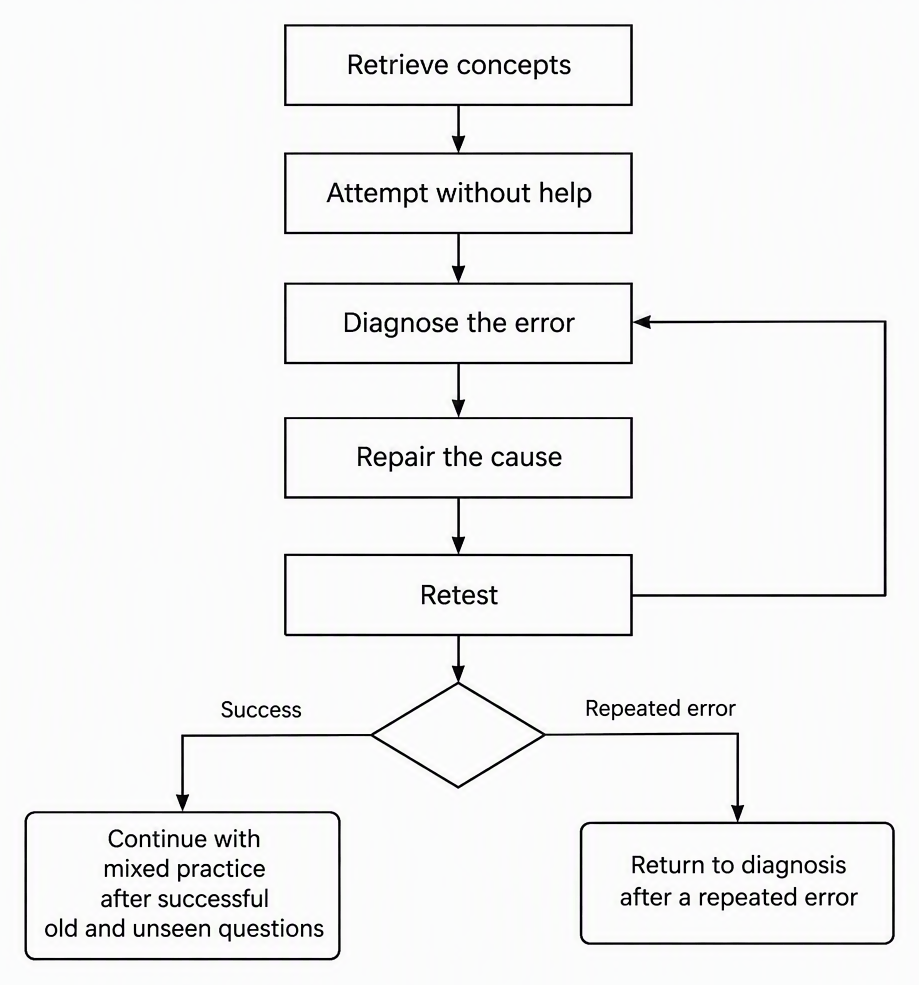
Use understand, attempt, diagnose, repair and retest for each manageable topic rather than trying to finish an entire chapter at once. Match the repair to the failure: a sign error needs a corrected calculation step; a wrong physical model needs another look at the governing principle. Do not prescribe another lecture for every wrong answer.
How do I move from theory to independent questions?
Start with NCERT theory, diagrams and worked examples, then attempt questions with the solutions closed. Use class notes or a targeted explanation only when the textbook leaves a specific gap unresolved. Keep one consistent question source so that study time goes into attempts and review, not repeatedly switching teachers and books.
Build a compact formula sheet containing symbols, units, applicability conditions and a common trap. For a constant-acceleration relationship, record the constant-acceleration condition and your sign convention. The formula alone does not tell you whether it applies.
Follow this solving sequence:
- Identify exactly what is asked.
- List known quantities and convert units where needed.
- Draw a diagram when it clarifies forces, directions or geometry.
- Choose the governing principle.
- Write the symbolic relationship before substituting values.
- Substitute carefully and calculate.
- Check units and physical plausibility.
Move from worked examples to independent topic questions, then relevant previous-year questions and mixed-topic practice. This tests increasing independence; it is not a guaranteed route to any score.
For a topic-level set, use Dual Nature Practice Questions NEET: 8 Explained MCQs. Attempt before reading the explanations, then locate your first wrong step.
How do I identify the right repair for a wrong answer?
Find the first point where your reasoning failed, rather than labelling the entire question “difficult.” A missing concept, a badly chosen equation and a calculation slip need different repairs. For a correct but slow answer, examine the method and unnecessary steps instead of treating speed as a concept gap.
- Concept or model gap: Revisit the governing principle. Explain the physical situation in words before retrying.
- Equation-selection error: Explain why the correct relationship applies, including its assumptions. State why your original choice does not.
- Algebra, unit or sign error: Redo the faulty step, then complete a related drill targeting that operation.
- Slow but correct solution: Compare approaches, remove avoidable steps and retest under time.
A Doppler echo problem tests model choice, not formula recall alone. Identify the outgoing and reflected stages before substituting, tracking source and observer roles separately. Practise that distinction with Doppler Effect NEET 2009: Car-and-Hill Echo at 720 Hz.
Keep a minimal error log: topic, error type, your wrong step, corrected reasoning and next review date. Record the failed decision, not a copied solution.
An optional implementation is the free NEET JEEnius AI mistake notebook: every wrong question is saved automatically and returned at 1, 3, 7 and 14 days until marked mastered.
At review, solve the old question without help, then attempt an unseen related question. Recalling an old solution checks memory; applying the principle to a changed situation checks transfer.
How should I review the week and decide what to study next?
Choose the next repair targets from your practice results, tracking accuracy, independence and time together. Repeated concept errors call for relearning; accurate work that leaves questions unfinished calls for timed practice. Use the weekly review to make that distinction rather than restarting chapters whenever confidence drops.
- Monday to Thursday: Current-topic learning, independent attempts and error repair.
- Friday: Older-topic retrieval and delayed reattempts.
- Saturday: Mixed Physics practice across current and older topics.
- Sunday: Review results and select the next repair targets.
Mixed practice replaces a regular Physics block. It does not automatically add another hour to the day.
For each set, record attempted questions, correct answers, wrong answers, unattempted questions and time taken. Accuracy is correct answers divided by attempted questions; calculate independent accuracy using only attempts made without help. Mark helped attempts separately.
Use the official marking rule: four marks for each correct answer, minus one for each wrong answer. Unattempted questions contribute zero.
Compare sets with similar topic coverage, difficulty and time allowance. One easier set cannot establish improvement.
- Repeated concept errors: Schedule targeted relearning followed by closed-solution attempts.
- Repeated calculation errors: Use focused algebra, sign or unit drills.
- High accuracy with unfinished questions: Schedule timed mixed practice and compare solution methods.
- Successful delayed and unseen attempts: Move forward while retaining revision.
The current full-paper pattern is 180 compulsory single-correct questions in 180 minutes, for 720 marks. There is no optional Section B; the optional format used from 2021 to 2024 ended in 2025.
The overall average is one minute per question, not a rigid Physics time limit. Determine subject timing through full-paper practice, allowing time for recording answers.
This does not confirm a NEET 2027 mode or date. Check the official NTA site, neet.nta.nic.in, and make full-paper practice follow the officially announced format.
Choose your current Physics topic, schedule the next two study blocks, and start an error log from your first independent set.
Next step: daily practice problems on NEET JEEnius AI and get a fresh set on a topic every day (20 free attempts a month).
Frequently asked questions
How many hours should I study Physics daily for NEET?
If Physics is weak, try 90 focused minutes within a four-hour self-study day, alongside 60 minutes of Chemistry and 90 minutes of Biology. Split Physics into a 60-minute learning-and-solving block and a 30-minute practice-and-repair block. This is a temporary repair plan, not a compulsory allocation; adjust it using comparable practice results and pending revision.
How do I stop making mistakes in NEET Physics numericals?
Find the first wrong step and classify it as a concept, equation-selection, algebra, unit or sign error. Repair that specific cause instead of watching another lecture for every wrong answer. Record the corrected reasoning and a review date, then test yourself with both the old question and an unseen related question.
How many Physics questions should I solve daily for NEET?
There is no compulsory daily question count. Finish your solving block with recorded independent attempts and identified errors, rather than rushing through a quota. If error analysis keeps getting postponed, reduce the set size before increasing study time.
How do I know if my NEET Physics preparation is improving?
Track independent accuracy, unattempted questions and time taken across sets with similar coverage, difficulty and time allowance. Calculate independent accuracy as correct independent answers divided by independent attempts, multiplied by 100, and mark helped attempts separately. Successful delayed reattempts and unseen related questions provide stronger evidence of repair than recognising familiar solutions.