
Should you start Dual Nature practice with chapter questions or a full mock?
Start with explained chapter questions, not a full mock, if your concepts are shaky. These free Dual Nature practice questions for NEET include eight original, single-correct MCQs with explanations below. Choose untimed practice for conceptual confusion, a timed chapter drill for hesitation, and full-length mocks for performance across the syllabus.
A full mock tests exam readiness, but it is an inefficient first tool for repairing one chapter.
How do untimed MCQs, timed chapter drills and full-length mocks compare?
Untimed MCQs expose conceptual gaps; timed drills expose hesitation; full mocks expose subject-switching and question-selection errors. The on-page set works untimed or timed on a first attempt. Repeating remembered answers under a stopwatch is not a fresh test.
For each criterion, the options appear in this order: untimed chapter MCQs; timed chapter drill; full-length mock.
- Scope: One chapter; one chapter under time pressure; Physics, Chemistry and Biology.
- Best use: Repair concepts; practise retrieval after understanding; test subject switching and paper-level decisions.
- Feedback timing: Explain each answer, then check; check after completing the drill; review after submitting the paper.
- Mistakes exposed: Confusing intensity with frequency; slow formula retrieval or graph reading; poor question selection and uneven time allocation.
- Limitations: Does not test speed; cannot test whole-paper stamina; spreads attention across chapters instead of isolating Dual Nature.
- Free access established here: Eight original questions below; the same questions with your own timer; NEET JEEnius AI’s 30 free full-length mocks a month.
The verified mock offering has 180 questions, 720 marks and 180 minutes, with 45 Physics, 45 Chemistry and 90 Biology questions, plus a scored per-subject breakdown. A full mock is not guaranteed to contain any particular number of Dual Nature questions.
Which practice mode should you choose right now?
Choose by your error pattern, not your class label. A Class 12 student may need untimed work, while a dropper may need conceptual repair rather than another full paper.
- Class 11 student studying ahead: Establish photon energy, work function and momentum first. Understand energy per photon, the minimum energy needed to remove an electron, and why momentum determines matter wavelength. Add timing after you can explain those ideas.
- Class 12 student who thinks brighter light produces faster photoelectrons: Choose untimed MCQs. Write a reason for each answer before checking the key, especially what changes and what stays fixed.
- Student who knows the physics but pauses over axes or proportionality: Choose a timed chapter drill. Record hesitation as well as wrong answers. A correct response reached through repeated guessing still needs review.
- Dropper who performs well in chapter sets but poorly in mixed Physics: Move to full-length mocks. Review which questions you attempted first, where you stayed too long and whether switching subjects disrupted your work.
Use your first attempt at these Dual Nature practice questions for NEET to identify your weakness. Later, use the set for error review, not proof of a score gain.
Timing a freshly memorised set measures recall of the answers, not independent mastery. Test your reasoning on fresh questions whose wording and conditions you have not already learned.
Can you solve these eight free Dual Nature practice questions for NEET?
Attempt all eight before reading the key. These are original practice questions, not authenticated NEET previous-year questions. Each has exactly one correct option. Work untimed if concepts are uncertain, or record your total time and hesitation points if you already understand them.
Use the standard one-photon photoelectric model. Unless a question changes a condition, treat the other experimental conditions as unchanged.
1. Can intensity overcome a frequency below threshold?
Light falls on a clean metal surface below its threshold frequency. The intensity increases while the frequency remains fixed. Which outcome follows?
- A. Emission begins after enough photons accumulate.
- B. No photoelectric emission occurs.
- C. Electrons emerge with greater maximum kinetic energy.
- D. The metal’s threshold frequency falls.
2. What changes when above-threshold light becomes brighter?
A metal emits photoelectrons under light of fixed frequency above threshold. Intensity increases without changing the illuminated area or collection arrangement. What happens to saturation photocurrent and maximum kinetic energy?
- A. Both increase.
- B. Current stays unchanged; maximum kinetic energy increases.
- C. Current increases; maximum kinetic energy stays unchanged.
- D. Current increases; maximum kinetic energy decreases.
3. What changes when the incident frequency increases?
For the same emitting metal, incident frequency increases from one above-threshold value to another. The work function remains fixed. What happens to maximum kinetic energy and stopping-potential magnitude?
- A. Both increase.
- B. Both remain unchanged.
- C. Kinetic energy increases; stopping potential decreases.
- D. Only saturation photocurrent must increase.
4. Which slope and intercept match the stopping-potential graph?
Stopping-potential magnitude is plotted vertically against incident frequency horizontally for the emitting region. Which pair gives its slope and frequency-axis intercept, respectively?
5. How do the threshold wavelengths compare?
Two materials A and B have work functions related as shown. Which statement correctly compares their threshold wavelengths?
- A. A has twice B’s threshold wavelength.
- B. Their threshold wavelengths are equal.
- C. A has four times B’s threshold wavelength.
- D. A has half B’s threshold wavelength.
6. Does mass matter when momentum is already equal?
Two particles have different masses but equal, nonzero momentum magnitudes. How do their de Broglie wavelengths compare?
- A. Their wavelengths are equal.
- B. The heavier particle has a longer wavelength.
- C. The lighter particle has a longer wavelength.
- D. Their speeds must be known before comparing wavelengths.
7. What happens at equal kinetic energy?
An electron and a proton have equal, nonzero, non-relativistic kinetic energy. Which statement correctly compares their de Broglie wavelengths?
- A. Their wavelengths are equal.
- B. The proton has the longer wavelength.
- C. The electron has the longer wavelength.
- D. The electron wavelength is larger by the proton-to-electron mass ratio.
8. How does accelerating voltage affect electron wavelength?
Two electrons start from rest and are accelerated through positive potential differences related below. Assume both remain non-relativistic. Compare the second electron’s wavelength with the first’s.
- A. It is one-quarter as large.
- B. It is half as large.
- C. It is twice as large.
- D. It is unchanged.
What are the answers, and which mistake does each question expose?
The key is 1 B, 2 C, 3 A, 4 B, 5 D, 6 A, 7 C, 8 B. Check your reasoning, not just your option. A correct guess does not test whether you can distinguish energy per photon from photon arrival rate.
1. B, no emission. Below threshold, each photon has insufficient energy to remove an electron. Increasing intensity cannot cause emission in the standard one-photon model. Option A wrongly treats separate photon energies as a stored pool available to one electron.
2. C, greater current but unchanged maximum kinetic energy. At fixed above-threshold frequency, increased intensity supplies more photons per unit time, increasing saturation photocurrent. Maximum kinetic energy and stopping potential remain unchanged. Option A confuses electron count with maximum electron energy.
3. A, both increase. In the applicable photoemission regime:
Increasing frequency raises the energy available after overcoming the fixed work function, so stopping-potential magnitude rises too. Option B confuses a fixed material property with fixed electron energy. Below threshold, a negative subtraction result means no emission, not electrons with negative kinetic energy.
4. B, read the vertical axis first. The emitting-region relation gives this slope and frequency-axis intercept:
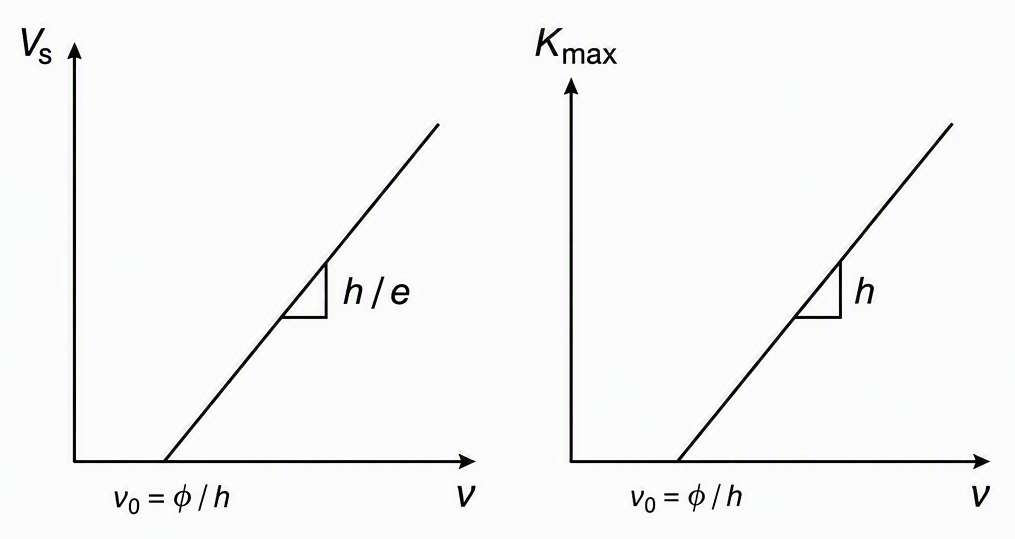
Option A belongs to a maximum-kinetic-energy-versus-frequency graph, whose slope is Planck’s constant. Remembering the line without checking its axes causes this error.
5. D, threshold wavelength halves. Use the inverse work-function relationship:
Threshold wavelength varies inversely with work function; threshold frequency varies directly with it. Option A transfers the frequency relationship to wavelength without taking the reciprocal.
6. A, equal momentum means equal wavelength. Apply the de Broglie relation directly:
Mass needs no separate consideration once momentum is specified. Option C imports the equal-kinetic-energy result into an equal-momentum question.
7. C, the electron has the longer wavelength. For non-relativistic particles:
At equal kinetic energy, the lighter particle has less momentum. Option D misses the square root and predicts a mass-ratio dependence instead.
8. B, wavelength halves. For an electron accelerated from rest, assuming non-relativistic motion:
Option A assumes inverse-voltage dependence. The actual dependence is inverse square root.
Error-label checklist: Mark each wrong or hesitant answer as concept, graph, proportionality, algebra or misread condition.
How should you turn these mistakes into your next session?
Use the error label to choose the next task, rather than immediately repeating all eight questions. Keep your chosen option and one sentence explaining why it failed.
- Concept error: Revisit the relevant relation and explain what is held constant before attempting a fresh question.
- Correct concept, slow execution: Use a fresh mixed chapter drill and record completion time. Do not impose a universal seconds-per-question target.
- Secure chapter, weak mixed-paper performance: Use a full-length mock and examine its scored per-subject breakdown alongside your question-selection decisions.
Score this set using official NEET marking:
The letters denote score, correct answers, wrong answers and unattempted answers, respectively. This set has no readiness cutoff.
The current paper has 180 compulsory questions and no optional Section B. “Compulsory” describes the paper format; leaving an answer unattempted still earns zero marks.
What else should you know about Dual Nature practice for NEET?
Move on when you can explain fresh answers and stop repeating the same error. There is no universal question-count target.
- Are these PYQs? No. They are original practice questions, not authenticated previous-year questions.
- Is formula recall enough? No. It does not test whether you read graph axes correctly or notice which quantity stays constant.
- Should chapter drills replace mocks? No. Chapter drills test chapter understanding and retrieval; full mocks test whole-paper execution.
If your chapter reasoning is secure but mixed-paper performance is weak, NEET JEEnius AI’s 30 free full-length mocks per month are a next-stage option. Use the scored per-subject breakdown to choose what to review next, not as a replacement for repairing the errors found here.
Next step: full-length mock tests on NEET JEEnius AI and sit a full 180-question, 720-mark, 180-minute paper, 45 Physics, 45 Chemistry and 90 Biology, and get a scored per-subject breakdown (30 free a month).
Related on NEET JEEnius AI: Immunity NEET 2026: Secondary Lymphoid Organs Explained.
Frequently asked questions
Should I practise Dual Nature chapter questions or take a full mock?
Start with untimed chapter questions if your concepts are shaky. Use a fresh timed chapter drill when you understand the physics but hesitate over formulas or graphs. Move to full-length mocks when chapter reasoning is secure but mixed-paper performance is weak.
Are these Dual Nature questions NEET previous-year questions?
No. These are eight original, single-correct practice MCQs, not authenticated NEET previous-year questions. Each includes an explanation of the answer and the mistake it tests.
Does increasing light intensity increase photoelectron kinetic energy?
At a fixed frequency above threshold, increasing intensity raises saturation photocurrent but leaves maximum photoelectron kinetic energy unchanged. Maximum kinetic energy depends on incident frequency and the metal's work function. Below threshold, increasing intensity cannot cause emission in the standard one-photon model.
How should I score these Dual Nature practice questions?
Award 4 marks for each correct answer, subtract 1 for each wrong answer and give zero for each unattempted question. This eight-question set has no readiness cutoff. Review wrong and hesitant answers by labelling the error as concept, graph, proportionality, algebra or misread condition.