What is the answer to the Doppler Effect NEET 2009 car-and-hill question?
The Doppler Effect NEET 2009 answer is C, 720 Hz, found using two Doppler stages, not one. A driver travelling towards a stationary hill at 30 m/s sounds a horn of frequency 600 Hz. Sound travels through the air at 330 m/s, and the question asks for the frequency of the returning echo heard by that same driver.
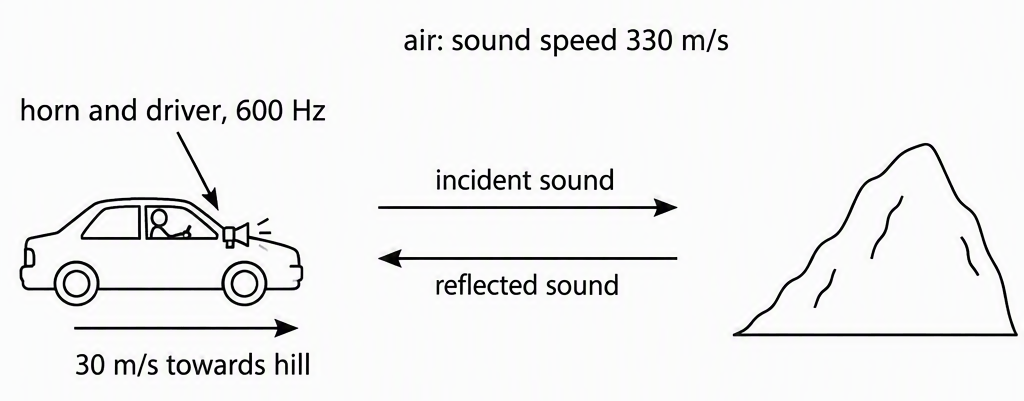
The supplied options are:
The question bank classifies this as hard and gives an expected solving time of 90 seconds. That is the question bank’s practice estimate, not an official exam time limit.
How do you find the frequency reaching the hill?
The hill receives 660 Hz because the horn moves towards it. On this outward leg, the horn is the moving source and the hill is the stationary receiver. In the standard stationary-air model, source and observer speeds are measured relative to the air.
Define the emitted frequency, sound speed and source speed:
As the horn approaches, each new wavefront is emitted closer to the hill than the previous one. This compresses the wavefront spacing ahead of the car, so the source term in the denominator is:
The official first-stage calculation is:
The denominator is smaller than the sound speed, so this factor increases the frequency. 660 Hz is the frequency received at the hill, not yet the frequency heard by the moving driver.
Why does the driver hear 720 Hz after reflection?
The driver’s motion produces a second frequency increase on the return leg. A stationary hill reflects the incident sound without changing its frequency in the stationary-air frame. Model the returning wave as coming from a stationary source of frequency 660 Hz.
The driver is now the moving observer, with speed:
The reflected wave travels from the hill towards the car, while the driver continues towards the hill. The driver therefore moves towards the incoming wavefronts and encounters them more often than a stationary listener would. This gives the numerator:
Apply the official second-stage calculation:
Thus, option C, 720 Hz, is correct. The hill remains stationary throughout: reflection does not turn it into a moving source. The second shift comes from the driver’s motion, not the reflection itself.
How can you check the two-stage answer quickly?
Both legs involve approach and must increase the received frequency, so a final answer below 600 Hz cannot fit this arrangement. The completed solution gives this directional check:
Only after completing both stages, multiply their factors. For this car, define its speed as:
Then:
The arithmetic checks:
Use this combined expression only when the same car carries source and observer, the reflector is stationary, and motion is along the sound path in stationary air. Stopping at 660 Hz leaves the return-leg observer shift uncalculated.
How does a wrong method produce option A, 550 Hz?
Using a receding-source sign and omitting the return-leg calculation produces this wrong answer. For the original approaching-car arrangement, that calculation is:
The method makes two separate errors:
- Wrong source sign: adding the source speed in the denominator describes recession, which spreads wavefronts apart. The original horn approaches the hill.
- Missing observer stage: the calculation stops before accounting for the moving driver receiving the reflection.
This is one demonstrable route to option A, not a claim about why the examiner supplied that distractor or how often students choose it.
Label the source and receiver separately on each leg before choosing signs. Decide whether each motion raises or lowers the received frequency, then write the corresponding factor.
How do you solve two related Oscillations and Waves practice questions?
A stationary listener at the hill hears 660 Hz; a driver moving away hears a 500 Hz echo. These are original practice variations, not additional verified PYQs. Both reuse the same car-and-hill geometry.
Question 1: The car approaches the hill at 30 m/s while sounding its 600 Hz horn. With sound speed 330 m/s, what frequency does a stationary listener at the hill receive?
Only the moving-source stage is needed:
The listener is stationary at the hill, so no moving-observer return calculation is required.
Question 2: Reverse only the car’s direction: it now travels away from the same hill at 30 m/s, sounding its 600 Hz horn. With sound speed still 330 m/s, what reflected frequency does the driver hear?
First, the source recedes from the hill:
Next, the driver travels away from the hill in the same direction as the returning wave, meeting fewer wavefronts per second:
500 Hz is correct for this changed, receding arrangement, not the original approaching-car question. Cover the working and reproduce both stages, writing “approach” or “recession” beside each role before selecting its sign.
Next step: photograph a doubt on NEET JEEnius AI and photograph any question you are stuck on and get a step-by-step solution across Physics, Chemistry and Biology (20 free a month).
If that step was the hard part, work through How to Prepare for NEET 2027: A September Study Plan.
Frequently asked questions
What is the answer to the Doppler Effect NEET 2009 car-and-hill question?
The correct answer is option C, 720 Hz. For a 600 Hz horn approaching the hill at 30 m/s, with sound speed 330 m/s, the hill receives 660 Hz. The driver's motion towards the returning wave raises the frequency heard to 720 Hz.
Why are there two Doppler shifts in the car-and-hill problem?
On the outward leg, the horn is a moving source approaching a stationary hill. On the return leg, the driver is a moving observer approaching the reflected wave. The stationary hill preserves the incident frequency on reflection; the driver's motion causes the second increase.
What is the shortcut formula for the echo heard by the approaching driver?
The combined formula is f_echo = f × (v + u)/(v - u), where f is the horn frequency, v is sound speed and u is car speed. It applies when the same car carries the source and observer, the reflector is stationary, and motion is along the sound path in stationary air. Here, 600 × (330 + 30)/(330 - 30) = 720 Hz.
What echo frequency does the driver hear if the car moves away from the hill?
With the same 600 Hz horn, car speed of 30 m/s and sound speed of 330 m/s, the driver hears 500 Hz. The receding source gives 600 × 330/360 = 550 Hz at the hill, and the receding observer then hears 550 × 300/330 = 500 Hz. This answers the changed arrangement, not the original approaching-car question.