What is the answer to the PCR and selectable markers NEET 2026 plasmid question?
Option A is correct: both statements are true. The PCR and selectable markers NEET 2026 question asks whether plasmids replicate autonomously and whether their DNA exists outside the main chromosome.
This question comes from NEET UG 2026, held on 21 June 2026, Code-50, Biology. The question bank classifies it as medium difficulty, using tag 2.
The bank labels the topic PCR and Selectable Markers. However, the tested fact is the NCERT definition of plasmids, not a PCR calculation.
Which NCERT definition settles both statements?
NCERT Class 12 Biology describes plasmids as extrachromosomal, self-replicating DNA molecules, usually circular and double-stranded. Start with this definition before judging either statement, as the supplied official solution does.
The source chapter is Biotechnology: Principles and Processes. The question bank files this item under Biotechnology and Its Applications, but that label does not change the fact being tested.
- Self-replicating describes replication.
- Extrachromosomal describes location relative to the main chromosome.
These properties are compatible, not mutually exclusive. A DNA molecule can remain separate from the chromosome and still replicate inside its host cell.
Why is each plasmid statement independently true?
Statement I is true because a plasmid has an origin of replication, called ori; Statement II is true because standard bacterial plasmids exist separately from the main chromosome. Both properties apply inside the bacterial cell.
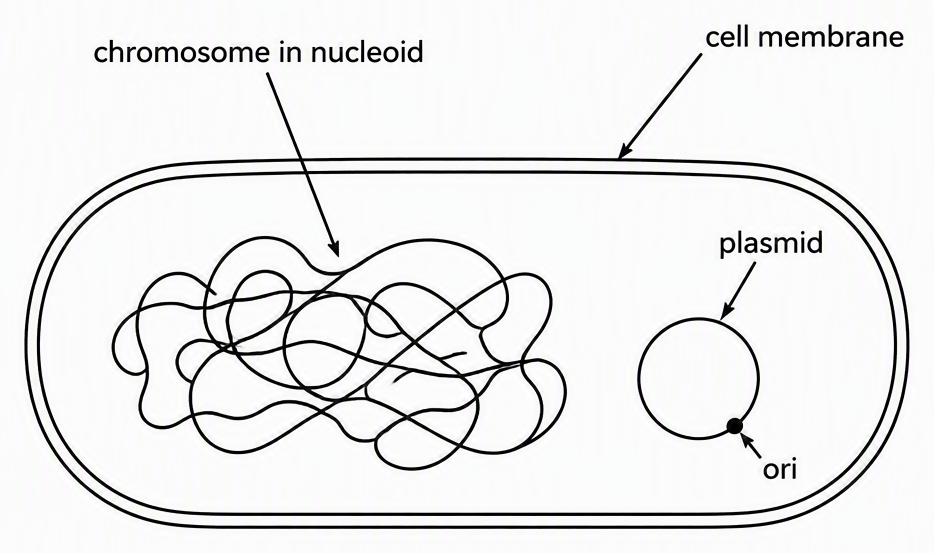
For Statement I, replication can begin at the plasmid’s ori inside the host cell. The plasmid does not need to integrate into the host chromosome before replicating, which supports calling it autonomously replicating.
Autonomous does not mean independent of the host’s cellular machinery. Nor does it mean that a plasmid can replicate by itself outside a cell. Statement I is therefore true.
For Statement II, standard bacterial plasmids occur as separate DNA molecules rather than as part of the main chromosome in the nucleoid. Extrachromosomal means outside the chromosome, not outside the bacterial cell. Statement II is therefore true.
These properties allow a suitable plasmid vector to maintain cloned DNA inside a host. Copy number varies with the plasmid and its replication control; not every plasmid has a high copy number.
How do the two truth values give option A?
Statement I is true; Statement II is true; therefore, option A is correct. Match this pair to the supplied choices:
- B fails because it rejects both established plasmid properties.
- C fails because it rejects the extrachromosomal location.
- D fails because it rejects autonomous replication.
Although the bank tags this item as Assertion and Reason, the choices ask only whether each statement is correct. Do not test whether Statement II explains Statement I. No explanatory-relationship option is supplied, so that extra test does not belong in this solution.
How does the chromosomal-integration assumption lead to option C?
Option C follows from accepting plasmid replication but wrongly assuming that replicating DNA must first become part of the chromosome. This produces the incorrect pair: I true, II false.
The error develops in three steps:
- Accept that plasmids replicate.
- Add an unstated requirement that replication needs chromosomal integration.
- Reject Statement II and choose C.
The method mistake is adding a requirement that NCERT’s definition does not contain. The official solution’s ori-based reasoning corrects it: plasmids can replicate as separate DNA molecules within the host.
Assess replication and chromosomal location separately. Use NEET Biology Preparation: NCERT, Recall and Revision to build the same checking habit: recall the definition before adding assumptions from another concept.
How do PCR diagnosis and selectable markers differ in application questions?
PCR amplifies selected DNA; an antibiotic-resistance marker allows selection under the matching antibiotic. These are original related practice questions, not additional NEET PYQs.
Why can PCR detect a pathogen when very little pathogen DNA is present?
Question 1 answer: A, target-DNA amplification. PCR increases copies of a selected DNA region so small starting quantities can become detectable. Which mechanism explains this?
PCR does not require a plasmid vector or a selectable marker as an essential component. For idealised numerical practice, start with one target DNA molecule and assume exact doubling in each of three cycles:
Which introduced feature selects plasmid-bearing bacteria during insulin production?
Question 2 answer: A, the antibiotic-resistance marker. In a recombinant-insulin production setup, an antibiotic-sensitive bacterial host receives a plasmid carrying resistance to the antibiotic in the growth medium. Which introduced feature permits selection?
The resistance marker permits growth under the stated antibiotic selection; ori supports plasmid replication, not antibiotic resistance. This distinguishes transformed from non-transformed cells under these conditions, but does not by itself verify the correct insulin insert.
Before choosing an option, assign its function:
- Plasmid: DNA vector.
- Selectable marker: feature used for selection.
- PCR: target-DNA amplification technique.
Next step: photograph a doubt on NEET JEEnius AI and photograph any question you are stuck on and get a step-by-step solution across Physics, Chemistry and Biology (20 free a month).
Frequently asked questions
What is the answer to the NEET 2026 plasmid question?
Option A is correct: both statements are true. Plasmids are self-replicating, extrachromosomal DNA molecules, so autonomous replication and existence outside the main chromosome are compatible properties.
Can plasmids replicate without integrating into the chromosome?
Yes. A plasmid has an origin of replication, called ori, which allows replication to begin while it remains separate from the main chromosome. Autonomous replication still depends on the host’s cellular machinery.
Does extrachromosomal DNA mean DNA outside the cell?
No. Extrachromosomal means separate from the main chromosome, not outside the cell. Standard bacterial plasmids remain inside the bacterial cell as separate DNA molecules.
What is the difference between PCR and a selectable marker?
PCR amplifies a selected DNA region, allowing small starting quantities to become detectable. An antibiotic-resistance selectable marker permits resistant cells to grow under the matching antibiotic. PCR does not require a plasmid vector or selectable marker as an essential component.
Can ori select plasmid-bearing bacteria on an antibiotic medium?
No. Ori supports plasmid replication; it does not confer antibiotic resistance. A matching antibiotic-resistance marker permits selection of plasmid-bearing bacteria under the stated conditions, but does not by itself confirm the correct insulin insert.