What is the correct answer to the rotational motion NEET 2010 two-disc question?
Option D is the official answer to the rotational motion NEET 2010 two-disc question. It gives the energy dissipated through friction by the two-disc system, not the initially spinning disc’s entire energy decrease. Conserve angular momentum first, then subtract final rotational kinetic energy from initial rotational kinetic energy.
The initially lower disc spins horizontally about its symmetry axis. A second, non-spinning disc is lowered onto it along the same axis. Friction slows the first disc and speeds up the second until both share one angular speed.
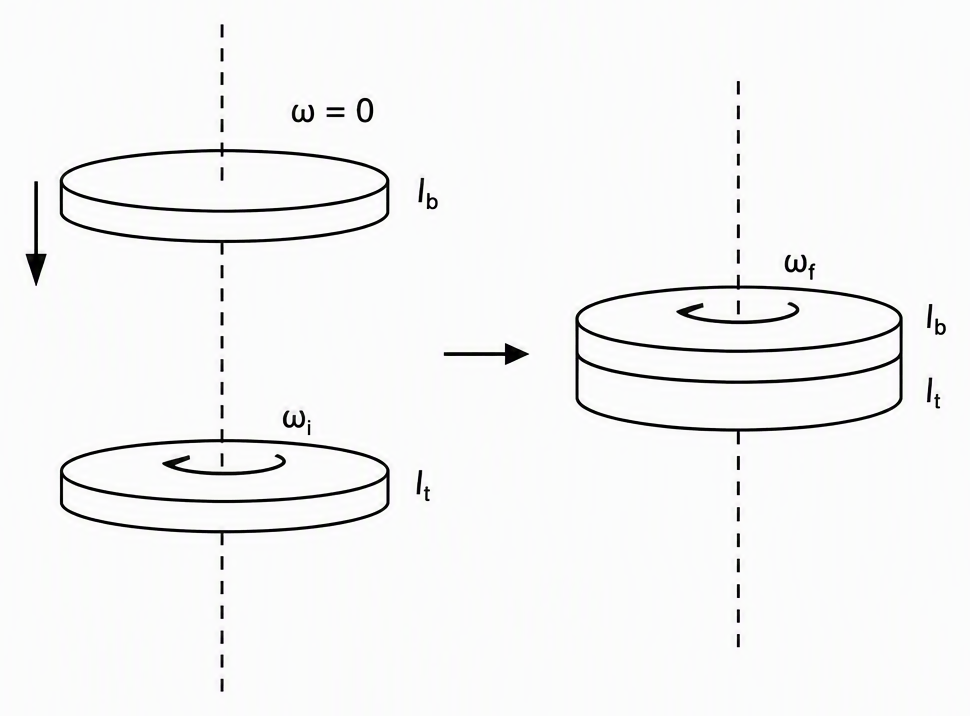
The symbols are:
Find the rotational energy dissipated through friction, the quantity calculated in the official solution. The supplied options are:
- A
- B
- C
- D
The question bank rates this problem hard. Its expected solving time of 90 seconds is a bank benchmark, not an official exam allowance.
How do you use angular momentum to find the common speed?
Choose both discs together as the system and consider torques about their common symmetry axis. No external torque acts about this axis in the stated model. Friction supplies equal-and-opposite internal torques, so the system’s total angular momentum stays constant.
Neither disc’s angular momentum is individually conserved: the first loses angular momentum while the second gains it. Initially, only the first disc contributes:
After slipping stops, both contribute at the same speed:
Equate these expressions, then divide by the combined moment of inertia:
Do not begin by conserving rotational kinetic energy. Friction dissipates some of that energy during slipping, even though angular momentum remains conserved.
How do you subtract the kinetic energies to reach option D?
The required loss is initial minus final rotational kinetic energy of both discs together. Use the common speed already obtained, without assuming kinetic energy is conserved. The stationary disc initially contributes no rotational kinetic energy:
Once both discs rotate together, add their energies:
Substitute the common speed explicitly:
Cancel one factor of the combined inertia:
This is energy remaining, so subtraction is still necessary:
Take a common denominator:
Expand the numerator and cancel the squared term:
That is option D. Slipping friction converts rotational kinetic energy into thermal energy. Total energy is not destroyed; only the system’s rotational kinetic energy decreases.
What does “energy lost” mean here?
The official calculation uses the combined system’s rotational kinetic-energy decrease. The supplied wording refers to the initially rotating disc, but its literal energy decrease is a different quantity. Option D represents frictional dissipation, consistent with the official method.
Keep these three quantities separate:
- First disc’s energy decrease
- Second disc’s energy gain
- Energy dissipated as heat
The first disc loses energy both to heating and to spinning up the second disc. Not all its lost kinetic energy becomes heat:
A useful check follows by dividing the already derived loss by the initial energy:
For equal inertias, the speed halves and half the initial energy is dissipated:
As the second inertia tends to zero, the loss tends to zero. For positive finite inertias and nonzero initial speed, the loss lies strictly between zero and the initial energy:
Why is option B energy remaining rather than energy lost?
Option B is exactly the final combined kinetic energy calculated in the official solution. It is an intermediate result, not the requested loss:
The method error is precise: find the common speed correctly, substitute it into the combined kinetic-energy formula correctly, then stop before subtracting. The algebra succeeds, but it answers the wrong question.
Label every energy line as initial, final or dissipated before comparing it with the options:
Equal inertias cannot distinguish B from D because their expressions coincide when:
Keep the general symbols for option selection. Use equal inertias only as a physical check afterward.
How do you solve three related rotational-motion practice questions?
Use angular momentum to determine speed, then calculate the requested energy or energy ratio. These are original practice questions, not additional verified PYQs. They test the same distinction between angular momentum conservation and kinetic-energy conservation.
What speed and energy loss result from equal disc inertias?
Question 1: Find the common speed and the fraction of initial rotational energy dissipated for equal disc inertias. Both answers are one-half of their respective initial quantities, as the derived results show:
Halving the speed leaves half the initial energy, not one-quarter. The total rotating inertia doubles.
What changes if the second disc has three times the inertia?
Question 2: Find the common speed, remaining-energy fraction and dissipated fraction for the inertia relation below. The speed and remaining-energy fraction are one-quarter; the dissipated fraction is three-quarters:
For a numerical check, take an illustrative initial energy of 100 joules:
What happens when an isolated rotating body halves its inertia?
Question 3: Find the new angular speed and kinetic-energy ratio when an isolated body reduces its inertia from the initial value to half that value. Both speed and rotational kinetic energy double. With no external torque:
Internal work supplies the increased rotational kinetic energy. Conservation of angular momentum does not imply conservation of rotational kinetic energy. Before your next energy subtraction, label exactly which body or system each energy belongs to.
Next step: the past-paper archive on NEET JEEnius AI and search past NEET papers by year, subject or chapter, each with a worked solution (100 free searches a month).
If that step was the hard part, work through NEET Chemistry Preparation: A 90-Minute Daily Plan.
Frequently asked questions
What is the correct answer to the NEET 2010 two-disc question?
Option D is the official answer: the energy dissipated is (1/2)[I_t I_b/(I_t + I_b)]ω_i². Here, I_t and I_b are the initially spinning and initially stationary discs’ moments of inertia, and ω_i is the initial angular speed. This is the combined system’s rotational kinetic-energy loss, not the initially spinning disc’s entire energy decrease.
Why is angular momentum conserved when friction acts between the discs?
For both discs taken together, friction produces equal-and-opposite internal torques. With no external torque about their common symmetry axis, total angular momentum remains constant. Rotational kinetic energy is not conserved because slipping friction converts some of it into thermal energy.
Why is option B wrong in the NEET 2010 two-disc problem?
Option B gives the final combined rotational kinetic energy, not the energy dissipated. You must subtract this final energy from the initial energy to obtain option D. Equal inertias cannot distinguish the two options because their expressions coincide in that special case.
What happens when the two discs have equal moments of inertia?
Their common final angular speed is half the first disc’s initial speed. Half the initial rotational kinetic energy is dissipated, and half remains. The remaining energy is not one-quarter because the total rotating moment of inertia doubles.