Gravitation NEET 2011: when is gravitational power greatest?
A body is launched vertically from Earth’s surface, rises by one Earth radius and then falls back. In this Gravitation NEET 2011 question, gravity supplies its greatest instantaneous power immediately before the body returns to the surface, option A. The motion is radial: outward from Earth’s centre during ascent and inward toward the centre during descent.
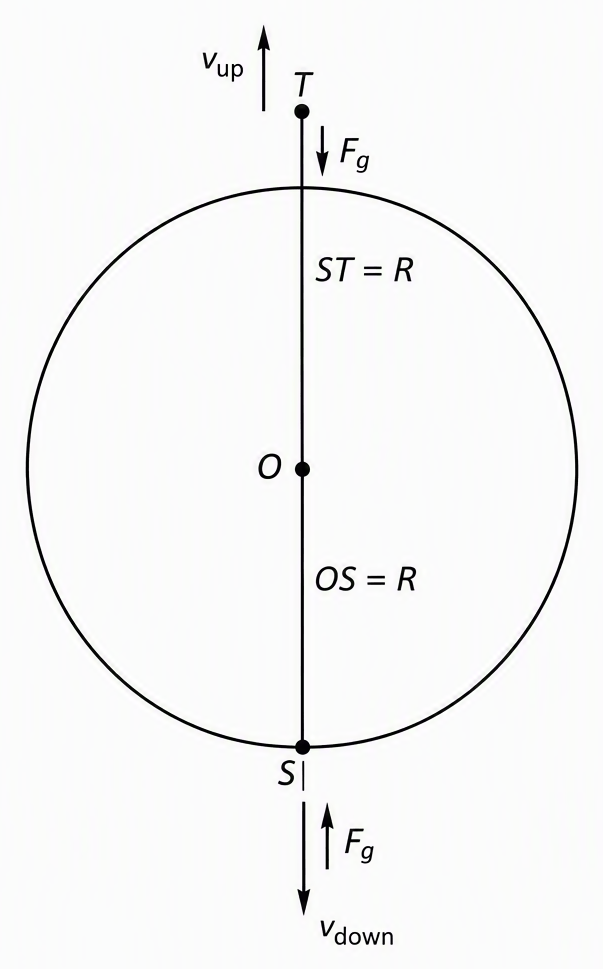
Height above the surface is not distance from Earth’s centre. At the highest point, the height equals Earth’s radius, but the centre-distance is twice that radius:
How does the sign of gravitational power give option A?
Option A is correct: immediately before the body reaches Earth’s surface on its return. Gravity’s power is negative during ascent, zero at the top and positive during descent. Start with this sign check, not a calculation of launch speed.
Instantaneous power is the dot product of force and velocity. The unarrowed symbols represent force magnitude and speed, and the angle is between the force and velocity vectors:
Gravitational force points toward Earth’s centre throughout the flight:
- Ascent: Velocity outward; force inward; power negative.
- Highest point: Velocity zero, so it has no direction; force inward; power zero.
- Descent: Velocity inward; force inward; power positive.
During ascent, force and velocity are opposite:
At the turning point, the body is momentarily stationary. Gravity still acts, but zero speed makes its power zero:
During descent, force and velocity point in the same direction:
Here, “greatest power” means the greatest signed value, not the greatest absolute value. Any positive value exceeds zero and every negative value.
Why does gravitational power increase as the body falls?
During descent, both gravitational-force magnitude and speed increase toward the surface. Their product is positive and increasing, so its greatest value occurs immediately before impact.
Newton’s gravitational-force law gives:
The symbols mean:
During the return journey, the centre-distance decreases:
The gravitational-force magnitude therefore increases. Gravity also accelerates the body along its inward motion, so its speed increases from zero at the top to its maximum on the return journey.
On descent:
Both positive factors increase, so power is greatest just before impact. This is not the collision itself: contact forces during the collision are outside the question.
Option A: check the sign first, then compare force and speed on the positive-power part of the motion.
Why is option C wrong even though launch speed is large?
Option C fails because gravity opposes the launch velocity, making its power negative. The flawed argument says that gravity and speed are large immediately after launch, so their product must give the greatest power. The missing step is the angle in the dot product, not arithmetic.
At launch:
This negative value cannot exceed the positive gravitational power during descent. Silently replacing signed power with its magnitude changes the question and cannot justify C.
Before comparing sizes, mark force and velocity as parallel, antiparallel or perpendicular. Multiplying their magnitudes without checking direction discards the information that decides the answer.
Record this as a method error: “I skipped the direction check.” Use that diagnosis to fix method errors before your next mock, rather than simply writing “revise power”.
How does the same method solve three related gravitation questions?
Identify the force direction and velocity direction before evaluating their dot product. These are original related practice questions, not additional verified NEET PYQs. They test zero speed, reversed velocity and perpendicular velocity.
At a height equal to Earth’s radius, what fraction of the surface gravitational force acts, and what is its power at rest?
The gravitational force is one-quarter of its surface value, while its instantaneous power is zero if the body is momentarily stationary. The force calculation uses centre-distance, not height above the surface:
The force remains 25 percent of the surface force. Power is zero because velocity is zero, not because gravitational force is zero:
What is gravity’s power when a body passes the same height upward and downward at equal speed?
The powers have equal magnitudes but opposite signs. Let the common speed and the gravitational-force magnitude at that height be:
On the upward pass:
On the downward pass:
The force magnitude is unchanged at the same height. Reversing velocity reverses the sign of power.
What instantaneous power does gravity deliver to a satellite in an ideal circular orbit?
Gravity delivers zero instantaneous power because radial gravitational force is perpendicular to tangential velocity. Neither force nor speed needs to be zero:
Gravity changes the direction of the satellite’s velocity without changing its speed in this ideal circular orbit. That differs from the turning point, where power vanishes because speed itself is zero.
Before using force and speed magnitudes, determine the force–velocity angle.
Next step: photograph a doubt on NEET JEEnius AI and photograph any question you are stuck on and get a step-by-step solution across Physics, Chemistry and Biology (20 free a month).
Frequently asked questions
When is gravitational power greatest in the Gravitation NEET 2011 question?
Gravitational power is greatest immediately before the body returns to Earth's surface, so option A is correct. During descent, gravitational force and velocity point inward, making power positive. Both force magnitude and speed increase as the body approaches the surface.
Why is gravitational power not greatest immediately after launch?
Immediately after launch, velocity points outward while gravity points inward, so gravitational power is negative. During descent, power is positive and therefore greater than its launch value. The question asks for the greatest signed power, not the greatest power magnitude.
Is gravitational force zero at the highest point?
At the highest point in this question, the body is 2R from Earth's centre, so gravitational force is one-quarter of its surface value, not zero. Gravitational power is zero there because the body's speed is zero.
Why is gravitational power zero for a satellite in a circular orbit?
In an ideal circular orbit, gravity acts radially inward while the satellite's velocity is tangential. The vectors are perpendicular, so P = Fv cos 90° = 0. Gravity changes the direction of velocity without changing the satellite's speed.