What is the correct answer to the adaptive radiation NEET 2026 question?
The adaptive radiation NEET 2026 answer is B) convergent evolution: the question tests resemblance between independently radiating groups, not diversification within either group. This Biology question comes from NEET UG 2026, held on 21 June 2026, Code-50. Medium is the question bank’s difficulty rating, not an official exam classification.
In plain words: placental mammals and Australian marsupials diversified independently, yet some distantly related forms came to resemble one another. Which evolutionary process explains that resemblance?
Correct answer: B) convergent evolution.
How do you solve the placental mammal and marsupial question step by step?
The similar body forms indicate convergent evolution because the comparison is between independently radiating groups. NCERT’s examples establish this resemblance between groups, while diversification within each group illustrates divergence. The deciding factor is the relationship being compared, not the presence of the phrase “adaptive radiation”.
Step 1: Identify the outcome in the stem. The question asks why distantly related mammalian forms became similar. Merely noticing that adaptive radiation occurred does not explain that resemblance.
Step 2: Identify the two independent radiations. Placental mammals and Australian marsupials diversified independently within their respective lineages. The resemblance being tested is between the groups, rather than among descendants within one radiation.
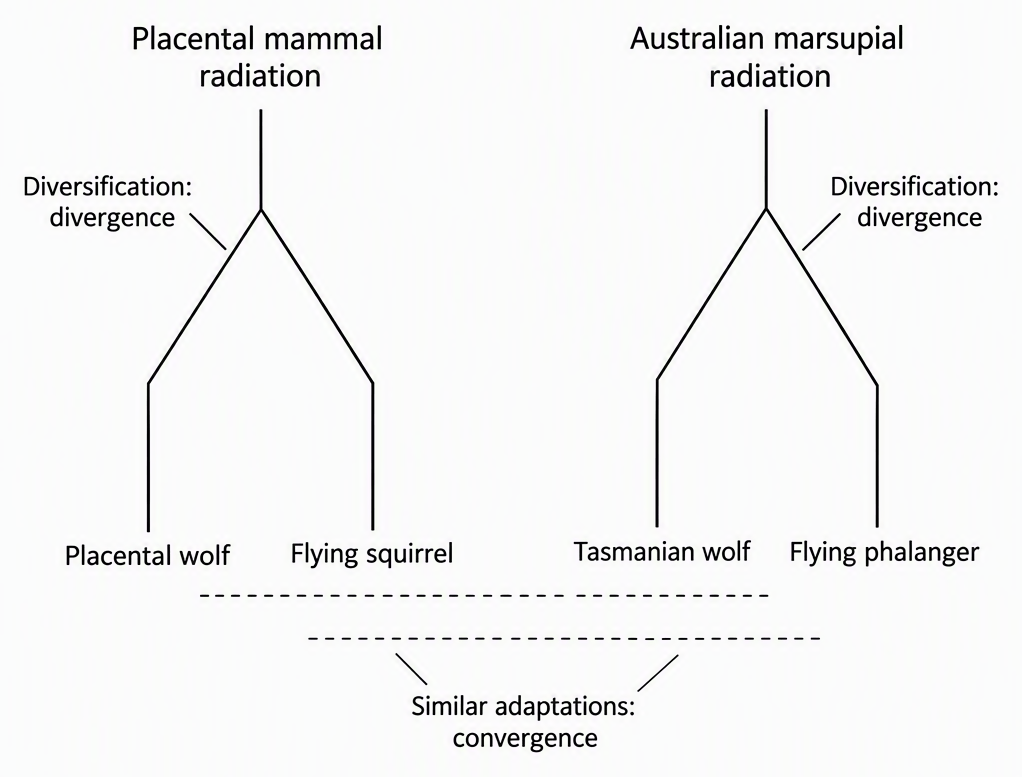
Step 3: Use both NCERT examples. The placental wolf and Tasmanian wolf show similar body forms despite belonging to different mammalian groups. Flying squirrels and flying phalangers likewise show similar gliding adaptations despite being distantly related.
Step 4: Connect resemblance to environmental pressures. Similar environmental pressures can independently favour analogous adaptations in distantly related lineages. This is convergent evolution. These mammals still share deeper ancestry: convergence does not mean they have no common ancestor whatsoever.
Step 5: Contrast divergence. Divergent evolution describes descendants of a common ancestor becoming different. Darwin’s finches and diversification within the Australian marsupial lineage illustrate this pattern. Option A explains that branching, not the resemblance asked about.
Step 6: Eliminate the chance-based processes. Genetic drift concerns chance changes in allele frequencies; founder effect is a special case involving a small founding population. Neither C nor D explains the adaptive resemblance described. Following NCERT Class 12 Biology, Evolution, the answer is B) convergent evolution.
Why is divergent evolution the wrong answer here?
Choosing A applies a correct definition to the wrong comparison. Adaptive radiation illustrates divergent evolution within an ancestral group, but this stem asks about resemblance between independently evolved counterparts. The incorrect method is: see “adaptive radiation”, recall “divergent evolution”, then select A without checking which relationship the stem asks about.
Keep these comparisons separate:
- Within one ancestral radiation: descendants diversify into different forms, indicating divergence.
- Between independent radiations: counterparts develop similar adaptations, indicating convergence.
If the question instead asked about the origin of different Australian marsupials from a common ancestor, divergence would be correct. That wording changes the answer without changing either definition.
If selecting B earns four marks and selecting A loses one mark, the score difference is:
Before selecting an option, identify the lineages being compared. Then decide whether the stem asks about their diversification or resemblance.
Can you apply the distinction to three related Evolution questions?
Apply the same evidence-first method: identify the lineages and the outcome before choosing a process. These are three original NEET-style practice questions, not additional verified PYQs. Each stays within Genetics and Evolution; choose your answers before reading the explanations in the next section.
Question 1: Several Australian marsupial forms arise from a common ancestral stock and occupy different ecological niches. Which pattern is illustrated?
Question 2: Flying squirrels and flying phalangers independently acquire similar gliding adaptations. Which process explains this resemblance?
Question 3: A few individuals establish an isolated population whose allele frequencies differ by chance from those of the source population. Which term most specifically describes this?
What evidence determines each practice answer?
The answers are 1: B, 2: C, and 3: A. The deciding evidence is common ancestry followed by diversification, independent origins of similar adaptations, and chance differences caused by a small founding sample, respectively. Match each answer to that evidence rather than selecting a process from a familiar keyword.
- Question 1, B: A common ancestral stock diversifies into forms occupying different ecological niches. This establishes adaptive radiation as divergent evolution within the marsupial lineage.
- Question 2, C: Similar gliding adaptations arise independently. This establishes convergence, matching the between-group comparison in the adaptive radiation NEET 2026 question.
- Question 3, A: A small founding sample has allele frequencies that differ by chance from the source population. Founder effect is the specific diagnosis, although it belongs to the broader category of genetic drift.
Question 3 tests chance sampling, unlike the diversification and adaptive resemblance in Questions 1 and 2. Before selecting an option, classify the relationship the question asks about, not an isolated keyword.
Next step: photograph a doubt on NEET JEEnius AI and photograph any question you are stuck on and get a step-by-step solution across Physics, Chemistry and Biology (20 free a month).
Keep going with Chemical Kinetics NEET 2013: Rate-Doubling Solution.
Frequently asked questions
What is the answer to the adaptive radiation NEET 2026 question?
The correct answer is B) convergent evolution. The question asks about resemblance between placental mammals and Australian marsupials that diversified independently, not diversification within either group.
Why is divergent evolution wrong in the placental mammal and marsupial question?
Divergent evolution explains descendants of a common ancestor becoming different, including diversification within an adaptive radiation. This question instead compares similar adaptations between independently radiating groups, so convergent evolution is correct.
Which NCERT examples show convergence between placental mammals and marsupials?
The placental wolf and Tasmanian wolf illustrate similar body forms in different mammalian groups. Flying squirrels and flying phalangers illustrate independently evolved gliding adaptations. These comparisons show convergence between groups, while diversification within each lineage illustrates divergence.
What is the difference between founder effect and genetic drift?
Genetic drift is a chance change in allele frequencies. Founder effect is a specific case in which a small founding population has allele frequencies that differ by chance from the source population. Neither explains the adaptive resemblance between placental mammals and marsupials in this question.