
How should I revise Chemistry in the last month for NEET?
A workable NEET Chemistry revision strategy prioritises previously studied but unreliable material over large untouched chapters. Start with 3 focused Chemistry hours within an 8-hour self-study day, adjusted to your needs rather than treated as a requirement. Follow this sequence: closed-book recall, targeted NCERT or formula checking, question practice, correction and retesting. Physics and Biology must continue daily.
What should my 30-day Chemistry revision timetable look like?
Use two 90-minute Chemistry blocks, with Physics and Biology protected between them. The clock times, study hours, practice targets and phase boundaries below are suggested planning choices, not official requirements or research findings. This is a full revision-day schedule, not eight extra hours to stack on top of school or coaching.
Daily schedule:
- 07:00–08:30 | Chemistry | 30 minutes closed-book recall and source checking, 45 minutes targeted questions, 15 minutes correction.
- 09:00–11:00 | Physics | Repair a selected weakness, solve questions and check the working.
- 11:30–13:00 | Biology | NCERT recall, exact-line checking and related questions.
- 14:00–15:30 | Chemistry | 20 minutes recall of a different branch, 45 minutes mixed or previous-year questions, 25 minutes correction and due error retests.
- 16:00–17:30 | Biology | Revise another topic and check mistakes from practice.
- Focused total | 8 hours | Chemistry 3 hours, Physics 2 hours, Biology 3 hours.
Meals and breaks sit outside these focused hours. Shift the clock times to suit your household or classes while preserving the blocks and their correction time.
Month plan:
- Days 1–3 | Audit and prioritisation | Classify recent Chemistry errors, identify unreliable topics and prepare your first repair queue.
- Days 4–17 | Repair and spaced revisits | Recall a selected topic, check it, practise it and return to earlier errors.
- Days 18–26 | Mixed timed practice and remaining repairs | Practise switching between branches and repair weaknesses that survive retesting.
- Days 27–30 | Consolidate and taper | Use compact recall sheets, revisit recurring errors and reduce new material and exhausting test volume.
Do not spend all three audit days making a spreadsheet. Begin the first repair during Day 1, then refine priorities as questions expose gaps.
Question volume must fit the checking time. Expect fewer attempts on calculation-heavy Physical Chemistry than on short factual questions because each solution takes longer to work through and check. Stop opening new questions when the correction block begins.
Choose tomorrow’s opening task before ending today’s second Chemistry block. Write a bounded instruction such as “reconstruct the Nernst equation, check reaction quotients and solve fresh applications”, not “finish Electrochemistry”.
If school or coaching occupies much of your day, use the smaller allocation below. Count relevant independent work already completed rather than adding another full day’s schedule.
How should I divide time between subjects and Chemistry branches?
Keep all three subjects active, and give Chemistry extra time only when recent errors justify it. The suggested 3-hour Chemistry, 3-hour Biology and 2-hour Physics split suits a student whose Chemistry needs repair while Physics is comparatively stable. Study time should respond to weaknesses, not mechanically copy each subject’s share of marks.
The official subject allocation is:
- Chemistry: 45 questions, 180 marks.
- Physics: 45 questions, 180 marks.
- Biology: 90 questions, 360 marks.
Biology accounts for half the questions and half the marks. A Chemistry rescue plan cannot become a Chemistry-only month. Use the NEET Biology Revision Strategy: A 30-Day NCERT Plan to replace “read NCERT later” with scheduled recall and checking.
For a 6-hour self-study day, a suggested alternative is:
- Chemistry: 2 hours.
- Biology: 2.5 hours.
- Physics: 1.5 hours.
Change that split if Physics errors are rising or Biology recall is failing. Protect daily work in each subject before giving extra time to your favourite one.
Within the 180-minute Chemistry budget, start with this average allocation across the week:
- Physical Chemistry: 60 minutes daily on average.
- Organic Chemistry: 60 minutes daily on average.
- Inorganic Chemistry: 60 minutes daily on average.
These are weekly averages, not a demand for three equal sessions every day. One branch can occupy the first block while the other two share later work across the week.
If one branch clearly needs more repair, temporarily use 90 minutes for it and 45 minutes for each other branch. Reallocate time using recurring errors and successful retests, not fear, preference or unsupported chapter-weightage predictions.
What mistakes can make this revision plan fail?
Passive rereading, unchecked questions and skipped branches leave weaknesses untested. Protect correction time, keep every branch in rotation and replace low-priority tasks when time runs out. Judge a day by what you can retrieve and apply on a retest, not by pages read, lectures watched or questions opened.
- Passive NCERT rereading: Familiar wording can hide weak recall. Close the book, answer a prompt, then check the exact missed fact, condition or exception. Reread the relevant passage, not the whole chapter automatically.
- Full lecture series for familiar chapters: Use a short explanation for an identified conceptual gap, then immediately solve questions on that point. Watching without applying the explanation leaves the gap untested.
- Solving without reviewing: Keep the correction block even if you attempt fewer questions. Record why your answer failed and what to check on the next attempt.
- Ignoring a weak branch: Keep Physical, Organic and Inorganic Chemistry in the weekly rotation. Do not wait to complete one branch before revisiting another.
- Chasing predicted weightages or obsolete questions: Filter question banks and older papers against the official syllabus for your exam year at neet.nta.nic.in. A question’s age or popularity does not establish current relevance.
- Using an obsolete optional-section strategy: The supplied current pattern has 180 compulsory questions and no optional Section B, which was discontinued from 2025. “Compulsory” means there is no optional question section, not that you must guess every answer.
- Carrying every unfinished task forward: Replace a lower-priority task tomorrow instead of extending the day or cutting sleep. Keep the higher-priority repair, not every item on yesterday’s checklist.
How should I revise Physical, Organic and Inorganic Chemistry differently?
Use formulas and problem setups for Physical Chemistry, connected transformations for Organic Chemistry, and precise NCERT recall for Inorganic Chemistry. Each session should produce something checkable: a reconstructed formula, a reaction map or an answer to a factual prompt. Follow it with a fresh question to test application, not just recognition.
How do I fix slow or inaccurate Physical Chemistry calculations?
Reconstruct the formula from memory, state its units and conditions, then solve a representative problem without looking at the solution. Separate a wrong setup from wrong arithmetic. An incorrect equation needs conceptual repair; a conversion or sign error needs correction in the working.
For Electrochemistry, begin with the general Nernst equation. Check the balanced cell reaction, the reaction quotient and the number of electrons transferred before substituting values.
The familiar base-10 coefficient of approximately 0.0591 volts applies at 298 kelvin; it is not a temperature-free constant. For the reaction quotient, check exponents and omit pure solids and pure liquids from activity expressions.
Label whether your mistake involved the quotient, electron count, temperature or arithmetic. Then use Electrochemistry Practice Questions NEET: 5 Explained MCQs for application practice.
How do I stop confusing Organic Chemistry reactions?
Retrieve reactions in both directions: reagent to transformation, and desired product to suitable reagent. Include the substrate and reaction conditions, because a reagent name alone does not specify the outcome. When reactions seem contradictory, use general organic principles to explain the difference rather than memorising another disconnected reaction.
Make a compact reaction map from memory, then check it against your source. Record conditions that change the outcome, such as aqueous versus alcoholic conditions or heating where relevant. Use electronic effects, resonance, intermediate stability and the reaction pathway to resolve confusion.
The map is a recall test, not a note-making project. Check it and move to questions instead of spending hours decorating it.
How do I retain Inorganic Chemistry facts and exceptions?
Turn NCERT content within your applicable official syllabus into closed-book prompts. Test trends, exceptions, equations, tables and distinctions between similar facts. After checking an answer, return specifically to what you missed rather than rereading several pages. Record the correction and schedule another recall attempt.
Use a four-column working sheet:
- Topic or prompt: The exact fact or distinction being tested.
- Recalled answer: What you wrote before checking.
- Correction: The missing or incorrect detail.
- Next retest: When to retrieve it again.
For every branch, use the same exit condition: explain the point without notes and apply it correctly to a fresh question. One familiar correct answer is not evidence of durable mastery.
How should my mistakes decide tomorrow’s Chemistry work?
Turn each error into a specific repair task, and check guessed correct answers separately from confident correct answers. Give priority to recurring weaknesses that a focused session can repair, while maintaining secure material. A wrong answer calls for diagnosis, not an automatic restart of the entire chapter.
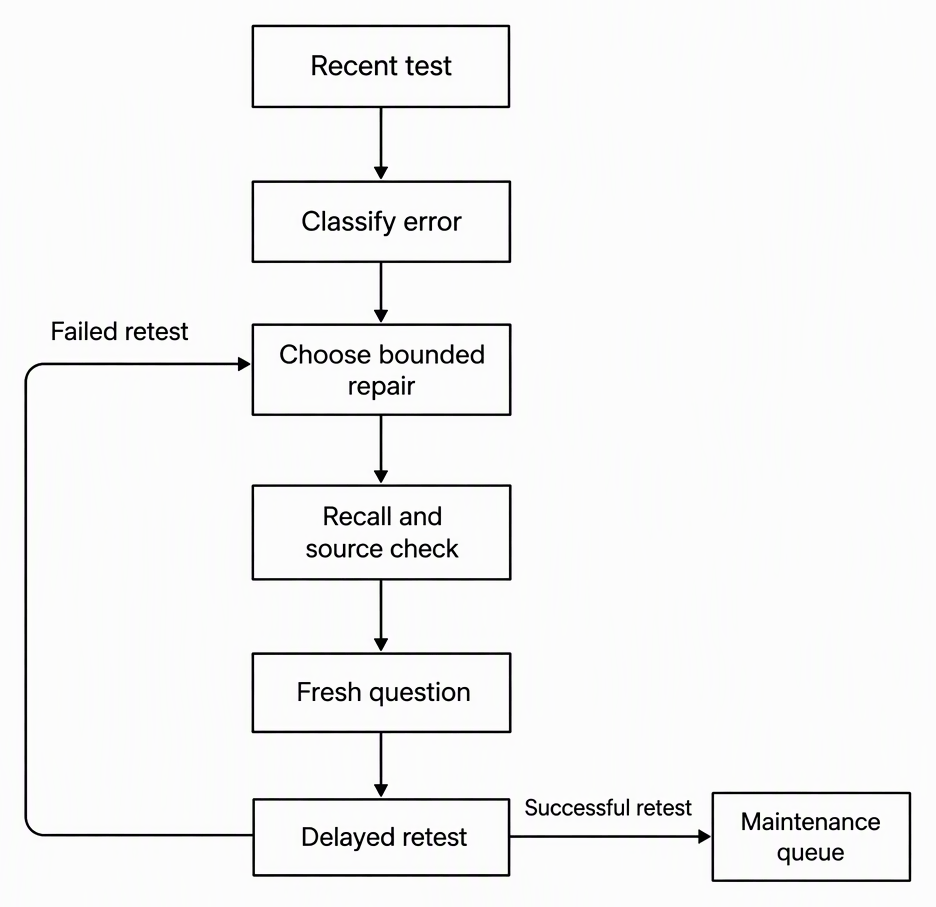
Use four error categories:
- Knowledge or recall gap: Retrieve the missing fact, formula or condition, then check it.
- Conceptual misunderstanding: Explain the governing idea and solve a fresh application.
- Calculation or unit error: Redo the working with units and intermediate steps visible.
- Reading or time-management error: Identify the missed word, rushed decision or question that consumed excess time.
Keep three revision queues:
- Studied but unreliable: First claim on repair time.
- Secure but due for maintenance: Short recall and mixed-question checks.
- Largely untouched: Selective assessment, not automatic inclusion.
Rank repairs by recurrence, prerequisite importance and whether a focused session can fix them. A repeated foundational error deserves attention before an isolated obscure fact. Do not assign invented “marks gained” to chapters.
Use the official Chemistry scoring calculation:
Unattempted questions score zero. Track blanks, guessed correct answers and error categories alongside the score so that a lucky answer does not hide a weakness.
Occasionally attempt a 45-question Chemistry section with an initial 60-minute training budget. This is not an official sectional time limit. A 60-minute section plus 60 minutes of review replaces two hours of that day’s Chemistry work; it is not added to them.
For a full-mock day, replace the normal timetable with:
- Full paper: 3 hours, following the official 180-question, 720-mark format.
- Review: 2 hours.
- Chemistry repair: 1 hour.
- Biology recall: 1 hour.
- Physics repair: 1 hour.
- Focused total: 8 hours.
During review, check uncertain answers and repeated errors first. Put remaining checks into the revision queues rather than extending the day.
A manual error log works. NEET JEEnius AI’s free mistake notebook automatically saves wrong answers and returns them at 1, 3, 7 and 14 days until marked mastered. Revisit late-month errors before the exam where feasible rather than waiting for a scheduled return after it.
What should I revise in the final 72 hours, and what should I cut?
Use the final 72 hours for compact formula sheets, reaction conditions, NCERT exceptions and unresolved recurring mistakes. Do not start a new question bank or full lecture course. On the final evening, choose brief familiar practice instead of a full mock, and protect normal sleep.
If you miss a day, resume the current phase and replace the least useful pending task. Do not attempt two full days of work the next day. Carry forward only work that still outranks your current priorities.
When only 90 Chemistry minutes are available, preserve recall, questions and correction:
- 25 minutes: Closed-book recall and targeted checking.
- 40 minutes: Questions on the selected weakness.
- 25 minutes: Correction and due retests.
For a largely untouched chapter, assess its prerequisites and choose a bounded portion before committing time. Check whether you can learn and test that portion without displacing several repairable weaknesses. If it requires a chain of unfamiliar concepts and a long lecture sequence, defer it; there is no defensible universal skip list for every student.
Judge readiness through observable behaviour: you retrieve without notes, solve a fresh application and avoid a mistake you previously repeated. Completing every page is not the stopping rule. Once a point meets that standard, move it into maintenance rather than repeatedly solving the same familiar example.
Select one recent Chemistry test now, classify its errors and put the first repair task into tomorrow’s opening block.
Next step: daily practice problems on NEET JEEnius AI and get a fresh set on a topic every day (20 free attempts a month).
Frequently asked questions
How many hours should I revise Chemistry daily before NEET?
Start with 3 focused Chemistry hours within an 8-hour self-study day if Chemistry needs repair and Physics is comparatively stable. For a 6-hour day, the article suggests 2 hours of Chemistry. These are adjustable planning choices, not requirements; keep Physics and Biology active daily.
How should I revise Physical, Organic and Inorganic Chemistry differently?
For Physical Chemistry, reconstruct formulas with their units and conditions, then solve fresh problems. For Organic Chemistry, retrieve connected transformations with substrates, reagents and reaction conditions. For Inorganic Chemistry, use closed-book NCERT prompts to test facts, trends and exceptions within your applicable syllabus.
How do I use mock test mistakes to plan Chemistry revision?
Classify mistakes as recall gaps, conceptual misunderstandings, calculation or unit errors, and reading or time-management errors. Prioritise recurring weaknesses that a focused session can repair, and check guessed correct answers separately. Turn each weakness into a bounded repair task, then test it with a fresh question and a delayed retest.
Should I start untouched Chemistry chapters in the last month?
Give previously studied but unreliable material first claim on repair time. For an untouched chapter, assess its prerequisites and choose a bounded portion that you can learn and test without displacing several repairable weaknesses. Defer it if it requires a long chain of unfamiliar concepts; there is no universal skip list.
What should I revise in Chemistry in the final 72 hours before NEET?
Revise compact formula sheets, reaction conditions, NCERT exceptions and unresolved recurring mistakes. Do not start a new question bank or full lecture course. On the final evening, use brief familiar practice rather than a full mock and protect normal sleep.