
Should I start Electrochemistry practice with chapter MCQs, PYQs or mocks?
Start with explained chapter MCQs when your concepts are shaky, verified previous-year questions for exam relevance, and full-length mocks for whole-paper execution. The free electrochemistry practice questions NEET students can attempt below are original, with explanations to help identify reasoning errors.
A full mock is not a substitute for targeted chapter repair. If you confuse electrode signs or conductivity units, fix those errors before spreading your attention across the paper. Use the comparison first, then attempt the questions without checking the answers.
How do free chapter MCQs, verified NEET PYQs and full-length mocks compare?
Chapter MCQs isolate errors, verified PYQs test your reasoning on actual exam wording, and mocks test execution across subjects. Choose by the task you need to practise, not by which format looks hardest.
- Purpose
- Original chapter MCQs here: Diagnose specific Electrochemistry errors.
- Verified NEET PYQs: Check performance on authentic past questions.
- NEET JEEnius AI full-length mocks: Practise a full 180-question, 720-mark paper in 180 minutes.
- Chapter focus
- Chapter MCQs: Every question below concerns Electrochemistry.
- PYQs: Select traceable Electrochemistry questions from past papers.
- Mocks: Cover Physics, Chemistry and Biology, not just this chapter.
- Explanation availability
- Chapter MCQs: Every answer has an explanation below.
- PYQs: Solution quality depends on the source.
- Mocks: The verified offer specifies a scored per-subject breakdown, not worked explanations.
- Exam authenticity
- Chapter MCQs: Original practice, not actual NEET questions or predictions.
- PYQs: Authenticity requires an identifiable paper and corresponding answer key.
- Mocks: Practice papers, not official past papers.
- Whole-paper practice
- Chapter MCQs: No.
- Selected chapter PYQs: No.
- Mocks: Yes, with 45 Physics, 45 Chemistry and 90 Biology questions.
- Free access
- Chapter MCQs: All questions and explanations on this page are free.
- PYQs: Free access depends on the source.
- Mocks: 30 free full-length mocks a month.
- Main limitation
- Chapter MCQs: This short diagnostic cannot establish complete chapter mastery.
- PYQs: Remembered answers can disguise weak reasoning.
- Mocks: Subject-level scores cannot identify a particular Electrochemistry misconception.
No fixed Electrochemistry question count per mock or official paper is established by the supplied information. Do not plan around an assumed count.
Which practice format should Class 11, Class 12 and dropper students choose?
Choose by your errors, not your class label alone. Reversed concentration terms call for chapter practice; correct chapter reasoning with poor mixed-paper timing calls for mocks.
- Class 11 students studying ahead: Check oxidation and reduction, concentration expressions and equilibrium first. If balancing a redox reaction or writing an equilibrium expression is unfamiliar, repair that prerequisite before attempting unfamiliar Electrochemistry material.
- Class 12 students who just finished the chapter: Begin with explained chapter questions. Write the reaction and units before selecting an option to expose sign, unit and formula-selection mistakes.
- Students who solve familiar examples but fail changed wording: Use verified PYQs to test whether you can apply the concept. Explain why the rejected options are wrong instead of memorising answer letters.
- Droppers who solve chapter questions correctly but lose marks in mixed papers: Prioritise full-length mocks. Review the Chemistry breakdown, then inspect individual questions to separate timing problems from concept gaps.
Move between formats as your errors change. Return to chapter practice when a mock exposes a concept error, then resume mixed-paper practice once you can explain a changed-condition question independently.
Can you solve these free Electrochemistry MCQs before checking the answers?
Attempt each question and write one sentence explaining your choice before checking the key. These original single-correct MCQs form an illustrative diagnostic, not complete chapter coverage, PYQs or predicted exam questions.
Question 1. Which statement correctly connects the anode with electrode polarity?
Compare a galvanic cell delivering current with an electrolytic cell driven by an external power supply. Select the correct statement.
- A. Oxidation occurs at the anode, which is negative in both cells.
- B. Oxidation occurs at the anode, which is negative in the galvanic cell and positive in the electrolytic cell.
- C. Reduction occurs at the anode, which is positive in both cells.
- D. Oxidation occurs at the cathode in the electrolytic cell.
Question 2. What does a higher cathode reduction potential imply?
For a cell reaction as written, the cathode reduction potential exceeds the anode reduction potential under the actual solution conditions. At constant temperature and pressure, select the correct statement.
- A. Cell potential is positive; the forward reaction is thermodynamically spontaneous.
- B. Cell potential is negative; the forward reaction is thermodynamically spontaneous.
- C. Cell potential is positive; the forward reaction is non-spontaneous.
- D. Cell potential is zero; the reaction is at equilibrium.
Question 3. How does increasing the reaction quotient affect cell potential?
Consider this reaction at fixed temperature, with pure solid electrodes and ideal dilute solutions. The zinc-ion concentration increases while the copper-ion concentration remains unchanged.
- A. The reaction quotient decreases and cell potential increases.
- B. The reaction quotient increases and cell potential increases.
- C. The reaction quotient increases and cell potential decreases.
- D. Neither quantity changes because both electrodes are solids.
Question 4. How do conductivity and molar conductivity change on dilution?
An aqueous potassium chloride solution is diluted within the dilute-solution range at fixed temperature. Select the correct trend.
- A. Both conductivity and molar conductivity increase.
- B. Both conductivity and molar conductivity decrease.
- C. Conductivity increases; molar conductivity decreases.
- D. Conductivity decreases; molar conductivity increases.
Question 5. How do charge and electron requirement affect deposited mass?
Two electrolytic cells deposit the same metal from monovalent ions in the first cell and divalent ions in the second. The second receives twice the charge received by the first.
Assume sufficient ions, complete retention of deposited metal, 100% current efficiency and no side reactions. Compared with the first cell, the second deposits:
- A. Twice the mass.
- B. The same mass.
- C. Half the mass.
- D. One-quarter of the mass.
What are the answers, and which mistake does each question expose?
The answer key is 1 B, 2 A, 3 C, 4 D and 5 B. A correct option with incorrect reasoning still needs repair. Compare your written reason with each explanation, especially if you guessed.
Why is Question 1 answered by B?
Oxidation defines the anode; reduction defines the cathode. Polarity depends on the cell type: the anode is negative in a galvanic cell delivering current but positive in an externally driven electrolytic cell.
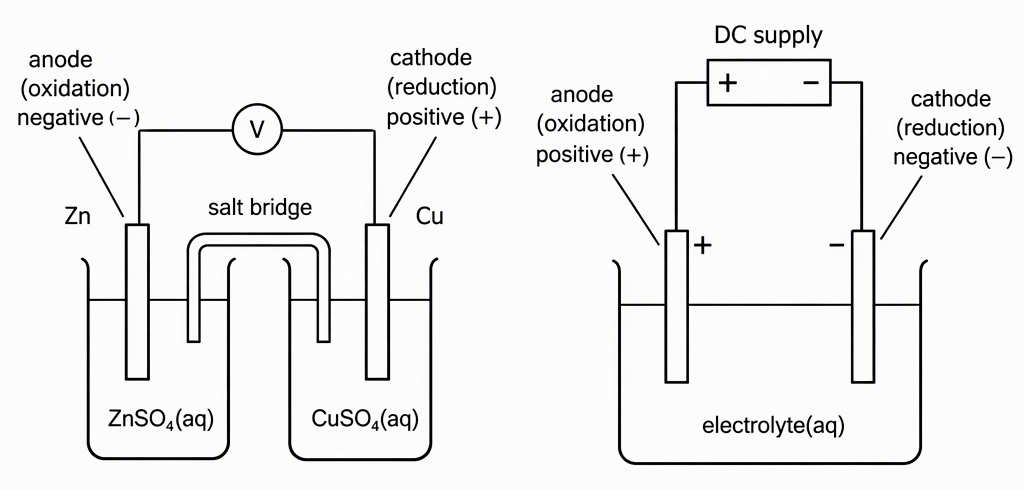
Option A carries the familiar galvanic-cell sign into every cell. The process names stay fixed; the signs do not.
Repair action: revisit the concept. State the electrode reaction first, then identify polarity from the cell type.
Why is Question 2 answered by A?
Subtracting the anode reduction potential from the higher cathode reduction potential gives a positive cell potential. The Gibbs energy change is therefore negative for the forward reaction under the stated conditions.
Use reduction potentials consistently because standard tables list half-reactions as reductions. If you reverse a half-reaction and use its oxidation potential, its sign changes: add that oxidation potential rather than subtracting it again.
Option C reverses the Gibbs-energy relationship. Spontaneous means thermodynamically favoured, not necessarily fast.
Repair action: rewrite the reaction. Label reduction and oxidation before inserting potentials.
Why is Question 3 answered by C?
Increasing zinc-ion concentration increases the reaction quotient and lowers cell potential. Pure solids do not appear in the quotient; under the stated ideal-solution assumption, the concentration ratio is:
At fixed temperature, a larger logarithmic term is subtracted, so cell potential decreases. Option B treats “more ions” as “more voltage” without checking which side of the reaction contains those ions.
Repair action: rewrite the reaction. Then practise a changed-condition variant in which copper-ion concentration increases instead.
Why is Question 4 answered by D?
Dilution reduces charge carriers per unit volume, so conductivity decreases. Molar conductivity measures conductivity relative to molar concentration; for dilute aqueous KCl, it increases towards its limiting value as interionic effects weaken.
This form uses conductivity in siemens per metre and concentration in moles per cubic metre. With conductivity in siemens per centimetre and concentration in moles per litre, the numerical conversion is:
Option B applies the drop in carriers per unit volume to both quantities. It misses that molar conductivity accounts for concentration rather than measuring conductivity alone.
Repair action: check the unit convention. Write units beside each supplied value before calculating.
Why is Question 5 answered by B?
Twice the charge is offset by twice the electron requirement, so the deposited masses are equal. Deposited mass depends on charge, molar mass and electrons required per deposited atom; the same metal has the same molar mass.
Option A notices twice the charge but misses twice the electron requirement. Both changes must be included.
Repair action: practise a changed-condition variant. Keep the charges equal and explain why the divalent-ion cell would then deposit half as much metal.
What counts as Electrochemistry chapter readiness?
Readiness means correct reasoning on unfamiliar variants and the ability to explain your errors, not completion of a question quota. Finishing this short diagnostic alone does not establish chapter mastery.
Are these free questions genuine NEET PYQs?
No. These free questions are original diagnostic practice, not predictions. Genuine PYQs need an identifiable paper and corresponding answer key; a “NEET-level” label does not establish authenticity.
Are textbook exercises enough for Electrochemistry?
Use textbook exercises for learning, but not as a substitute for answer-selection or whole-paper practice. The formats serve different tasks:
- Textbook exercises: Develop concepts and working.
- Single-correct MCQs: Train answer selection.
- Full mocks: Test whole-paper execution.
How many questions should I solve before calling the chapter complete?
There is no magic total. Test yourself on unfamiliar variants and explain your errors without copying the solution. Change one condition in a question you missed and justify the new answer before checking it.
What should your next practice session contain?
Use textbook repair for unfamiliar reasoning, setup practice for miswritten expressions, and a full mock for mixed-paper execution problems. Choose the next task from your error record, not from how many questions remain in a resource.
- If the explanation is unfamiliar: Return to the relevant textbook concept and worked example before attempting more variants.
- If the concept is clear but the setup is wrong: Practise writing the cell reaction, reaction quotient or electron requirement before looking at options.
- If unfamiliar chapter answers are consistently reasoned correctly: Move to whole-paper practice when timing, subject switching or answer selection breaks down.
Record topic, selected option, reason for the mistake and corrected reasoning. A Chemistry score is not a chapter-level diagnosis.
The current full paper has 180 compulsory questions in 180 minutes; Chemistry contributes 45 questions and 180 marks. The official scheme awards +4 for a correct answer, -1 for a wrong answer and 0 for an unattempted question. A wrong answer costs one mark compared with leaving that question blank.
For this stage, NEET JEEnius AI offers 30 free full-length mocks monthly with a scored per-subject breakdown. Use that breakdown to locate subject-level trouble, then inspect individual errors yourself.
Next step: full-length mock tests on NEET JEEnius AI and sit a full 180-question, 720-mark, 180-minute paper, 45 Physics, 45 Chemistry and 90 Biology, and get a scored per-subject breakdown (30 free a month).
Related on NEET JEEnius AI: Chordates and Vertebrates NEET 2026: Human Origins.
Frequently asked questions
Should I start Electrochemistry practice with MCQs, PYQs or mocks?
Start with explained chapter MCQs if your concepts or question setups are weak. Use verified NEET PYQs to practise authentic exam wording. Move to full-length mocks when your chapter reasoning is sound but timing or subject switching causes errors.
Are these Electrochemistry questions actual NEET PYQs?
No. These five questions are original diagnostic MCQs with explanations, not past NEET questions or predictions. Genuine PYQs require an identifiable exam paper and its corresponding answer key.
How many Electrochemistry questions should I solve to complete the chapter?
There is no fixed question total that establishes chapter readiness. Test whether you can solve unfamiliar variants and explain your mistakes without copying a solution. Completing these five diagnostic questions alone does not establish mastery.
Are textbook exercises enough for NEET Electrochemistry?
Textbook exercises develop concepts and working, but they do not replace MCQ or whole-paper practice. Single-correct MCQs train answer selection, while full-length mocks test timing and execution across subjects. Use each format for the weakness it addresses.