
What is the correct answer to the Properties NEET 2006 floating-block question?
Option B is correct in the Properties NEET 2006 floating-block question: the period varies inversely with the square root of horizontal cross-sectional area. Calculate the change in buoyancy, not the entire buoyant force, to find the restoring force.
A rectangular block floats upright in a liquid with a constant horizontal cross-sectional area. After a small vertical shift from equilibrium, which listed dependence of its oscillation period is correct?
The symbols and supplied options are:
- A)
- B)
- C)
- D)
This question belongs to Properties of Solids and Liquids. Its hard tag and 90-second target are question-bank metadata, not an official exam classification or a guaranteed solving time.
Why does extra buoyancy provide the restoring force?
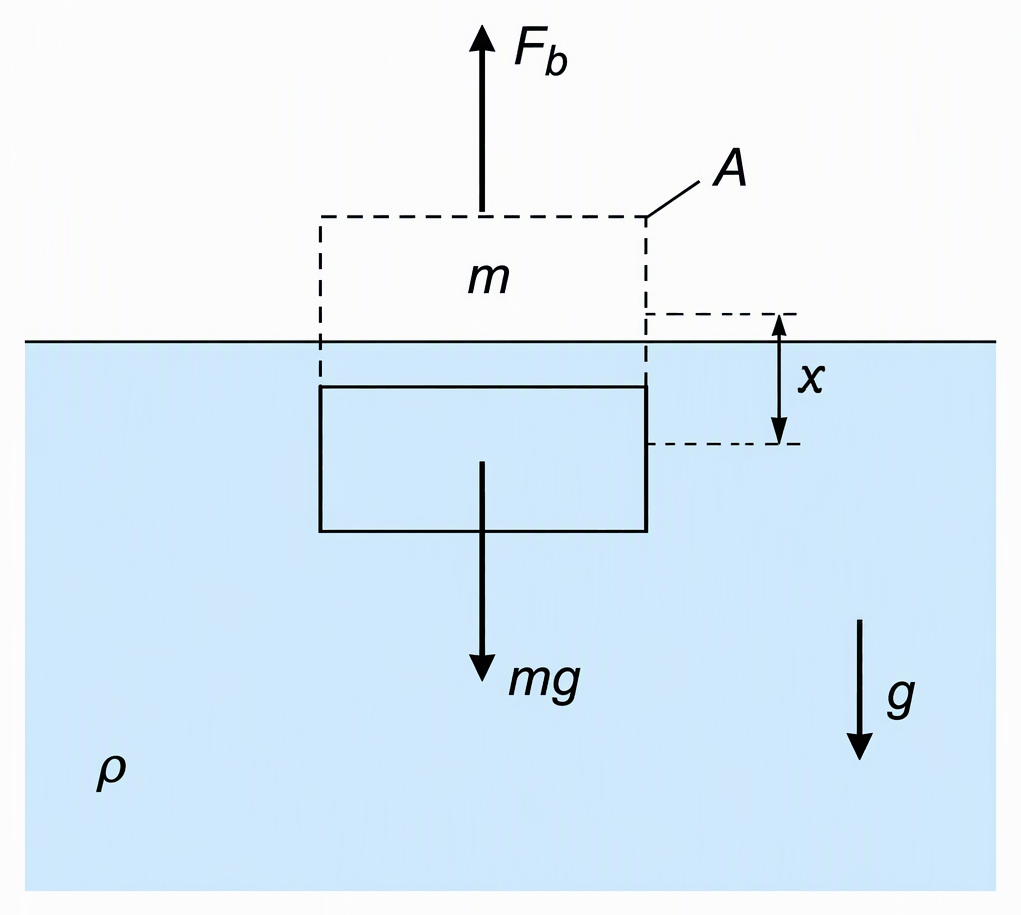
The equilibrium buoyancy already balances the block’s weight. Only the change in buoyancy caused by displacement remains as the net force. Pushing the block down submerges more of it, increasing the upward force while its weight stays unchanged. The net force therefore acts upward, opposite to the displacement.
Assume the block keeps its orientation and constant horizontal cross-section. It remains partly submerged throughout the small motion; liquid drag and additional fluid-inertia effects are neglected.
Choose downward displacement as positive. Denote that displacement and the equilibrium displaced-liquid volume by:
At equilibrium, upward buoyancy balances weight:
A downward shift adds submerged volume equal to horizontal area multiplied by displacement:
The total buoyancy at the displaced position is:
Weight is positive under our downward sign convention, while buoyancy is negative. Hence:
For this downward shift, the magnitude of the extra buoyant force is:
The minus sign expresses the net force’s restoring direction. For an upward displacement, buoyancy decreases below the weight, giving a downward restoring force.
How do you obtain the period and check all four options?
The period varies as the square root of mass and inversely as the square roots of liquid density and area, so option B is correct. Each dependence holds with the other quantities fixed. To derive these results, compare the acceleration equation with the standard SHM equation, then take the square root of the frequency coefficient.
Newton’s second law gives:
Divide by the block’s mass:
Compare with the standard SHM equation:
Therefore:
The period follows:
With other quantities fixed:
Check every option:
- A is wrong: it predicts the wrong density trend. Greater liquid density makes the period shorter, not longer.
- B is correct: it matches the inverse-square-root area dependence.
- C is wrong: its density exponent is incorrect.
- D is wrong: it reverses the mass dependence. Greater mass gives a longer period at fixed area and liquid density.
Thus, the correct answer is option B:
A dimensional check gives:
Taking the square root therefore gives time units. This checks the formula independently of the option labels.
How does losing the square root produce option C?
Option C results from confusing angular frequency squared with angular frequency. The force calculation can be correct, yet the final dependence can fail at this step. Liquid density multiplies the coefficient identified as angular frequency squared, not angular frequency itself.
The incorrect chain is:
Repair the exact step:
Write this intermediate line explicitly:
Only then use:
Record the failed step as “treated angular frequency squared as angular frequency”, rather than simply “silly mistake”. Use NEET Silly Mistakes: Find the Cause and Fix the Check to turn that diagnosis into a repeatable check. Never jump directly from squared frequency to a claimed period dependence.
Can you solve three related buoyancy questions using the same method?
Use period ratios for the first two questions and test whether displaced volume changes in the third. These are original related practice questions, not additional verified PYQs. Keep the same partly submerged rectangular-block model and idealisations unless the question explicitly changes them.
Question 1: The area becomes four times its original value, with mass and liquid density unchanged. Find the new period.
Using the inverse-square-root area dependence:
Four times the area gives four times the restoring-force coefficient, but only half the period. Retain the square root when taking the ratio.
Question 2: The same block floats in a liquid four times as dense. Find its equilibrium displaced volume and period.
Equilibrium requires buoyancy to balance weight:
The period ratio is:
The block displaces one-quarter as much liquid, and its period halves. Distinguish the equilibrium submerged volume from the volume change during oscillation.
Question 3: A rigid, incompressible block is fully submerged and neutrally buoyant in a uniform-density liquid. Does a small vertical shift alone produce the same SHM?
No. While it remains fully submerged, its displaced volume stays constant. Buoyancy continues to equal weight, so no position-dependent restoring force arises.
Before applying the floating-block formula, check that displacement changes submerged volume:
That changing volume is essential. Do not transfer the formula to a fully submerged rigid body.
Next step: the past-paper archive on NEET JEEnius AI and search past NEET papers by year, subject or chapter, each with a worked solution (100 free searches a month).
Frequently asked questions
What is the correct answer to the Properties NEET 2006 floating-block question?
Option B is correct: the period varies inversely with the square root of horizontal cross-sectional area, with mass and liquid density fixed. The formula is T = 2π√(m/(ρgA)), where m is block mass, ρ is liquid density, g is gravitational acceleration and A is horizontal cross-sectional area.
Why is the restoring force on a floating block equal to −ρgAx?
At equilibrium, buoyancy already balances the block's weight. A small downward displacement x adds submerged volume Ax, increasing upward buoyancy by ρgAx, where A is horizontal cross-sectional area and ρ is liquid density. Taking downward as positive, the net restoring force is therefore −ρgAx.
Why is option C wrong in the floating-block question?
Option C incorrectly states that the period is inversely proportional to liquid density. The SHM equation gives angular frequency squared proportional to density, so angular frequency is proportional to its square root. The period therefore varies inversely with the square root of density, not density itself.
Does a fully submerged neutrally buoyant block perform the same SHM?
No: a rigid, incompressible block that remains fully submerged in a uniform-density liquid displaces the same volume after a vertical shift. Buoyancy continues to balance weight, so the shift produces no position-dependent restoring force. The floating-block period formula does not apply.