
What is the correct option for the Current Electricity NEET 2006 cell question?
Option A is correct for this Current Electricity NEET 2006 PYQ: subtract the second cell’s internal resistance from the first’s. It tests combination of cells and internal resistance and is tagged hard on this question bank’s scale, not on the basis of student performance.
A closed loop contains two equal-emf cells connected in series aiding and an external resistor, with resistances labelled below. A voltmeter across the first complete cell, including its internal resistance, reads zero; determine the external resistance.
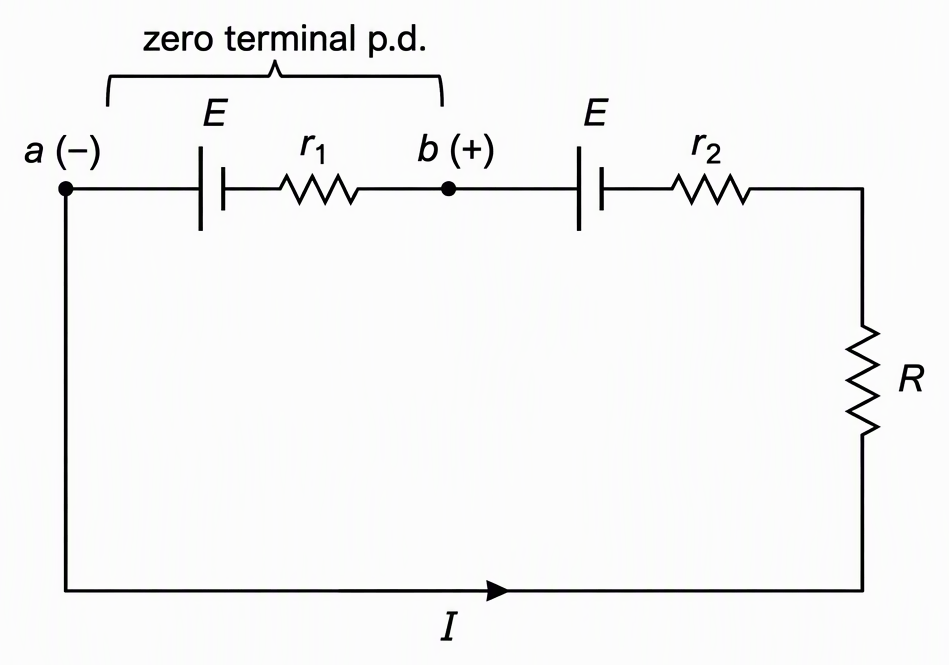
The supplied options are:
- A)
- B)
- C)
- D)
The decisive detail is the voltmeter’s endpoints. It measures neither the ideal emf source alone nor the external resistor.
How do you calculate the current around the whole loop?
Add both emfs and all three resistances before applying the loop equation. The cells aid each other, so their emfs add rather than cancel. Both internal resistances carry the same current as the external resistor because there is only one conducting path.
Let the emf of each cell be:
The total emf and total loop resistance are:
Applying the loop equation gives:
Therefore:
This follows the official solution’s first step. It describes the whole loop, not the voltage across either cell separately.
Keep the first cell’s internal resistance in this denominator. A zero terminal reading does not remove a physical resistance from the circuit.
How does zero terminal voltage give option A?
Set the first cell’s terminal voltage to zero, then equate the resulting current with the whole-loop current. For a cell supplying current, terminal voltage is its emf minus the voltage drop across its own internal resistance.
For the first cell:
Using the stated condition:
Equate the two expressions for the same circuit current:
Cancel the nonzero emf:
Cross-multiply:
Subtract both internal resistances from both sides:
Hence, option A is correct. Zero terminal voltage means that the internal voltage drop equals the emf, not that the emf or current is zero.
A nonnegative external resistance requires:
A strictly positive external resistance requires:
If the first internal resistance is smaller, the stated condition is impossible with an ordinary passive external resistor under these assumptions. A negative value here signals incompatible circuit conditions, not a valid passive resistance.
For an illustrative numerical check, not values from the PYQ, take:
Why does using the wrong voltage endpoints produce option C?
Option C follows if you wrongly assign the first cell’s zero terminal voltage to the external resistor. The cell’s terminal voltage and the resistor’s voltage refer to different pairs of points in this two-cell loop.
The incorrect chain is:
Since current is nonzero, this wrongly leads to:
Compare the correct expressions:
The second cell can maintain a nonzero voltage across the external resistor even when the first cell’s terminal voltage is zero. The zero reading applies only to the marked terminals of the first complete cell.
Option C agrees with the derived answer only in the special case:
It is not the general answer. Mark the two endpoints of the stated potential difference before choosing a voltage equation. Add this endpoint check to your error log using the NEET Physics Revision Strategy: A 30-Day Repair Plan.
How do you solve three related questions using the same circuit?
Use one equation for the entire loop and one for the specified cell. The following are three original practice questions, not additional verified PYQs. All refer to the existing circuit figure, with only the stated conditions changed.
What is the second cell’s terminal voltage under the original condition?
Its terminal voltage equals the voltage across the external resistor. Substitute the current obtained from the first cell’s zero-voltage condition:
Verify this using the derived external resistance:
What resistance and current work when both internal resistances are equal?
The external resistance must be zero, but the current remains finite. Let the common internal resistance be positive:
Then:
The ideal external short does not make the total loop resistance zero. Both internal resistances remain and limit the current.
What changes if the two cells have unequal emfs?
The external resistance now depends on the ratio of the emfs as well as the internal resistances. Keep the cells series aiding and the first cell’s terminal voltage zero, with nonzero first-cell emf:
Equating and cross-multiplying gives:
Cancel the matching terms:
Therefore:
Setting the emfs equal recovers the original result:
Cover the solutions and redo these variations. For each, mark the voltage endpoints first, then write the whole-loop and single-cell equations separately.
Next step: the past-paper archive on NEET JEEnius AI and search past NEET papers by year, subject or chapter, each with a worked solution (100 free searches a month).
Frequently asked questions
What is the correct answer to the Current Electricity NEET 2006 cell question?
Option A is correct: R = r₁ - r₂. The first cell’s zero terminal voltage gives I = E/r₁, while the whole-loop equation gives I = 2E/(R + r₁ + r₂). Equating these expressions gives the required external resistance.
Does zero terminal voltage mean the current is zero?
No. For the first cell supplying current, V₁ = E - Ir₁, so zero terminal voltage means Ir₁ = E. The current is I = E/r₁, not zero, and the internal resistance remains part of the circuit.
Why is R = 0 not the general answer to this cell question?
The voltmeter measures the voltage across the first complete cell, not across the external resistor. Setting IR = 0 therefore uses the wrong voltage endpoints. The correct result is R = r₁ - r₂, which becomes zero only when the internal resistances are equal.
What happens if the two series-aiding cells have unequal emfs?
If the first cell still has zero terminal voltage, I = E₁/r₁. Combining this with I = (E₁ + E₂)/(R + r₁ + r₂) gives R = r₁E₂/E₁ - r₂. Equal emfs recover R = r₁ - r₂.