
What is the correct answer to the rotational motion NEET 2006 liquid-tube question?
Option A is correct: the rotational motion NEET 2006 question requires adding the forces on liquid slices at different radii, not placing the entire mass at the outer end. The factor of one-half comes from integrating those contributions.
An incompressible liquid completely fills a straight tube. Both ends are sealed, and the tube rotates in a horizontal plane at constant angular speed about one end. Find the force the liquid exerts on the sealed end away from the rotation axis.
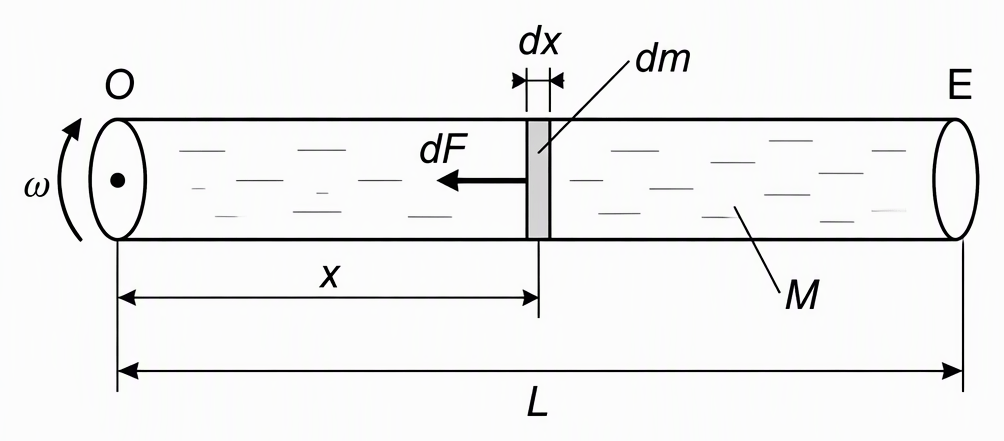
Use these symbols for the setup:
The supplied choices are:
- A
- B
- C
- D
This is a 2006 Physics PYQ, tagged hard on this question bank’s own scale. Its suggested solving time is 90 seconds, a practice target, not an official exam time limit.
How do you write the force on a small liquid element?
Start with one thin slice and use that slice’s own radius. The official solution treats the liquid column as a uniform rod-like mass distribution. Every element has the same angular speed, but its distance from the axis varies from zero to the full tube length.
Let the Greek letter lambda denote linear mass density, meaning mass per unit length. Since the distribution is uniform:
Define the slice’s distance from the axis, small width and small mass:
Uniform density gives:
The slice’s inward centripetal acceleration is:
Denote its required centripetal force by:
Multiplying slice mass by acceleration, then substituting the slice mass, gives:
The radius changes along the tube. Keep it variable until the force contributions have been added.
How does integration give option A and the factor of one-half?
The factor of one-half comes from integrating the linearly increasing radius. Density and angular speed stay constant, but each slice has its own radius. Denote the total force by capital F; the integration limits cover the complete liquid column, from the pivot to the outer sealed end:
Take the constants outside:
Evaluate the integral, including both limits:
Now substitute the original linear mass density:
Using the official solution’s result, this is the force exerted by the liquid on the outer sealed end. Correct option: A.
The completed calculation can be interpreted using the mass-weighted mean radius:
This is an interpretation of the integration, not a replacement for the slice method. The liquid occupies every radius along the tube, rather than just the outer radius.
Check the options by units:
- A and C: both have force units.
- B: fails the force-unit check.
- D: also fails.
Dimensional analysis removes B and D. It cannot distinguish A from C, because a numerical factor does not change units.
Why does using the outer radius give the wrong option C?
Option C assumes that the entire liquid mass sits at the outer end. The incorrect substitution is:
This describes the centripetal-force requirement of a point mass at the tube’s outer radius. It does not describe liquid spread uniformly along the tube.
Only the outermost elements lie near the full tube length. Elements closer to the pivot need less centripetal force per unit mass, even though their angular speed is identical. Assigning the outer radius to every slice overcounts those inner contributions.
This is a mass-distribution error, not an integration error. Compare the two results:
Option C is twice the official answer. Before inserting a radius into the point-mass formula, check whether all the mass is actually at that radius. If not, assign radii element by element.
What happens to the force if the angular speed doubles?
The force becomes four times its original value. This is original practice based on the PYQ, not another verified past-paper question: keep the same liquid mass and tube length, but double the angular speed. Find the new force.
Substitute the new speed explicitly:
Compare with the original result:
For a worked numerical example, choose:
Then:
The force scales with the square of angular speed, not directly with angular speed. Doubling the speed therefore multiplies the force by four, not two.
How much centripetal force does the inner half of the liquid require?
The inner half requires one-quarter of the whole column’s total centripetal force. This second original Rotational Motion practice question keeps the original filled tube and asks for the total centripetal force required by the liquid in this interval:
This concerns the selected liquid portion’s centripetal-force requirement, not the force on a newly inserted cap. The original density stays unchanged:
Use the same elemental force, but change the upper integration limit:
Compare it with the whole-column result:
Half the mass requires only one-quarter of the total because that half also lies closer to the axis. Assign each slice its own radius before adding its force contribution.
Next step: the past-paper archive on NEET JEEnius AI and search past NEET papers by year, subject or chapter, each with a worked solution (100 free searches a month).
If that step was the hard part, work through NEET Chemistry Revision Strategy: A 30-Day Repair Plan.
Frequently asked questions
What is the answer to the rotational motion NEET 2006 liquid-tube question?
The official solution gives option A: F = MLω²/2, where M is the liquid mass, L is the tube length and ω is the angular speed. It obtains this result by integrating the centripetal-force contributions of liquid slices from the pivot to the outer end.
Why is there a factor of one-half in the rotating liquid-tube answer?
Each slice has the same angular speed but a different radius, so its centripetal-force contribution is dF = (M/L)ω²x dx. Integrating from x = 0 to x = L gives MLω²/2. Using L for every slice instead gives option C, which is twice the official answer.
Can dimensional analysis solve the NEET 2006 liquid-tube question?
Dimensional analysis eliminates options B and D because neither has force units. Options A and C both have force units, so units alone cannot distinguish them. Accounting for the liquid's distributed mass gives the factor of one-half.
What happens to the liquid-tube force if angular speed doubles?
With liquid mass and tube length unchanged, doubling the angular speed makes the force four times as large because F is proportional to ω². In the article's practice example, increasing the speed from 3 rad/s to 6 rad/s raises the calculated force from 9 N to 36 N.