
How do you set up the electrostatics NEET 2009 shell question?
The electrostatics NEET 2009 shell question asks for total potentials, not just each shell’s own surface potential. The supplied 2009 question-bank entry tags it hard, with an expected solve time of 120 seconds. These are the bank’s labels, not official exam classifications.
Three spherical shells share one centre. From inside to outside, they are A, B and C, with radii a, b and c in increasing order. Their respective surface charge densities are positive sigma, negative sigma and positive sigma. Compare their total potentials when the outer radius equals the sum of the other two radii.
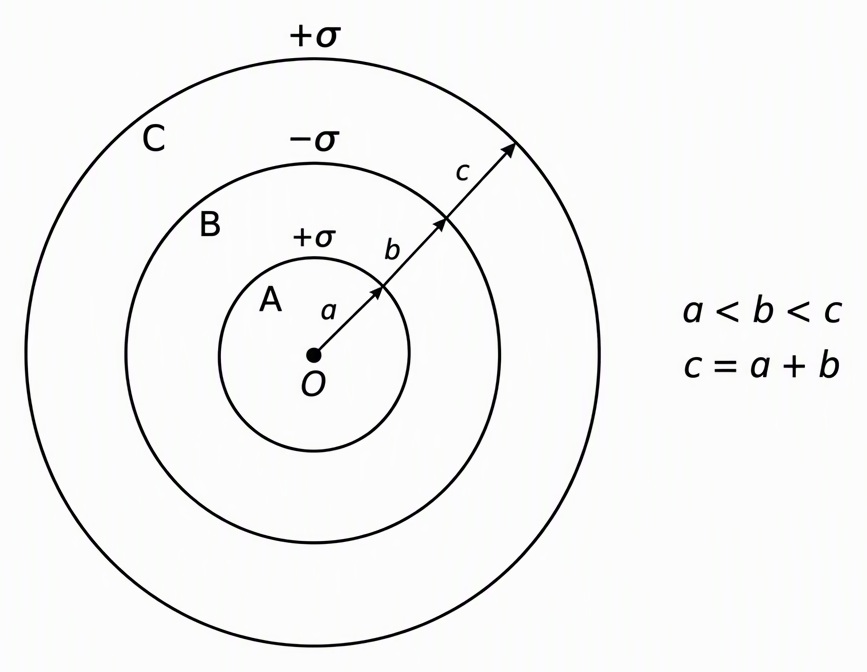
The supplied choices are:
Which radius belongs in each shell’s potential contribution?
Use the source shell’s radius inside that shell, and the observation distance outside it. Follow the official solution by adding contributions shell by shell. Take potential as zero at infinity and define the Coulomb constant:
For a uniformly charged shell, define:
Its potential is:
Both expressions agree at the surface. Charge equals surface charge density multiplied by spherical area:
Therefore:
Equal charge-density magnitudes do not mean equal charge magnitudes. Define the official solution’s common constant:
The contribution list keeps source shells ordered A, B, C in every row:
- At A: all three contributions use their source-shell radii.
- At B: the observation point is outside A.
- At C: the observation point is outside A and B.
Add the scalar potentials in each row to obtain the total potential there. Do not keep only the contribution from the shell carrying that point.
Why does the middle shell have a different potential from the inner shell?
The middle shell receives a smaller positive contribution from A than the inner shell does. The contributions from B and C are unchanged between these two observation surfaces. Following the official calculation, start at A:
Apply the given radius condition:
Next, add the contributions at B:
Substitution gives:
The radii establish the inequality:
Thus, for these nonzero surface charges:
Check the comparison by subtracting:
Why is option A correct for the outer shell?
The outer-shell calculation gives the same potential as the inner shell because the given outer radius cancels a factor in the difference of squares. This equality follows from the radius condition, not from concentric geometry alone.
Start with the third contribution row:
Factor the numerator:
Then use the given outer radius:
Complete the calculation:
Option A is correct:
Equal potentials at A and C do not make the potential constant throughout the region between them. The different value already calculated at B disproves that inference.
How does using the surface-potential formula everywhere produce option D?
Option D follows from incorrectly giving every shell its surface-potential contribution at every observation radius. That error assigns the same three terms everywhere:
The resulting incorrect calculation is:
A shell contributes its surface potential only at its surface or inside it, not outside it. The required corrections are:
- At B, the point is outside A:
- At C, the point is outside A and B:
Each spherical surface is equipotential because of spherical symmetry. That does not mean separate spherical surfaces have equal potentials.
For every contribution, compare the observation radius with that source shell’s radius before choosing the denominator. Use this check rather than memorising the final equality.
Can you apply the method to two related electrostatics questions?
Use the same inside-or-outside check: select each source shell’s denominator, then add its contribution. Both questions below are original same-chapter practice, not additional NEET 2009 questions or verified past-paper items.
What are a charged shell’s potentials at its centre, surface and twice its radius?
The centre and surface potentials are equal; at twice the radius, the potential is half the surface value. Question 1: Verify this for a uniformly charged spherical shell with the following radius and nonzero charge, taking zero potential at infinity:
The worked answer is:
For a numerical check, use these illustrative values:
Then:
Does zero net charge make the centre’s potential zero?
No. Equal and opposite charges cancel the exterior potential in this concentric arrangement, but their centre contributions have different denominators.
Question 2: Two concentric uniformly charged shells have these radii and charges:
Find the total potential at their common centre and outside the outer shell, taking zero potential at infinity. At the centre:
Outside both shells:
Zero net charge therefore does not force the interior potential to vanish. Retry the electrostatics NEET 2009 question against the bank’s 120-second target only after you can justify every denominator in the contribution list.
Next step: the past-paper archive on NEET JEEnius AI and search past NEET papers by year, subject or chapter, each with a worked solution (100 free searches a month).
If that step was the hard part, work through NEET Biology Revision Strategy: A 30-Day NCERT Plan.
Frequently asked questions
What is the correct option for the electrostatics NEET 2009 shell question?
Option A is correct: V_C = V_A ≠ V_B. For concentric shells A, B and C with radii a < b < c and surface charge densities +σ, −σ and +σ, the condition c = a + b makes the total potentials at A and C equal. The total potential at B is lower.
Which radius should I use when calculating a spherical shell's potential?
For a uniformly charged shell of radius R and charge Q, use V = kQ/R at its surface or anywhere inside it. Outside the shell, use V = kQ/r, where r is the observation distance from its centre. For several concentric shells, apply this rule separately to each source shell and add the contributions.
Why is option D wrong in the three-shell potential question?
Option D incorrectly treats every shell's contribution as its surface potential at every observation point. At B, the point is outside A; at C, it is outside both A and B, so those contributions require the observation distance in the denominator. Each spherical surface is equipotential, but separate surfaces need not have equal potentials.
Does zero net charge mean zero potential inside concentric shells?
No. For concentric shells carrying +Q at radius R and −Q at radius 2R, the centre potential is kQ/R − kQ/(2R) = kQ/(2R), taking zero potential at infinity. Outside both shells, the contributions cancel because they have the same observation-distance denominator.