
What is the correct answer to the electromagnetic induction NEET 2009 four-loop question?
Option B, the circular and elliptical loops, is correct: their boundary-cut lengths change during exit. In the electromagnetic induction NEET 2009 question, constant speed does not by itself mean constant emf. The deciding quantity is the length cut through the loop’s enclosed area by the field edge.
Four wire loops, rectangular, square, circular and elliptical, lie in the xy-plane and move at constant speed towards positive x. They leave a uniform magnetic field directed into the plane. The official solution assumes a straight field boundary parallel to the y-axis, with the rectangle and square having sides parallel to it.
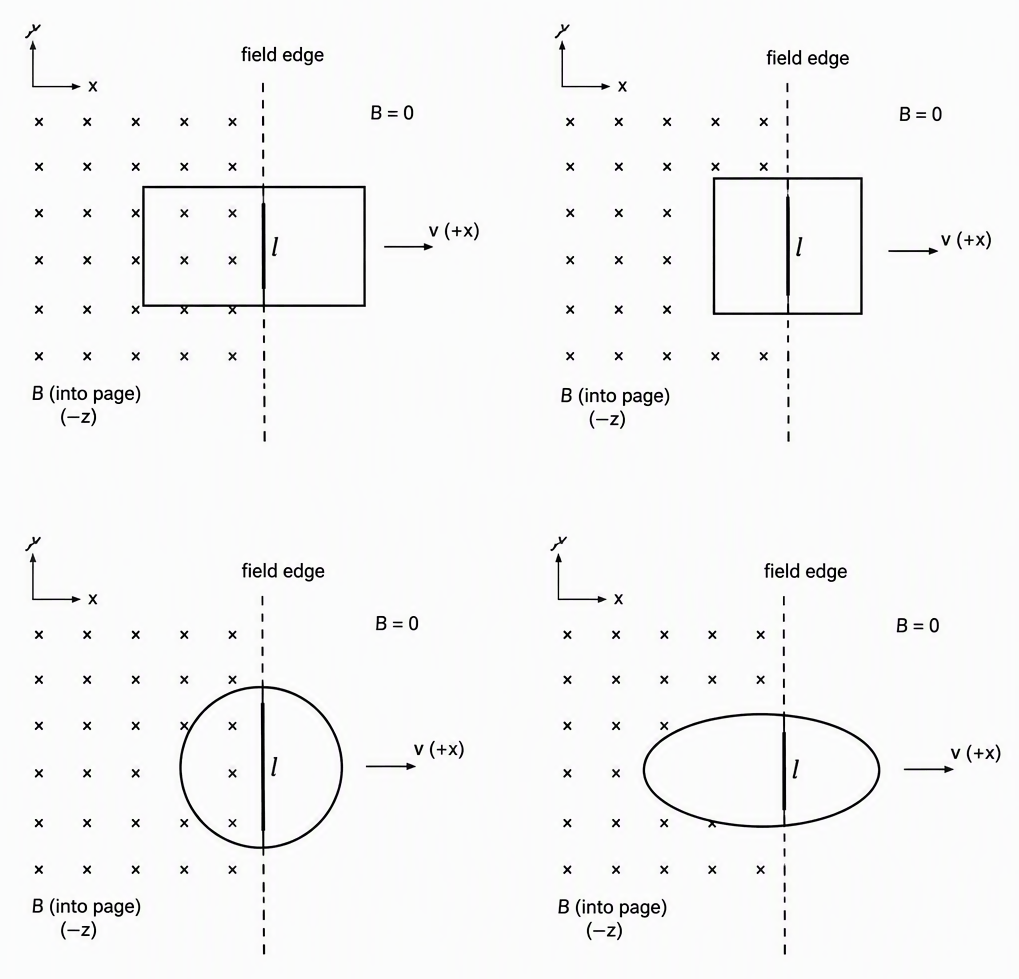
The question asks which shapes have an emf that varies during exit:
This 2009 question is tagged hard on this question bank’s scale, with a suggested solving time of 90 seconds. Neither label measures actual student performance.
How does Faraday’s law give the area-sweep rule?
The emf magnitude equals the field magnitude multiplied by the rate at which enclosed area leaves the field. The motional-emf formula follows from this flux change, using the instantaneous boundary-cut length.
Define the field magnitude and the enclosed area still within the field:
The second quantity is not the loop’s total enclosed area. Choose the surface normal along the magnetic field, into the page:
Faraday’s law gives:
Since the field is uniform and constant:
The minus sign determines polarity relative to the chosen orientation. This question asks whether the magnitude stays constant.
During an infinitesimal time interval, the loop travels:
The boundary-cut length is:
It is neither the wire perimeter nor a fixed characteristic size. The infinitesimal strip leaving the field has area:
Therefore:
The area inside decreases at the same rate:
Combining these steps:
Fixed field strength and fixed speed do not guarantee fixed emf. The boundary-cut length must also remain fixed.
Why do only the circle and ellipse have varying emf?
Only the curved loops have changing boundary-cut lengths in the stated arrangement. For the axis-aligned rectangle and square, the boundary cuts the same height throughout partial exit. The official answer is therefore B, the circular and elliptical loops.
- Rectangle: The cut length remains equal to the side parallel to the boundary. The emf magnitude stays constant during partial exit.
- Square: In the shown orientation, the cut length remains equal to its side. The emf magnitude stays constant during partial exit.
- Circle: The cut is a chord. It grows towards a diameter, then shrinks, so the emf magnitude varies.
- Ellipse: The boundary-cut chord also changes as the loop passes the edge. Its emf magnitude varies.
“Constant” applies only to the interval of partial exit. Fully inside the uniform field, each loop has constant flux. Fully outside, its flux is zero and remains zero. In both cases, the net induced emf is zero.
Keep the orientation qualification attached to the answer. A tilted rectangle need not have a constant boundary-cut length, so “rectangles always produce constant emf” is not a valid rule.
How does using the circle’s diameter incorrectly produce option C?
Replacing the changing chord with the fixed diameter falsely makes the circle’s emf constant. That error leaves only the ellipse as variable and produces option C.
The faulty substitution applies the diameter throughout exit:
The radius is fixed, but the formula needs the instantaneous boundary-cut length, not the circle’s maximum width. The chord equals the diameter only when the boundary passes through the centre. At every other partially overlapping position, it is shorter.
Before substituting, compare the boundary segment at three positions:
- Near first contact: The boundary segment is short.
- Through the centre: It equals the diameter.
- Near final exit: It is short again.
The segment cannot be constant if these lengths differ. Track the segment at the field edge, not a familiar dimension of the whole loop.
Can you solve three related electromagnetic induction checks?
Doubling speed doubles the emf at the same position; motion wholly inside the uniform field gives zero net emf; an exiting loop carries clockwise induced current. These are original related practice questions, not verified past-paper questions. Use the established field arrangement for all three.
What happens if the loop moves twice as fast at the same partial-exit position?
The emf magnitude doubles. Comparing the same position keeps the boundary-cut length unchanged, so only the speed changes:
Comparing different positions would not isolate speed for a circle or ellipse. Their cut lengths could also differ.
What is the net emf if the moving loop remains entirely inside the uniform field?
The net induced emf is zero. Both field strength and enclosed area within the field remain constant:
Hence:
Motion alone is insufficient. Faraday’s law requires changing magnetic flux through the loop.
Which way does the induced current flow during exit, viewed from positive z?
The current is clockwise. Into-page flux decreases as the conducting loop exits, so Lenz’s law requires an induced field into the page to oppose that decrease. The right-hand rule gives clockwise current when viewed from positive z.
For your next question, apply this distinction: Faraday’s law checks flux change, the boundary-cut length sets the magnitude during exit, and Lenz’s law sets the direction.
Next step: the past-paper archive on NEET JEEnius AI and search past NEET papers by year, subject or chapter, each with a worked solution (100 free searches a month).
If that step was the hard part, work through NEET Physics Preparation: A 90-Minute Daily Plan.
Frequently asked questions
What is the correct answer to the NEET 2009 four-loop question?
Option B, the circular and elliptical loops, is correct because their boundary-cut lengths change during exit. The rectangle and square have constant emf during partial exit only in the stated orientation, with their sides parallel to the straight field boundary.
Why does emf vary if the loop moves at constant speed?
During exit from a uniform magnetic field, the emf magnitude is Bvl, where l is the instantaneous boundary-cut length through the loop's enclosed area. Even when B and v are constant, emf varies if l changes. This happens for the circular and elliptical loops.
Can I use the circle's diameter in the formula for induced emf?
The diameter is the correct boundary-cut length only when the field edge passes through the circle's centre. At other partial-exit positions, the boundary cuts a shorter chord. Using the diameter throughout exit incorrectly makes the circle's emf constant and leads to option C.
What is the direction of induced current when the loop leaves the field?
For the article's into-page magnetic field, the induced current is clockwise when viewed from positive z. The into-page flux decreases during exit, so Lenz's law requires an induced field into the page to oppose that decrease.