What is the correct answer to the s-block elements NEET 2012 adsorption question?
None of the supplied options matches the correct order in the s-block elements NEET 2012 adsorption question. Arrange hydrated lithium, sodium, potassium and rubidium ions from least easily to most easily adsorbed on an ion-exchange resin.
The correct increasing order is:
The supplied options are:
- A)
- B)
- C)
- D)
The question bank classifies this as hard, with a target solving time of 60 seconds. That is a bank-listed target, not a measured student average.
For comparison, a paper allowing 180 minutes for 180 questions has this mean time budget:
The bank target equals that mean budget. It does not mean every question deserves exactly one minute.
How do hydration and hydrated size determine the adsorption order?
Stronger hydration gives a larger effective hydrated ion, which is less easily adsorbed under the supplied rule. Compare the bare ions first, then account for their surrounding water. Hydration is the necessary link between ionic size and adsorption in this solution.
Step 1: Compare the bare ions. All four ions carry the same positive charge:
Bare ionic size increases down the group:
Step 2: Compare hydration. Lithium has the smallest bare ion, so its charge is most concentrated and attracts water most strongly. Hydration decreases down this group.
Step 3: Separate bare size from hydrated size. The bare ion excludes its surrounding hydration shell. In the supplied solution’s model, stronger hydration gives a larger effective size for the ion together with that shell.
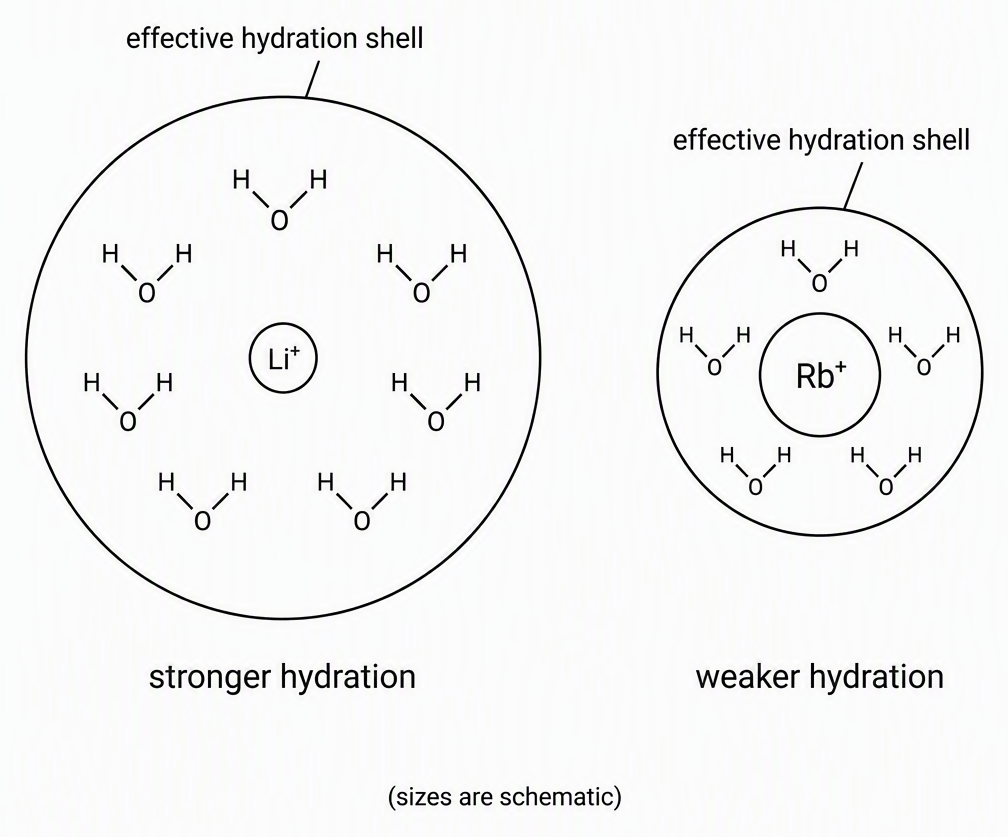
The hydrated-size order is:
Step 4: Apply the adsorption rule. A larger effective hydrated ion is less easily adsorbed on the resin. This is the supplied rule for this question, not an unconditional claim about every resin and experimental condition.
Step 5: Reverse the property ranking. Lithium is largest when hydrated, so it belongs at the least easily adsorbed end:
Keep these comparisons separate:
- Bare ionic size: increases from lithium to rubidium.
- Effective hydrated size: decreases from lithium to rubidium.
- Adsorption ease: increases from lithium to rubidium.
Bare size and adsorption have matching sequences here. That does not justify skipping hydration, which explains the adsorption order.
Why is none of the four supplied options correct?
Every option breaks at least one relationship required by the worked solution. Reject the incorrect pair rather than choosing the nearest-looking sequence.
The supplied question/options appear to contain a misprint. No letter should be assigned as correct.
“None of these supplied options is correct” is the finding, not a selectable “none of the above” option. No such option is present, and the supplied material establishes no official correction, historical marking decision or bonus marks.
What reasoning mistake produces option B?
Start from the valid hydrated-size ranking:
Option B results from treating greater hydrated size or stronger hydration as greater adsorption ease. That faulty step puts the most strongly hydrated ion at the most easily adsorbed end.
Written in increasing order, the mistaken adsorption ranking becomes:
This is exactly option B. The error is using a direct relationship where the supplied solution requires an inverse relationship.
Before checking letters, test lithium: it is most hydrated, so it must be least easily adsorbed in this question. If lithium ends up at the most easily adsorbed end, correct the final relationship, not the hydration trend.
How do you solve three related s-block practice questions?
Identify the property first: bare size, effective hydrated size or adsorption ease. These three questions are original chapter practice questions, not verified past-paper questions. Use the worked explanations to check each ordering step.
How do you arrange lithium, sodium, potassium and rubidium ions by increasing bare ionic size?
Bare ionic size increases down the group, giving:
Moving down the group adds occupied electron shells, making the bare ions larger. Water surrounding the ions is excluded from this comparison, so lithium’s strong hydration does not change this order.
How do you arrange the same four ions by increasing effective hydrated size?
Under the original solution’s model, rubidium has the smallest effective hydrated size and lithium the largest:
Lithium attracts water most strongly, while rubidium is least hydrated among these four. Hydration therefore reverses the bare-size ranking in this model.
This is option B’s sequence, but it answers a different question. It gives increasing hydrated size, not increasing adsorption ease.
Which hydrated ion is more easily adsorbed, sodium or potassium?
Potassium is more easily adsorbed under the original question’s rule. Sodium is more strongly hydrated, so it has the larger effective hydrated size and is less easily adsorbed.
The pairwise adsorption order is:
This comparison exposes the error in option A. You do not need the full four-ion sequence to reject that swapped pair.
Before selecting an option, label the property above your order. Then apply this recall chain:
Stronger hydration → larger effective hydrated size → lower adsorption ease.
Next step: photograph a doubt on NEET JEEnius AI and photograph any question you are stuck on and get a step-by-step solution across Physics, Chemistry and Biology (20 free a month).
For a worked example of the same idea, see Electromagnetic Induction NEET 2009: Four-Loop Answer.
Frequently asked questions
What is the correct answer to the s-block elements NEET 2012 adsorption question?
The correct increasing order of adsorption ease is Li+ < Na+ < K+ < Rb+ under the supplied solution’s rule. None of the four supplied options matches this order. The options appear to contain a misprint, so no answer letter should be assigned as correct.
Why is lithium the least easily adsorbed hydrated ion?
Lithium has the smallest bare ion and attracts water most strongly among these four ions. In the supplied model, this gives it the largest effective hydrated size. Since larger hydrated ions are less easily adsorbed under the question’s rule, lithium is least easily adsorbed.
Why is option B wrong in the NEET 2012 adsorption question?
Option B gives Rb+ < K+ < Na+ < Li+, which is the increasing effective hydrated-size order in the supplied model. It incorrectly treats stronger hydration or larger hydrated size as greater adsorption ease. The question’s rule requires the inverse relationship.
Is sodium or potassium more easily adsorbed on an ion-exchange resin?
Potassium is more easily adsorbed under the supplied question’s rule. Sodium is more strongly hydrated and has a larger effective hydrated size, making it less easily adsorbed. The pairwise adsorption order is Na+ < K+.