
What is the correct answer to the VSEPR theory and bond angles NEET 2010 question?
Option B is correct for the VSEPR theory and bond angles NEET 2010 question. Equal lone-pair counts do not guarantee equal bond angles when the central and surrounding atoms differ.
The task is to arrange chlorine monoxide, Cl₂O, the chlorite ion, ClO₂⁻, and chlorine dioxide, ClO₂, from smallest to largest bond angle. This is the archive’s 2010 Chemistry question from Chemical Bonding and Molecular Structure. Hard is the question bank’s difficulty label, not an official exam classification; 90 seconds is its suggested solving time, not a measured student average.
All three species are bent. Cl₂O has a Cl–O–Cl angle centred on oxygen, while ClO₂⁻ and ClO₂ have O–Cl–O angles centred on chlorine.
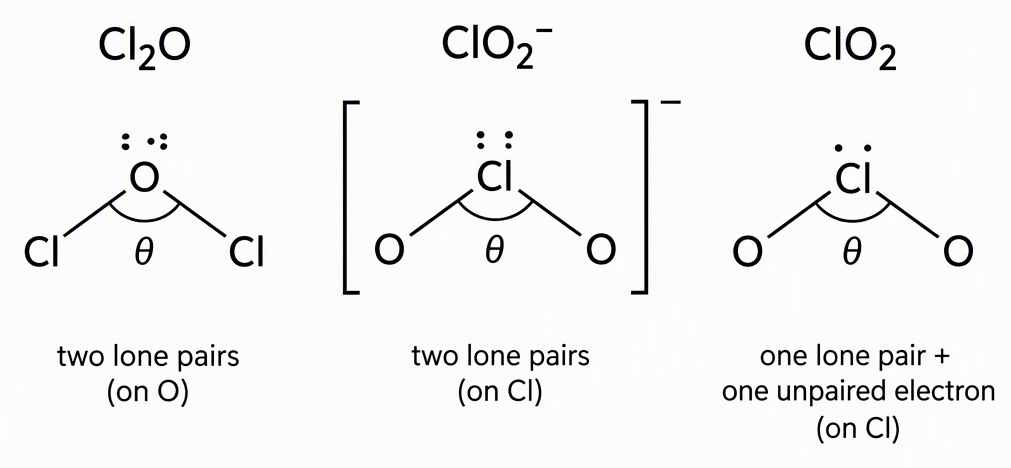
The supplied choices are:
How do you identify the central atom and count the electrons?
Start with oxygen at the centre of Cl₂O and chlorine at the centre of the other two species. Oxygen contributes 6 valence electrons and chlorine contributes 7; the negative charge adds one electron to the chlorite ion. These counts identify the odd-electron species.
- Cl₂O: central oxygen has two bonding directions and two lone pairs. Its valence-electron count is:
- ClO₂⁻: central chlorine has two bonding directions and two lone pairs. Its valence-electron count is:
- ClO₂: in the schematic VSEPR account used here, central chlorine has two bonding directions, one lone pair and one unpaired electron. Its odd valence-electron count is:
A bonding direction is one VSEPR domain, not a separate direction for every electron pair in a multiple bond. Resonance bond notation does not create extra geometrical directions.
A lone pair contains two electrons; an unpaired electron occupies a singly occupied region. Do not treat them as equal sources of repulsion.
Why is the angle in Cl₂O larger than in ClO₂⁻ despite equal lone-pair counts?
The supplied solution attributes the slightly larger angle in Cl₂O to its larger terminal chlorine atoms. Both species have two central lone pairs, so lone-pair counting alone cannot settle this close comparison. Identify the centre first, then compare its surroundings.
The qualitative repulsion hierarchy is:
The supplied explanation treats the two central lone pairs in ClO₂⁻ as compressing its O–Cl–O angle. Their repulsions are stronger than bond-pair repulsions, so counting only the two bonds misses the main source of compression.
ClO₂ has fewer full lone-pair repulsions around chlorine than ClO₂⁻. Its unpaired electron is not another two-electron lone pair, so the supplied comparison places its O–Cl–O angle above that of the chlorite ion.
For Cl₂O versus ClO₂⁻, the central and terminal atoms change. Cl₂O has central oxygen and terminal chlorine; ClO₂⁻ has central chlorine and terminal oxygen. This is why matching central lone-pair counts do not establish equal angles.
Keep the official terminal-atom size explanation specific to these species. “Larger terminal atoms always give larger angles” is not a universal VSEPR law. This qualitative argument explains the supplied order; it does not calculate exact angles.
How do the supplied angles confirm option B?
The supplied approximate reference angles increase from chlorite to chlorine monoxide to chlorine dioxide, confirming option B. These values come from the worked solution, not from the valence-electron arithmetic.
- ClO₂⁻: central chlorine; two central lone pairs; about:
- Cl₂O: central oxygen; two central lone pairs; about:
- ClO₂: central chlorine; one lone pair plus one unpaired electron; about:
The numerical check is:
The final increasing order is option B:
How can counting an unpaired electron as a lone pair lead to option D?
Treating the unpaired electron in ClO₂ as another full lone pair exaggerates the compression assigned to its bond angle. That mistake can place ClO₂ below Cl₂O in a student’s comparison, reversing the final pair and producing option D:
This is a possible faulty reasoning pathway, not an order mathematically determined by the incorrect count. The repair starts with the total: ClO₂ has 19 valence electrons, so a singly occupied region must remain distinct from a two-electron lone pair.
Use this sequence when reworking the solution:
- Identify the central atom.
- Distinguish paired from unpaired electrons.
- Compare repulsions and resolve any lone-pair-count tie.
- Check the complete increasing order, not just one pair.
Which three Chemical Bonding questions test the same method?
Use these questions to check lone-pair comparisons, equal-electron-count shortcuts and odd-electron species. They are original related practice questions, not additional verified PYQs.
- Arrange CH₄, NH₃ and H₂O in increasing bond angle.
The answer is:
The central atoms have two, one and zero lone pairs, respectively. For this set, increasing lone-pair repulsion compresses the bond angle, placing water first and methane last.
- Cl₂O and ClO₂⁻ both contain 20 valence electrons. Must their bond angles be identical?
No. Their total electron counts and central lone-pair counts match, but their central and terminal atoms differ. Cl₂O has central oxygen with terminal chlorine atoms; ClO₂⁻ has central chlorine with terminal oxygen atoms. Matching counts are a starting point, not proof of equal angles.
- Which has the larger O–Cl–O angle, ClO₂ or ClO₂⁻?
ClO₂. In the supplied comparison, it has one central lone pair plus one unpaired electron, rather than the two central lone pairs of ClO₂⁻. Fewer full lone-pair repulsions support the larger angle; the single electron must not be counted as a full lone pair.
Cover the answers and solve all three again. If you miss one, mark the failed check: central atom, electron pairing or comparison. Use that error to choose your next revision task in the NEET Chemistry Revision Strategy: A 30-Day Repair Plan.
Frequently asked questions
What is the correct bond angle order for Cl₂O, ClO₂⁻ and ClO₂?
The increasing bond angle order is ClO₂⁻ < Cl₂O < ClO₂, which corresponds to option B. The supplied worked solution gives approximate angles of 110°, 111° and 117°, respectively.
Why does Cl₂O have a larger bond angle than ClO₂⁻?
Both species have two central lone pairs, but their central and terminal atoms differ. The supplied solution attributes the slightly larger angle in Cl₂O to its larger terminal chlorine atoms. This explanation is specific to the comparison, not a universal rule that larger terminal atoms always produce larger angles.
How many valence electrons does ClO₂ have?
ClO₂ has 19 valence electrons: 7 from chlorine and 6 from each oxygen atom. In the schematic VSEPR account used here, central chlorine has two bonding directions, one lone pair and one unpaired electron. The unpaired electron must not be counted as a second full lone pair.
Do equal lone-pair counts mean equal bond angles?
No, equal central lone-pair counts do not guarantee equal bond angles when the central and surrounding atoms differ. Cl₂O and ClO₂⁻ each have two central lone pairs and 20 total valence electrons, yet their supplied approximate angles are 111° and 110°. Identify the central atom and its surroundings before comparing angles.