What is the answer to the Bt toxin mechanism NEET 2026 question?
Correct answer: A, alkaline pH. The Bt toxin mechanism NEET 2026 question tests NCERT’s stated activation condition, not every biochemical event involved in producing an active toxin.
The supplied question is from NEET 2026, Code-50, Biology, Biotechnology and Its Applications. Its medium difficulty is the question bank’s classification, not an official NEET rating.
The question asks: Which condition inside an insect’s gut makes an ingested, inactive Bt toxin functional?
Choose A because NCERT attributes activation to the alkaline gut environment, which solubilises the toxin crystals. Proteolytic processing is part of the detailed biochemistry, but it is not the condition asked for here.
How does inactive Bt protoxin cause midgut-cell lysis?
The insect first ingests inactive protoxin. Alkaline gut conditions solubilise the crystals and enable activation; the activated toxin then binds to midgut epithelial cells and forms pores. Cell swelling and lysis follow, eventually killing the insect.
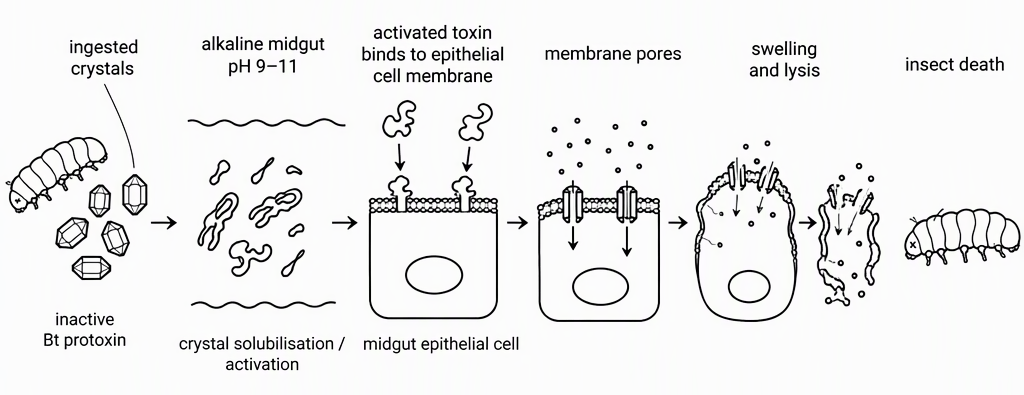
- Starting material: Bt toxin protein is initially present in its inactive protoxin form.
- Ingestion: The insect eats material containing the toxin. Ingestion comes before gut activation.
- Gut condition: The supplied solution gives an alkaline insect midgut range of pH 9–11.
- Activation: Alkaline pH solubilises the toxin crystals. This is the condition NCERT names for conversion to the active form.
- Target binding: Activated toxin binds to the surface of midgut epithelial cells and creates membrane pores.
- Cell damage: Pores cause cell swelling and lysis, eventually killing the insect.
The supplied range spans two pH units. The hydrogen-ion concentration at pH 9 is therefore 100 times that at pH 11:
Both conditions are alkaline. This calculation checks the pH scale, not toxin activity.
Evaluate the options against the activation condition:
- A matches NCERT: alkaline pH provides the stated condition.
- B gives the wrong condition: acidic pH does not match the alkaline environment described.
- C describes biochemical processing: proteolytic cleavage has a role, but it is not the keyed NCERT explanation.
- D is unrelated: nucleases act on nucleic acids rather than activating this protein toxin.
Ingestion → alkaline-gut crystal solubilisation/activation → epithelial binding → pores → swelling and lysis → insect death.
Why is choosing proteases a method error in this MCQ?
Proteases have a biological role, but C does not match the explanation this question tests. Detailed Bt toxin biochemistry includes proteolytic cleavage. The error is choosing that detail without checking which cause the question asks you to identify.
A student might remember that a protoxin undergoes proteolytic processing and immediately choose C. That reasoning skips the distinction between the environmental condition highlighted by NCERT and the enzymatic processing described in more detailed accounts.
For this exact single-correct MCQ, the supplied official answer remains A: NCERT attributes conversion to alkaline pH, which solubilises the crystals. This does not mean proteases never participate in activation. Both facts belong in your understanding, but only A matches the stated condition tested here.
Use this repeatable check:
- Identify the event asked about: conversion of ingested inactive toxin to its active form.
- Recall the relevant NCERT explanation: alkaline gut conditions solubilise the crystals.
- Match the stated causal condition: choose alkaline pH before importing further biochemical detail.
The mistake is failing to match the answer to the source, not necessarily lacking knowledge. Find the cause of a NEET mistake and fix the check explains how to turn that error into a specific checking habit.
Before gut activation, in which form is Bt toxin present?
Answer: B, inactive protoxin. The mechanism starts with an inactive protein precursor, not an enzyme that attacks nucleic acids. This is original same-chapter practice, not a verified previous-year question.
Question: Before gut activation, in which form is the Bt toxin protein present?
Worked explanation: Recall the first step of the main solution: the insect ingests inactive protoxin. Activation occurs afterward in the appropriate gut environment. Pore formation is a later action of the activated protein, not evidence that the starting material is a lipid.
What happens after activated Bt toxin binds to midgut cells?
Answer: C, membrane pore formation. Binding is followed by pore formation, which causes swelling and lysis of the target cells. This original same-chapter practice checks the damage mechanism rather than the activation condition.
Question: After activated Bt toxin binds to midgut epithelial cells, which event leads to their destruction?
Worked explanation: Follow the chain: binding → pores → swelling → lysis. Alkaline pH enables activation earlier in the gut; pore formation damages the target cells afterward. The activation condition and the mechanism of cell destruction are different steps.
How do cry genes protect Bt cotton against bollworms?
Answer: D, the plant produces Bt toxin protein that acts after ingestion by a susceptible insect. This original same-chapter practice connects the mechanism to Bt cotton.
Question: Which explanation connects cry gene expression in Bt cotton with protection against susceptible bollworms?
Worked explanation: Follow cry gene expression → toxin production → ingestion → gut activation → midgut damage. Bollworms are the lepidopteran pests relevant to the supplied solution.
Before selecting an option, assign each role: gene, toxin production; alkaline gut, activation; activated toxin, pore formation.
Next step: the past-paper archive on NEET JEEnius AI and search past NEET papers by year, subject or chapter, each with a worked solution (100 free searches a month).
Frequently asked questions
What activates Bt toxin in the insect gut?
NCERT identifies alkaline gut conditions as the activation condition for ingested Bt protoxin. Alkaline pH solubilises the toxin crystals and enables activation. For the supplied MCQ, choose A, alkaline pH.
Why is proteases not the correct answer for Bt toxin activation?
Proteolytic processing participates in detailed Bt toxin biochemistry, but this MCQ asks for the gut condition highlighted by NCERT. That condition is alkaline pH, which solubilises the crystals. Choosing alkaline pH does not mean proteases have no biological role.
How does Bt toxin kill insect midgut cells?
Activated Bt toxin binds to the surface of midgut epithelial cells and forms membrane pores. These pores cause cell swelling and lysis, eventually killing the insect. Gut activation occurs before binding and pore formation.
How do cry genes protect Bt cotton from bollworms?
Expression of cry genes enables Bt cotton to produce Bt toxin protein. After a susceptible bollworm ingests it, gut conditions enable activation, followed by toxin binding and pore formation in midgut cells. The resulting midgut damage eventually kills the insect.