What is the correct match in this NEET 2026 question?
Option A is correct: A-II, B-III, C-I. This NEET 2026 question indexed under meiosis and prophase-I stages tests fungal sexual reproduction, not prophase-I substages. It comes from NEET 2026, held on 2026-06-21, Code-50, and is rated medium on this question bank’s scale.
The bank places it under “Meiosis: Prophase-I stages” and “Cell Structure and Function”. The stem directly tests the fungal sexual-reproduction sequence discussed in NCERT Biological Classification.
Match these events in List I:
Use these processes from List II:
- I: Meiosis.
- II: Plasmogamy.
- III: Karyogamy.
The options are:
Answer: option A, A-II, B-III, C-I. The following steps establish each match from its definition.
What fuses during plasmogamy?
Plasmogamy is fusion of the gametes’ protoplasms, or cytoplasms, without simultaneous nuclear fusion. Therefore, event A matches process II. A dikaryotic condition can follow in fungi such as ascomycetes and basidiomycetes: two separate haploid nuclei occupy the same cell.
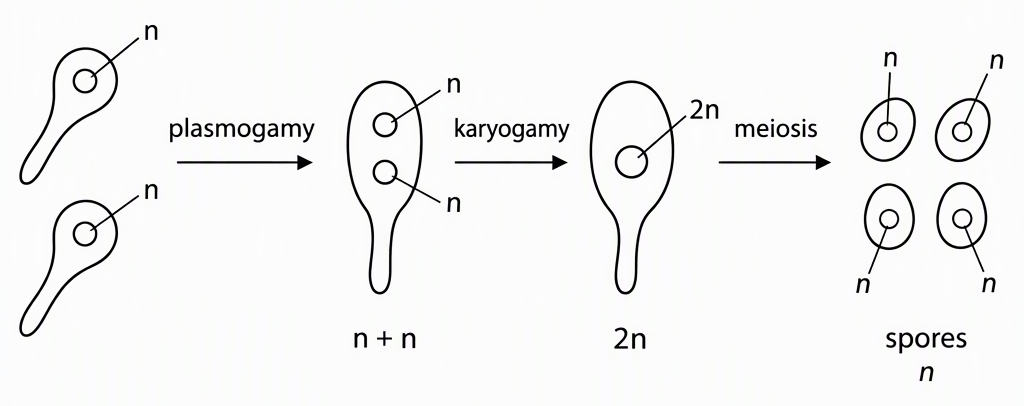
The dikaryotic condition is written as:
This means two haploid nuclei sharing a cell, not one diploid nucleus. Sharing cytoplasm does not combine their chromosome sets into a single nucleus.
Use the root “plasma” as a supporting cue for cytoplasm after learning the definition. Match what fuses, not just the word ending.
What changes when karyogamy occurs?
Karyogamy fuses the two haploid nuclei into one diploid zygote nucleus. Event B therefore matches process III. Unlike plasmogamy, this event brings both chromosome sets into a single nucleus.
These expressions describe different nuclear arrangements, not interchangeable labels for the same state. Before nuclear fusion, each nucleus carries one chromosome set; after fusion, one nucleus carries both sets.
Plasmogamy and karyogamy need not be simultaneous. Cytoplasmic fusion can leave the nuclei separate, which is why the two events require separate matches.
Why does haploid spore formation match meiosis?
In the fungal sexual cycle described, the diploid nucleus undergoes meiosis, restoring the haploid phase and generating haploid spores. Meiosis reduces chromosome number rather than fusing nuclei. Event C therefore matches process I.
For a chromosome-count check, suppose each haploid nucleus has four chromosomes. This is an illustrative example, not a number supplied in the question.
- After plasmogamy: two nuclei, each containing four chromosomes. There are eight across the cell, but no single diploid nucleus.
- After karyogamy: one nucleus contains eight chromosomes.
- After meiosis: each haploid product contains four chromosomes.
The independently derived matches are A-II, B-III, C-I, exactly matching option A. The complete sequence is:
This match concerns the sexual cycle in the stem. Not every fungal haploid spore is produced by meiosis; asexual spores can form through mitosis. No prophase-I substage needs to be identified to solve this question.
Why is option C wrong if it also matches spores with meiosis?
Option C reverses cytoplasmic fusion and nuclear fusion. Its mapping is “A-III, B-II, C-I”. The C-I match remains correct, but the other two matches contradict the definitions.
- A-III: wrongly assigns cytoplasmic fusion to karyogamy.
- B-II: wrongly assigns nuclear fusion to plasmogamy.
- C-I: correctly assigns the stated haploid spore formation to meiosis.
The method mistake is matching on the shared word “fusion” while ignoring what is fusing. The object of fusion decides the match.
Repair it on paper: underline “cytoplasms” and “nuclei” separately. Attach plasmogamy to the first and karyogamy to the second, then select the option. Use definitions before checking options, rather than trusting a partly remembered sequence.
Which prophase-I stages should I know for related questions?
Synapsis occurs in zygotene, crossing over in pachytene, and chiasmata become evident in diplotene. The following are original related practice questions, not additional verified NEET PYQs. They address prophase-I stages within the bank’s “Cell Structure and Function” grouping.
In which prophase-I stage do homologous chromosomes undergo synapsis?
Answer: zygotene. Homologous chromosomes pair, and the synaptonemal complex forms between them. Synapsis means pairing of homologues, not fusion of two nuclei.
In which stage does crossing over occur between non-sister chromatids of homologous chromosomes?
Answer: pachytene. Non-sister chromatids of homologous chromosomes exchange genetic material. This differs from initial pairing in zygotene: pairing brings homologues together; crossing over exchanges segments.
When do chiasmata become evident as homologues begin separating?
Answer: diplotene. Homologues begin separating as the synaptonemal complex dissolves, but remain attached at chiasmata. Chiasmata reveal the earlier crossover connections; crossing over itself occurs in pachytene.
Use this compact stage-order check:
Before your next matching attempt, write the two sequences separately. Prophase-I substages describe events within meiosis; plasmogamy, then karyogamy, then meiosis describes successive events in the fungal sexual cycle.
Next step: photograph a doubt on NEET JEEnius AI and photograph any question you are stuck on and get a step-by-step solution across Physics, Chemistry and Biology (20 free a month).
Keep going with Redox Reactions and Electrochemistry NEET 2008: Fuel Cell EMF.
Frequently asked questions
What is the correct match for plasmogamy, karyogamy and meiosis?
Cytoplasmic fusion matches plasmogamy, nuclear fusion matches karyogamy, and haploid spore formation in the stated fungal sexual cycle matches meiosis. These give A-II, B-III, C-I, so option A is correct.
What is the difference between n + n and 2n in fungi?
The dikaryotic condition, n + n, means two separate haploid nuclei occupy the same cell. The diploid condition, 2n, means one nucleus contains both chromosome sets. Karyogamy converts the two haploid nuclei into one diploid nucleus.
Are all haploid fungal spores produced by meiosis?
No, asexual fungal spores can form through mitosis. In the sexual cycle described in this question, meiosis reduces the diploid chromosome number and produces haploid spores.
Which prophase-I stages show synapsis, crossing over and chiasmata?
Synapsis occurs in zygotene, crossing over occurs in pachytene, and chiasmata become evident in diplotene. Crossing over exchanges segments between non-sister chromatids of homologous chromosomes. Chiasmata become evident later as homologues begin separating.