
What does the Aldol Condensation NEET 2026 question ask?
The aldol condensation NEET 2026 hard PYQ turns on one fact: only one side of 2,2-dimethylcyclopentanone can form an enolate. Option A requires reaction from the blocked side, so it cannot form. This single-correct MCQ appeared in the NEET 2026 re-examination. Its hard tag carries an expected solving time of 90 seconds.
The question asks which proposed product cannot arise through self-aldol condensation of the cyclic ketone or crossed aldol condensation with benzaldehyde. The four candidates are:
How do you mark the two alpha-carbons correctly?
An alpha-carbon is directly adjacent to the carbonyl carbon. In 2,2-dimethylcyclopentanone, both ring carbons beside the carbonyl are alpha-carbons, but only one is enolizable. The carbon bearing two methyl groups has zero alpha-hydrogens. The alpha-carbon on the opposite side is CH2 and has two alpha-hydrogens.
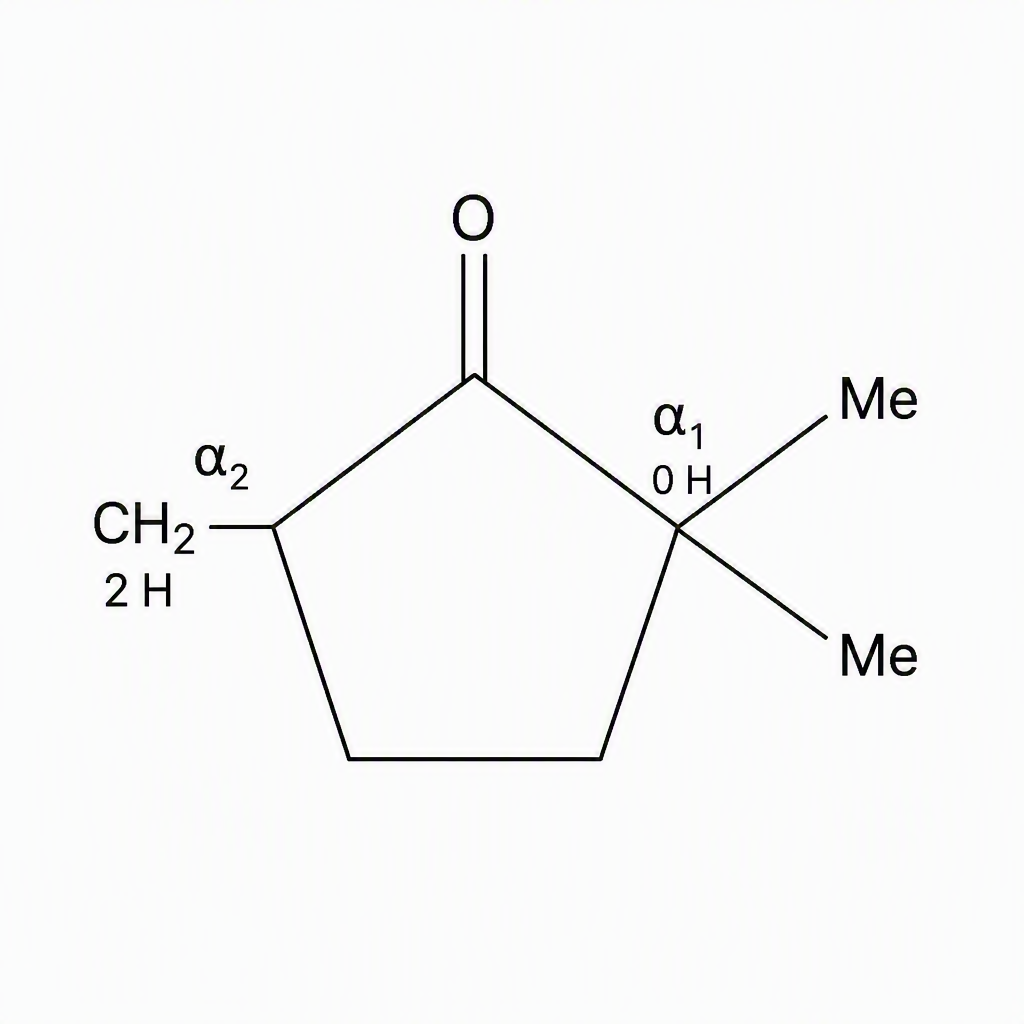
Use a valency count on the dimethyl-substituted alpha-carbon. It is bonded to the carbonyl carbon, the next ring carbon and two methyl carbons:
Therefore:
The opposite alpha-carbon is CH2. It has single bonds to two ring carbons, leaving two bonds for hydrogen:
Thus, the number of enolizable alpha-sides is:
Merely confirming that the molecule has an alpha-hydrogen somewhere is insufficient. You must identify its exact position. Enolate formation is possible only from the CH2 side.
How are options B and D formed in crossed aldol condensation?
Options B and D are obtainable under the official interpretation. The enolate donor is 2,2-dimethylcyclopentanone, reacting only through its CH2 alpha-carbon. Benzaldehyde is the electrophilic carbonyl partner. It has no alpha-hydrogen, so it cannot form a competing benzaldehyde enolate.
The crossed aldol sequence is:
- Base removes an alpha-hydrogen from the CH2 side of 2,2-dimethylcyclopentanone.
- The resulting enolate attacks the carbonyl carbon of benzaldehyde.
- Protonation gives a beta-hydroxy carbonyl compound.
- Loss of water forms an alpha,beta-unsaturated ketone.
The alkene must develop from the enolizable CH2 alpha-position of the cyclic ketone. The benzylidene enones represented by options B and D satisfy this positional test, so both are obtainable.
Why can option C form but option A cannot form?
Option C can form through self-condensation, but option A requires enolate formation at the blocked alpha-carbon. One molecule of 2,2-dimethylcyclopentanone forms the enolate through its CH2 side. A second molecule acts as the carbonyl electrophile. Neither role requires enolate formation on the dimethyl-substituted side.
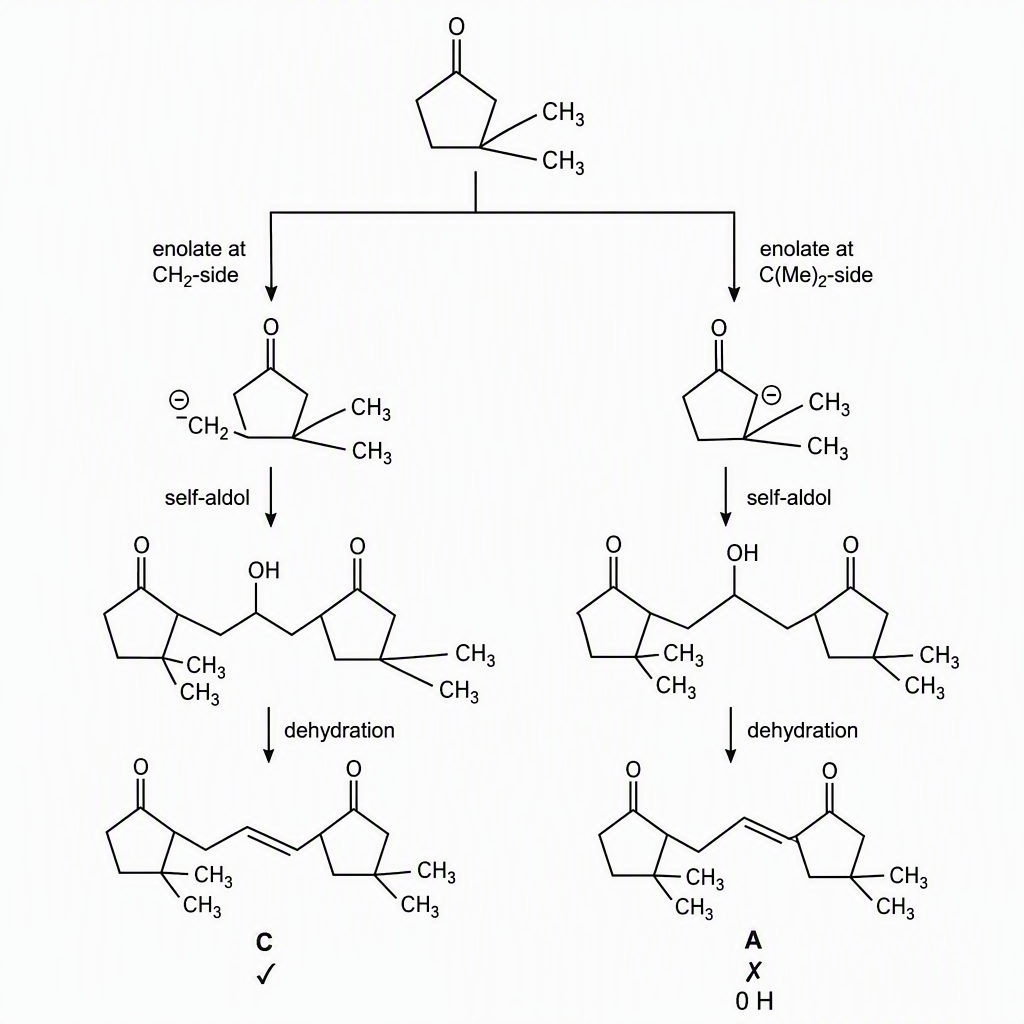
For option C:
- The CH2 alpha-carbon of the first ketone forms an enolate.
- This enolate attacks the carbonyl carbon of the second ketone.
- Self-aldol addition produces a beta-hydroxy carbonyl compound.
- Loss of water gives the dimeric alpha,beta-unsaturated ketone represented by option C.
Option A fails when mapped back to the starting ketone. Its required exocyclic double bond traces to the alpha-carbon bearing two methyl groups. Forming that double bond would require an enolate at this blocked alpha-carbon.
That carbon has zero hydrogens. Base cannot remove an alpha-hydrogen from it, so the required enolate and product cannot form.
Final answer: Option A
What positional mistake leads to a wrong aldol answer?
The error is checking only whether the ketone has an alpha-hydrogen somewhere, then treating both sides of the carbonyl as enolizable. This can make option A appear possible. The starting ketone does have alpha-hydrogens, but they are on the opposite CH2 carbon, not on the carbon required to produce option A.
Rejecting option C merely because it is a self-condensation product is also incorrect. Two ketone molecules can take different roles:
- One molecule forms the enolate through its available alpha-CH2.
- The other molecule supplies the electrophilic carbonyl carbon.
- Dehydration then gives the self-condensation enone.
Use this rule for the aldol condensation NEET 2026 question and similar MCQs:
For every proposed alkene, trace the alkene-forming alpha-carbon back to the starting carbonyl compound. Verify that this exact carbon originally carried at least one hydrogen.
Do not check the molecule as a whole. Check the exact carbon that must generate the enolate.
Which related aldol questions should you be able to solve?
You should be able to decide whether benzaldehyde undergoes self-aldol condensation, assign the donor and acceptor in the acetophenone-benzaldehyde reaction, and count the enolizable sides of 2,2-dimethylcyclohexanone. All three use the same test: locate the exact alpha-carbon and count the hydrogens attached to it.
Can benzaldehyde undergo self-aldol condensation?
No. Benzaldehyde cannot form the enolate required for ordinary self-aldol condensation. Its carbonyl carbon is attached directly to a phenyl group and hydrogen, so there is no alpha-carbon bearing an alpha-hydrogen. Without an enolate donor, two benzaldehyde molecules cannot complete a self-aldol reaction.
Which compounds are the donor and acceptor when acetophenone reacts with benzaldehyde?
Acetophenone is the enolate donor, and benzaldehyde is the electrophilic acceptor. Acetophenone has alpha-hydrogens on its methyl group, so base can convert it into an enolate. Benzaldehyde has no alpha-hydrogen, so it does not form a competing enolate and contributes only its electrophilic carbonyl carbon.
How many enolizable alpha-sides does 2,2-dimethylcyclohexanone have?
It has one enolizable alpha-side. The alpha-carbon bearing two methyl groups already has four carbon bonds and therefore no hydrogen. The alpha-carbon on the opposite side is CH2 and can lose an alpha-hydrogen. Enolate formation is possible only from that side.
For a 90-second attempt, spend the first 20 seconds marking both alpha-carbons and counting their hydrogens. Inspect the options only after fixing the blocked side and the enolizable side.
Next step: the past-paper archive on NEET JEEnius AI and search past NEET papers by year, subject or chapter, each with a worked solution (100 free searches a month).
Frequently asked questions
Why is option A wrong in the Aldol Condensation NEET 2026 question?
Option A requires enolate formation at the alpha-carbon bearing two methyl groups. That carbon has four carbon bonds and no alpha-hydrogen, so base cannot generate the required enolate.
How many enolizable alpha-sides does 2,2-dimethylcyclopentanone have?
It has only one enolizable alpha-side. The dimethyl-substituted alpha-carbon has no hydrogen, while the alpha-carbon on the opposite side is CH2 and can form an enolate.
Can benzaldehyde undergo self-aldol condensation?
No, benzaldehyde cannot undergo ordinary self-aldol condensation because it has no alpha-hydrogen. It cannot form the enolate needed to act as the nucleophilic aldol donor.
Which compound is the donor when acetophenone reacts with benzaldehyde?
Acetophenone is the enolate donor because its methyl group contains alpha-hydrogens. Benzaldehyde has no alpha-hydrogen and therefore acts only as the electrophilic carbonyl acceptor.