What is the hard NEET 2025 Atoms and Nuclei question on de Broglie wavelength ratio using Bohr's model?
An electron in the ground state of the hydrogen atom has orbital radius 5.3 × 10^{-11} m. The electron in the third excited state has orbital radius 8.48 × 10^{-10} m. The question asks for the numerical ratio of de Broglie wavelength in the ground state to that in the third excited state. Options are the single integers 4, 9, 3 and 16. The correct answer is 4.
How does the official worked solution derive the ratio for this atoms and nuclei NEET 2025 question?
The de Broglie wavelength is given by
Bohr angular momentum quantisation states
Solve for mv to get
Substitute this expression for mv into the wavelength formula. This yields
Therefore
Ground state corresponds to n = 1. Third excited state corresponds to n = 4. The ratio becomes
Plug in the values:
This equals 1/4, so the ratio is 1:4. The final answer corresponds to option A (4).
This derivation follows directly from the two postulates and finishes inside the 120-second window.
What algebraic slip leads to picking 16 as the answer in this de Broglie wavelength problem?
Many students write while completely omitting the 1/n factor from . They then compute
This produces the distractor 16 and leads to wrongly selecting that option. The n in the denominator originates directly from Bohr's quantisation condition and cannot be dropped.
Forgetting the quantisation step turns the question into a trap. Always carry the n through every line of working.
Why does the n factor have to be in the de Broglie wavelength formula for Bohr orbits?
De Broglie standing wave condition requires the circumference to equal n times the wavelength, so . Rearrangement gives . This is not optional but mandatory once the electron forms a standing wave.
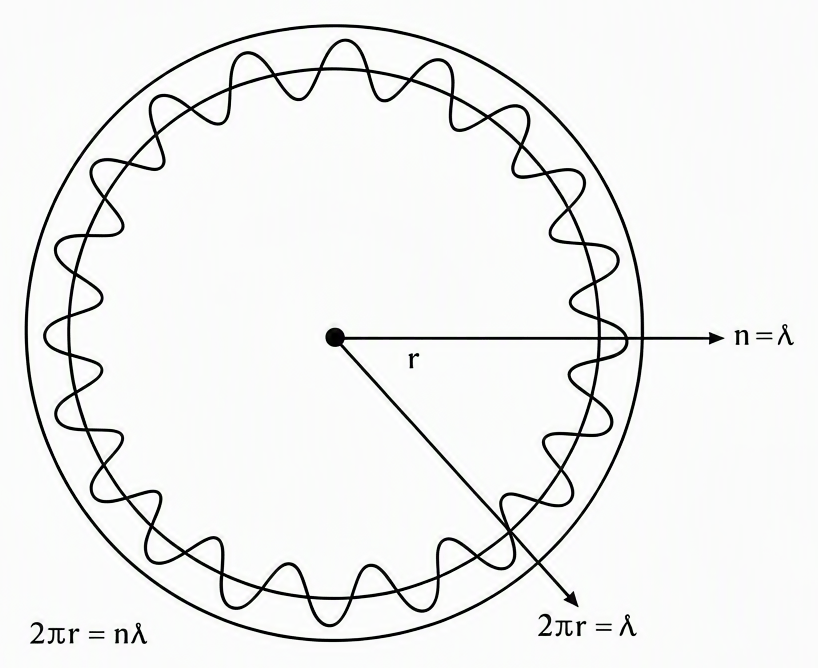
Radius scales as n squared from Bohr's model. Wavelength therefore scales as n because the extra n squared is divided by the extra n. The mistaken proportionality that ignores angular momentum quantisation drops this division and produces the 1/16 error shown earlier.
The n factor appears because the electron must fit an integer number of wavelengths around the orbit.
Can you give two related practice questions from atoms and nuclei for NEET?
Question 1: If radius in first excited state is four times ground state, find ratio of de Broglie wavelengths for n=2 to n=1 using the same derivation.
From the ratio
The ratio is 2.
Question 2: Calculate ratio of linear momenta (mv) for ground and third excited states given the same radii values.
From momentum is proportional to n/r. The ratio
With r₄ = 16 r₁ the ratio equals 4.
Both questions use identical logic and the same n values. Solve them in one minute each after the main example.
What key takeaways help crack atoms and nuclei NEET 2025 questions like this one?
Always start from when wavelength is asked. This single equation generates the working formula without memorisation.
Third excited state is n = 4. Never count n = 3 as third excited because ground state is n = 1, first excited n = 2, second excited n = 3 and third excited n = 4.
r₄ = 16 r₁ is a standard result. Combine it with the extra factor of n in the denominator to obtain exactly 4.
Students who practice 5–6 such ratio questions from the past-paper archive can expect to solve them in under 90 seconds. The archive lets you search by chapter and gives a worked solution for each.
If you get stuck on a similar problem, photograph a doubt to receive a step-by-step solution.
What are the most common student questions on de Broglie wavelength in Bohr orbits for NEET 2025?
How is wavelength related to radius and n?
It equals 2πr divided by n. Both values must be used.
What n value belongs to the third excited state?
It is n = 4. Ground state is always n = 1.
Does wavelength increase or decrease with higher orbits?
It increases as n because radius grows faster than n. The exact factor is r/n.
Why do some calculations give 16 instead of 4?
They forget the n values in the denominator. The quantisation condition supplies that n and must stay in the working.
Can the same steps be used for momentum ratios?
Yes. Momentum equals nh divided by 2πr, so the ratio follows at once from the n and r values given.
Next step: photograph a doubt on NEET JEEnius AI and photograph any question you are stuck on and get a step-by-step solution across Physics, Chemistry and Biology (20 free a month).
For a worked example of the same idea, see Biomolecules Practice Questions NEET: Full Mocks vs PDFs.
Frequently asked questions
What is the de Broglie wavelength ratio for ground state to third excited state in the NEET question?
The ratio λ1/λ4 is 4. From λ = 2πr/n the expression becomes (r1 × n4)/(r4 × n1). Given r1 = 5.3 × 10^{-11} m and r4 = 8.48 × 10^{-10} m this evaluates to 4. Third excited state is always n = 4.
Why do students get 16 instead of 4 in atoms and nuclei NEET 2025 de Broglie wavelength problem?
They incorrectly assume λ ∝ r and drop the 1/n factor, calculating only r1/r4 = 1/16. The correct relation λ = 2πr/n comes from Bohr quantisation mvr = nh/2π and must include both n = 1 and n = 4. This changes the ratio from 1/16 to 4.
What is the principal quantum number for third excited state in Bohr model for NEET?
Third excited state corresponds to n = 4. Ground state is n = 1, first excited state n = 2, second excited state n = 3, and third excited state n = 4. Using n = 3 by mistake leads to wrong ratio in wavelength and momentum problems.
How is de Broglie wavelength related to radius and n in Bohr orbits?
De Broglie wavelength equals 2πr/n. This follows from the standing-wave condition 2πr = nλ and from substituting mv = nh/(2πr) into λ = h/mv. Wavelength is therefore proportional to r/n, not simply to r. Radius scales as n² so wavelength ultimately scales as n.