What is the banking of roads NEET 2026 question and its answer?
The banking of roads NEET 2026 answer is option A: minimum tyre wear means no friction is required for the turn. A car follows a banked circular track of radius 50 metres at 10 metres per second, the speed at which tyre wear is minimum. Taking gravitational acceleration as 10 metres per second squared, find the road’s banking angle.
The supplied choices are:
- A)
- B)
- C)
- D)
This is a Laws of Motion question, rated medium on the question bank’s own scale. The question bank’s expected solving time is 45 seconds, not an official per-question time limit.
Why does minimum tyre wear mean zero required friction?
The official solution treats minimum tyre wear as the condition where friction is not needed to maintain the circular turn. The car is therefore moving at the bank’s design speed. This is an idealised force condition, not a claim that the road is incapable of providing friction.
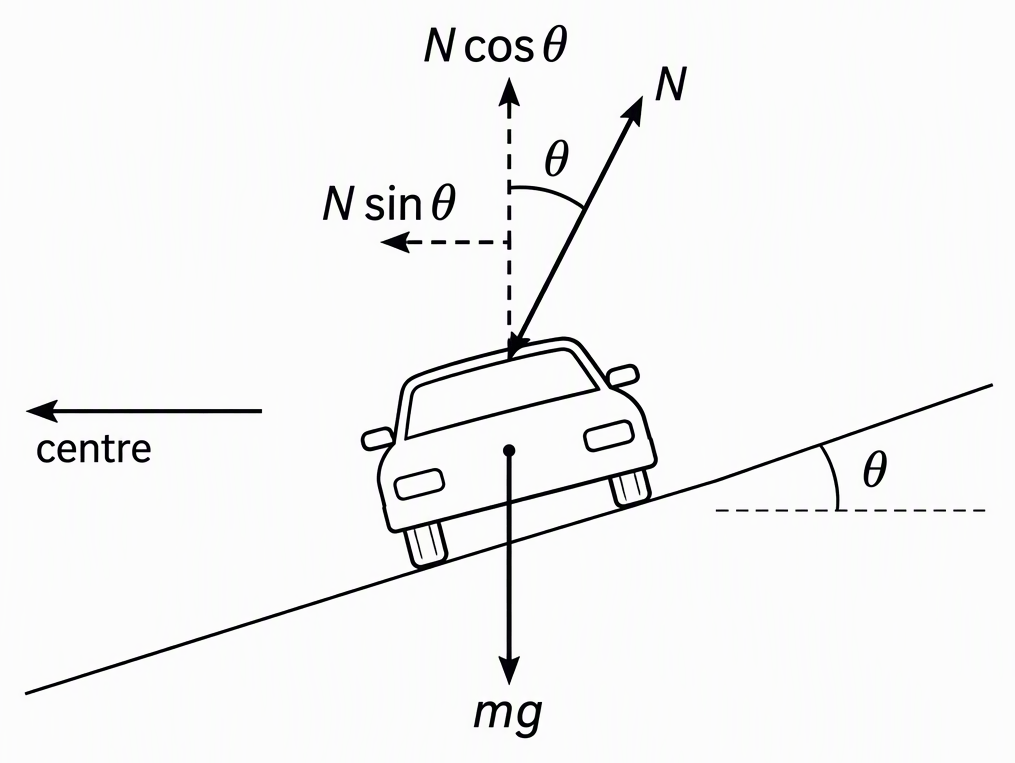
Only weight and the normal reaction are needed in this model. The normal reaction is perpendicular to the bank, so it has an upward component and an inward component. Define:
There is no vertical acceleration. The upward normal component therefore balances the weight:
The inward normal component supplies the required centripetal force:
Centripetal force is the name for the net inward force, not an extra force to add to the diagram. Here, it is supplied entirely by the horizontal component of the normal reaction.
Divide the inward equation by the vertical equation:
Both the normal reaction and the mass cancel. This explains why the question does not supply the car’s mass: it does not affect the required bank angle at the design speed.
How do you substitute the values and select option A?
Substitution gives a tangent of one-fifth, so option A is correct. Keep the answer in inverse-tangent form to match the supplied choice.
The inputs are:
Substituting:
Here, inverse tangent means the angle whose tangent is one-fifth. It does not mean the reciprocal of the tangent.
The numerator and denominator have the same units:
Their ratio is dimensionless, as a tangent must be. Use this exam sequence:
- Identify zero required friction.
- Write the design-speed banking relation.
- Substitute the speed, radius and gravitational acceleration.
- Match the exact inverse-tangent option.
A decimal angle adds work without improving this answer. No calculator is needed.
How does a radius mistake produce option B?
Option B follows if the stated radius is wrongly treated as a diameter and halved. The banking formula needs the radius of the car’s circular path, and the question already supplies it.
Suppose someone reads the given 50 metres as a diameter. Their incorrect input becomes:
The resulting calculation is:
That matches option B. The arithmetic is internally consistent, but the geometry has been misread: the calculation answers a different question about a smaller circular path.
Rechecking multiplication alone will not catch this error. Mark every supplied length as radius or diameter before substituting, and halve it only when it is explicitly a diameter.
How do speed, mass and friction changes affect the same banked-road model?
Use the same vertical balance and inward-force equation for each change; no new formula is needed. The following are original related practice questions, not verified additional PYQs.
If the design speed doubles, how must the bank angle change?
The tangent of the bank angle must quadruple, with radius and gravitational acceleration unchanged. Speed is squared in the relation:
Quadrupling the tangent does not mean quadrupling the angle. Apply the factor to the tangent first, then take inverse tangent.
If the car’s mass doubles, does the required bank angle change?
No, the required angle stays unchanged at the original speed and radius. For the heavier car, dividing the inward and vertical force equations still cancels mass:
The required normal reaction increases, but its component ratio does not change. A heavier car does not need a steeper bank for this design speed.
Below the design speed, which way does static friction act?
Static friction acts up the slope, towards the outside of the turn, assuming sufficient static friction is available to prevent slipping. Below design speed, the car tends to slip down the bank, so friction opposes that tendency.
Uphill friction has an outward horizontal component. Together with vertical balance, this allows a smaller net inward force than at the design speed.
Do not assume friction always points towards the centre. Before adding its arrow, identify the direction the car would tend to slip relative to the road.
Next step: photograph a doubt on NEET JEEnius AI and photograph any question you are stuck on and get a step-by-step solution across Physics, Chemistry and Biology (20 free a month).
If that step was the hard part, work through How to Study Cell Cycle NEET: Stages and Chromosome Counts.
Frequently asked questions
What is the answer to the banking of roads NEET 2026 question?
The correct answer is option A: θ = arctan(1/5). At minimum tyre wear, tanθ = v²/(rg), so substituting v = 10 m/s, r = 50 m and g = 10 m/s² gives tanθ = 100/500 = 1/5.
Why does minimum tyre wear mean no friction is required?
In this idealised model, minimum tyre wear identifies the bank’s design speed, at which friction is not needed to maintain the turn. The normal reaction’s vertical component balances weight, while its horizontal component supplies the centripetal force. This does not mean the road cannot provide friction.
Why is option B wrong in the banked-road question?
Option B results from incorrectly treating the supplied 50 m radius as a diameter and halving it to 25 m. That gives tanθ = 2/5, but the stated radius gives tanθ = 1/5. Halve a supplied length only when it is explicitly a diameter.
Which way does friction act below the design speed on a banked road?
Below the design speed, static friction acts up the slope, towards the outside of the turn, provided sufficient friction is available to prevent slipping. It opposes the car’s tendency to slip down the bank. Its horizontal component points outward, not towards the centre.