
How should I study Cell Cycle for NEET in five steps?
Count chromosomes by centromeres, not by DNA amount. To study Cell Cycle for NEET, use a stage–event–count method: identify the stage, name what changes, then count within the unit asked. Build one NCERT revision sheet around these five steps.
- Read NCERT with a phase map as your output.
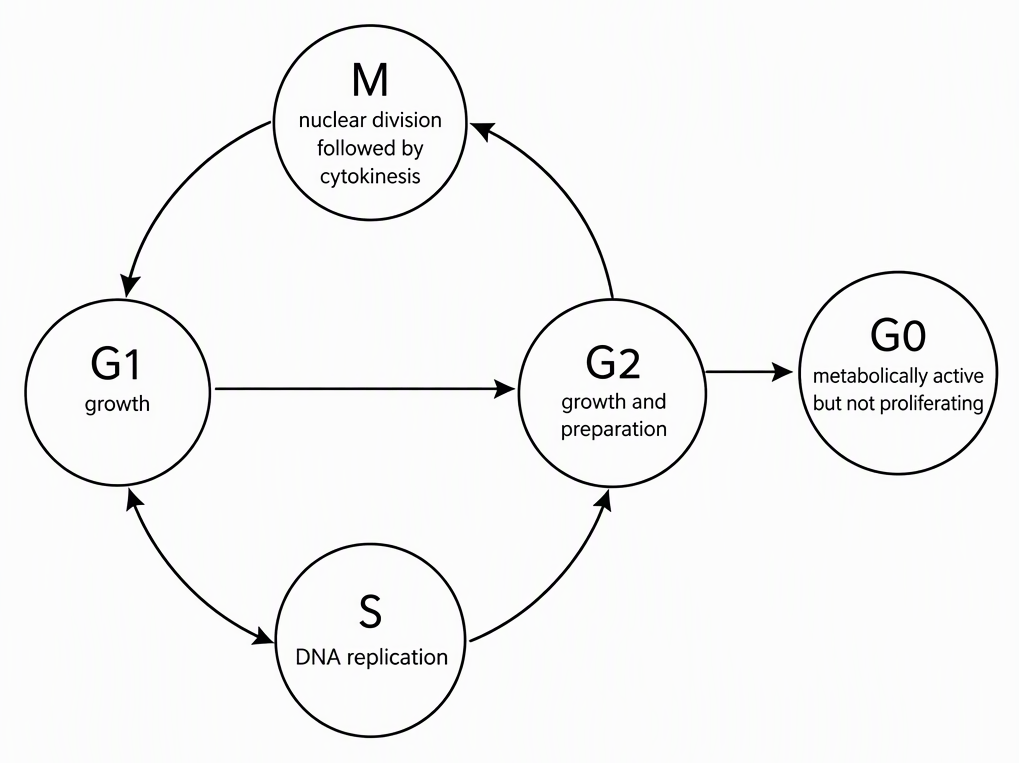
Read Cell Cycle and Cell Division, then draw this sequence:
Mark growth in G1 and G2, DNA replication in S, and nuclear division followed by cytokinesis under M. Interphase is active preparation, not a resting interval. Place G0 as an exit from G1, not another compulsory phase. G0 cells remain metabolically active but do not proliferate unless called upon to do so.
- Make stage–event–diagram cue entries.
Use these compact entries instead of copying paragraphs. Connect each stage to an event you can recognise in an NCERT diagram.
- Mitotic prophase: chromosomes condense; the spindle develops.
- Mitotic metaphase: individual duplicated chromosomes align at the equator.
- Mitotic anaphase: centromeres divide; sister chromatids separate.
- Telophase: daughter nuclei reorganise; chromosomes decondense.
- Leptotene: chromosomes become increasingly visible through condensation.
- Zygotene: homologues pair by synapsis.
- Pachytene: crossing over occurs between non-sister chromatids of homologues.
- Diplotene: homologues begin separating; chiasmata become evident.
- Diakinesis: chiasmata terminalise; chromosomes are fully condensed.
- Metaphase I: bivalents align at the equator.
- Anaphase I: homologous chromosomes separate; centromeres do not divide.
- Metaphase II: individual duplicated chromosomes align at each cell’s equator.
- Anaphase II: centromeres divide; sister chromatids separate.
- Write the counting rules before attempting numericals.
Count chromosomes by centromeres. Replication increases DNA content without increasing chromosome number. Once sister chromatids separate, each becomes a daughter chromosome.
Keep this ledger, with chromosome number first and DNA content second:
- G1, one typical diploid cell:
- Completed S phase or G2, one cell:
- Each product of meiosis I:
- Each product of meiosis II:
There is no DNA replication between meiosis I and meiosis II. Never copy a ledger value without its counting unit.
- Check division, exact stage and counting unit.
Before choosing an option, identify mitosis or meiosis, the exact stage, and whether the question asks about the whole cell, nucleus, pole or daughter cell. Underline that wording. A pole during anaphase is not yet a separate daughter cell, so its count need not equal the whole-cell count.
- Close NCERT and test reconstruction.
Redraw the map, label an NCERT diagram and explain why one tempting option fails. Include statement checks: animal cytokinesis uses a cleavage furrow progressing inward; plant cytokinesis involves cell-plate formation progressing outward. Explain why G0 is not a compulsory phase.
Does DNA replication double the chromosome number?
No. Completed S phase doubles DNA content, not chromosome number. Replication produces sister chromatids without separating their centromeres. Use that event check to solve this constructed practice example, not a previous-year NEET question.
A hypothetical diploid cell starts in G1 with:
What are its chromosome number, chromatid number and DNA content at the end of S phase?
- A:
- B:
- C:
- D:
Apply the method: stage, end of S; event, replication without centromere separation; counting unit, one cell.
- Before replication:
- After replication:
The 12 DNA molecules are arranged as sister chromatids, two per chromosome. A is correct. B wrongly doubles chromosome number merely because replication occurred; C describes the starting state; D doubles chromatids but leaves DNA content unchanged.
“In S phase” does not necessarily mean replication is complete. During S, DNA content rises between its starting and final values; “end of S” fixes the final value.
Why do whole-cell and pole counts differ during anaphase?
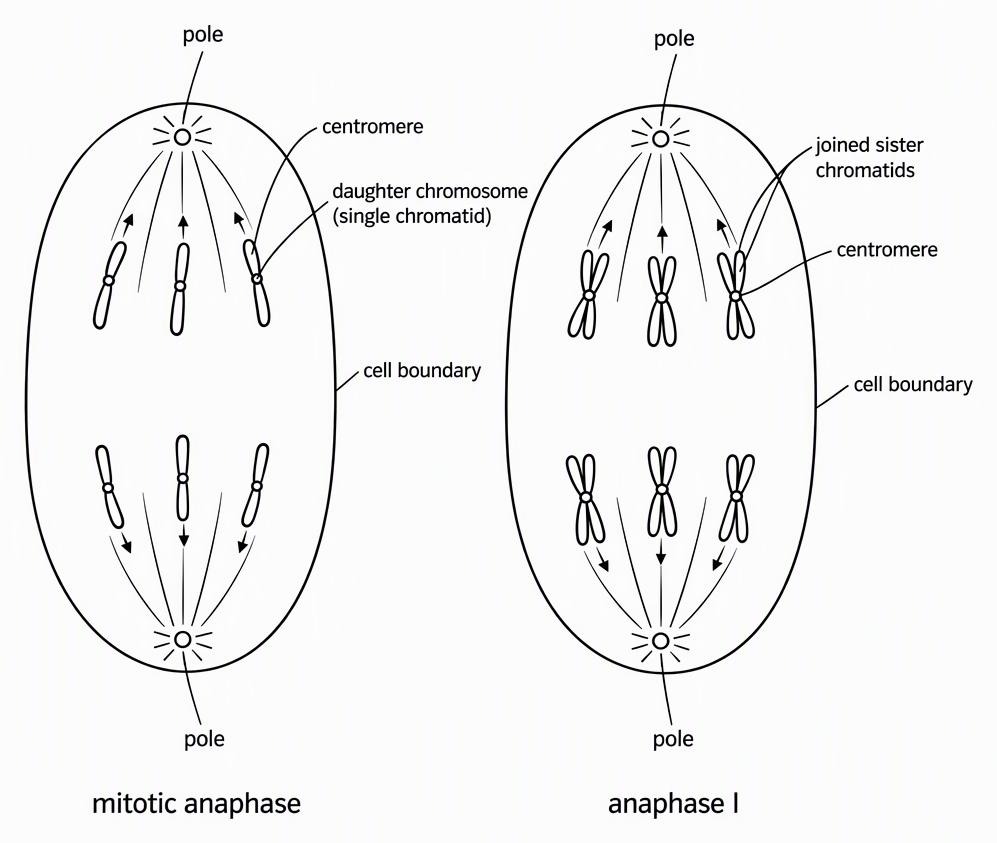
The whole undivided cell contains both separating chromosome groups; each pole receives only one group. In mitotic anaphase, centromeres have divided, so former sister chromatids now count as daughter chromosomes. Cytokinesis has not yet occurred.
Constructed practice example: continue with the same starting cell:
During mitotic anaphase after sister-chromatid separation, how many chromosomes are in the entire undivided cell and in the group moving towards each pole, respectively?
- A: 6 and 3.
- B: 6 and 6.
- C: 12 and 6.
- D: 12 and 12.
C is correct. Six duplicated chromosomes have produced 12 daughter chromosomes, with six moving towards each pole.
Compare counts by division and counting unit:
- Mitotic anaphase, whole cell:
- Mitotic anaphase, each pole’s group:
- Anaphase I, whole cell:
- Anaphase I, each pole’s group:
Mitotic anaphase separates sister chromatids. Anaphase I separates homologous chromosomes, with sister chromatids still joined. Neither event includes another round of DNA replication. Report counts and units rather than calling the mitotic-anaphase cell tetraploid.
Practise switching the counting unit while keeping the stage unchanged. Optionally, NEET JEEnius AI practice mode offers topic sets that skip questions already seen, with 60 free sets a month.
How do I separate synapsis, crossing over and chiasmata in MCQs?
Synapsis occurs in zygotene, crossing over in pachytene, visible chiasmata in diplotene and terminalisation in diakinesis. Pairing, exchange and visible connections are different events. Check the event against the substage, not just a familiar term in the option.
Constructed practice example: which statement is correct?
- A: Synapsis occurs during leptotene.
- B: Crossing over occurs between non-sister chromatids of homologous chromosomes during pachytene.
- C: Chiasmata first become evident during zygotene.
- D: Terminalisation of chiasmata occurs during diplotene.
B is correct. Check every option against this sequence:
- Leptotene: chromosome condensation makes chromosomes increasingly visible. A fails because synapsis belongs to zygotene.
- Zygotene: homologous chromosomes pair. C confuses pairing with visible chiasmata.
- Pachytene: non-sister chromatids of homologues exchange genetic material. This makes B correct.
- Diplotene: homologues begin separating but remain attached at chiasmata, which become evident.
- Diakinesis: terminalisation occurs here, so D assigns it too early.
Crossing over is the exchange event; chiasmata are its visible connections as homologues begin separating. Their appearance does not mean exchange has only just started.
Diagram-transfer check: identify the two homologous chromosomes, then the two sister chromatids within each duplicated chromosome. Point out which chromatids can cross over rather than only naming the stage.
What should I practise next, and how do I know I am ready?
Start with closed-book recall, then diagrams, counting and mixed statements. Use observable performance as your readiness check: reconstruct the ledger without notes and explain why every distractor fails. Recognising the correct answer alone does not test whether you can apply the rule.
- Recall first: close NCERT and rebuild the phase map and all five prophase-I substages, adding one event to each.
- Identify diagrams: label NCERT figures using chromosome alignment, pairing, centromeres and separation.
- Vary counting questions: cover G1, completed S phase, metaphase, mitotic anaphase, anaphase I and products of meiosis II. Alternate whole-cell, nucleus, pole and daughter-cell wording where applicable.
- Attempt mixed single-correct statements: include G0, plant and animal cytokinesis, and absent replication during interkinesis. Check that mitosis usually preserves chromosome number for growth and repair, while meiosis halves it and contributes genetic variation.
Use four error-log labels: wrong stage, wrong event, wrong counting unit and missed NCERT wording. Rewrite the relevant rule, then retry a fresh question testing it.
For the wider recall routine, use How to Study Cell Biology NEET: NCERT Recall and Practice. Optional follow-up: NEET JEEnius AI daily practice problems provide a fresh set on a topic every day, with 20 free attempts a month. Use your next attempt to test the rule you just repaired.
Frequently asked questions
How should I study Cell Cycle for NEET?
Read NCERT and build a G1–S–G2–M phase map, with G0 as an exit from G1. Link each division stage to its event and diagram cue, then write chromosome and DNA counts with their counting units. Close the book and reconstruct these before attempting diagrams, counting questions and mixed statements.
Does chromosome number double during S phase?
No. Completed S phase doubles DNA content without increasing chromosome number because sister chromatids remain joined at their centromeres. A typical diploid cell changes from 2n, 2C in G1 to 2n, 4C at the end of S phase.
How do I count chromosomes during mitotic anaphase?
Count separated sister chromatids as daughter chromosomes after centromeres divide. For a starting cell with 2n = 6, the entire undivided cell contains 12 chromosomes during mitotic anaphase, while the group moving towards each pole contains six. Always check whether the question asks for the whole cell or one pole.
What is the difference between synapsis, crossing over and chiasmata?
Synapsis is the pairing of homologous chromosomes in zygotene. Crossing over occurs between non-sister chromatids of homologues in pachytene. Chiasmata become evident in diplotene as homologues begin separating, and their terminalisation occurs in diakinesis.