
How should I study and solve Alternating Current for NEET?
Classify the circuit before choosing a formula. For Alternating Current for NEET, use this routine: identify peak or RMS values, find net reactance, predict phase, then calculate. Build one revision sheet containing the relationships below and a lead/lag sketch, not disconnected formulas copied from several sources.
- Repair only the prerequisites you need. Revise Ohm’s law, sine-wave amplitude, phase, and frequency versus angular frequency. An inductor opposes changes in current; a capacitor stores charge, with current linked to its changing voltage. Use NCERT’s corresponding AC explanations and diagrams before attempting circuit calculations. Do not restart all of electromagnetic induction.
- Separate instantaneous, peak and RMS values. Instantaneous values change with time; peak values are amplitudes. RMS values describe the equivalent heating effect in a resistor. For sinusoidal AC:
The signed full-cycle average is zero, not the RMS value. Circle the value convention in each question before substituting anything.
- Classify the circuit. Choose among pure resistor, pure inductor, pure capacitor, series LCR, or transformer. The series impedance formula below does not apply blindly to parallel circuits, where branch currents need separate treatment.
- Find reactance, then predict phase. Use voltage relative to current as the phase convention. Subtract capacitive reactance from inductive reactance:
Positive net reactance means current lags voltage; negative means current leads. Zero means they are in phase. Predict this before calculating any phase angle.
- Pure R: current and voltage are in phase.
- Pure L: current lags voltage by a quarter-cycle.
- Pure C: current leads voltage by a quarter-cycle.
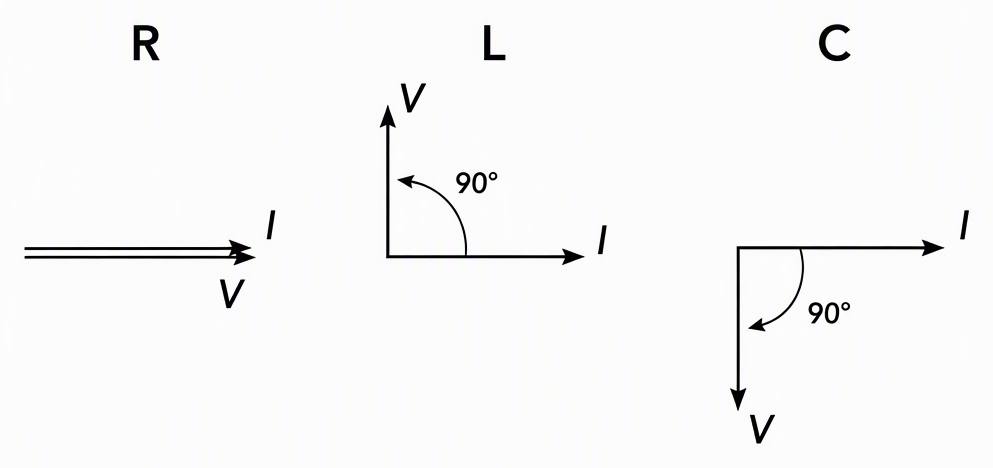
- Match the requested quantity to a short formula strip. Use RMS values consistently for current and average power:
Ideal pure inductors and capacitors consume zero average power despite carrying current. They return stored energy to the source rather than dissipating it.
- Check special conditions before arithmetic. At series resonance, the reactances cancel:
Current is maximum for fixed source RMS voltage and fixed resistance. An ideal transformer instead uses turns ratio and power conservation, not series impedance:
Write this working line above every numerical:
Circuit type → peak/RMS → frequency → net reactance and phase → required quantity → physical check.
How do I solve a series-LCR question without confusing RMS and power?
Convert the source amplitude to RMS first, then subtract reactances before finding impedance. This question combines four traps: peak versus RMS, phase sign, apparent versus average power, and phasor addition. All worked examples here are constructed teaching questions, not NEET previous-year questions or evidence of chapter weightage.
Given a series circuit at the source frequency, find RMS current, phase behaviour and average power:
Read the source before calculating. Its amplitude gives peak voltage; the coefficient of time gives angular frequency:
Positive net reactance means current lags voltage. Using peak voltage here would give peak current, not the requested RMS current.
Verify independently through resistor heating. Both power calculations must agree:
The voltage-current product alone is apparent power, not average power in watts. The power factor is below unity:
Finally, check the component RMS voltages. Their arithmetic sum is wrong because resistor and net reactive voltages are perpendicular phasors:
What happens to a series-LCR circuit when frequency doubles?
Inductive reactance doubles, but capacitive reactance halves. If the circuit starts at resonance, doubling frequency makes it net inductive and reduces current at fixed source voltage. This constructed teaching question tests that prediction: do not double both reactances.
Keep resistance, inductance, capacitance and source RMS voltage fixed. The starting conditions are:
At this frequency, equal reactances mean resonance. Only resistance limits the current:
At the doubled frequency, scale each reactance separately. Then subtract them before calculating impedance:
Current now lags voltage. The simplest power calculation uses resistor heating:
Fixed voltage does not mean fixed power: impedance changed, so current changed. In a fixed series-LCR circuit, frequencies below resonance are net capacitive; frequencies above resonance are net inductive.
Resonance cancels the reactive phasor contributions, not each component voltage. Here, each reactive voltage exceeds the source voltage without violating the phasor sum:
Why do transformer voltage and current ratios run in opposite directions?
An ideal step-down transformer lowers voltage while permitting higher secondary current because input and output powers are equal. Use the turns ratio first, the load resistance second, and power conservation third. This is a separate calculation family, not a series-LCR problem.
For this constructed teaching question, assume an ideal transformer with no losses and a purely resistive secondary load. The primary and secondary turn counts and supply conditions are:
Find secondary voltage from the turns ratio. Then apply Ohm’s law to the load:
Use ideal power conservation to find primary current. Input power equals load power:
The physical check is lower secondary voltage with higher secondary current, not newly created power. The secondary frequency remains unchanged at 50 Hz.
Normal transformer action requires changing magnetic flux. Steady DC does not produce a continuous transformed secondary voltage; switching transients are a different matter.
For a fresh topic set each day, NEET JEEnius AI’s optional daily practice problems provide 20 free attempts a month.
What should I practise next to make the method reliable?
Start with NCERT examples and exercises, practising each question family separately before mixing them. Prioritise correct circuit classification over speed, using this order:
- Sinusoidal peak/RMS conversion.
- Pure R, L and C circuits and phase.
- Series impedance and phasor voltages.
- Resonance and average power.
- Ideal transformers.
Check chapter scope against the current official syllabus at neet.nta.nic.in. Do not treat a subtopic as deleted or guaranteed to appear without verification.
Next, attempt a mixed set without formula labels so you must identify the circuit and requested quantity. For every wrong answer, assign one specific error tag: peak/RMS, frequency/angular frequency, phase sign, phasor addition, frequency scaling, power factor, or transformer ratio. Redo that question unaided, then solve a fresh question with the same trap.
Use a skill-based exit test: explain lead/lag without a mnemonic, predict the effect of changing frequency, and solve a mixed question with units and a physical check. Base your phase explanation on how an inductor opposes current change and how capacitor current follows the rate of voltage change.
Only add time pressure once this routine is reliable. NEET has 180 compulsory questions in 180 minutes, but that average is not a mandatory one-minute limit for every Physics question.
For follow-up, NEET JEEnius AI’s optional practice mode offers topic sets that skip questions already seen, with 60 free sets a month. Choose the topic behind your latest error tag and solve the next set with the working line written first.
Next step: daily practice problems on NEET JEEnius AI and get a fresh set on a topic every day (20 free attempts a month).
Related on NEET JEEnius AI: Tapetum and Microsporangium NEET 2026: Why Option C Is Correct.
Frequently asked questions
How should I start studying Alternating Current for NEET?
Revise Ohm’s law, sine-wave amplitude, phase, and the difference between frequency and angular frequency. Then practise NCERT examples and exercises in this order: peak/RMS conversion, pure R/L/C circuits, series impedance, resonance and power, and ideal transformers. Build one revision sheet with the core relationships and a lead/lag sketch before attempting mixed questions.
What is the difference between peak and RMS values in AC?
Peak values are the amplitudes of the alternating voltage or current, while RMS values describe the equivalent heating effect in a resistor. For sinusoidal AC, divide the peak value by √2 to get the RMS value. The signed full-cycle average is zero, but the RMS value is not.
How do I know whether current leads or lags in an LCR circuit?
For a series-LCR circuit, calculate net reactance as X_L − X_C. If it is positive, current lags voltage; if it is negative, current leads voltage. At zero net reactance, current and voltage are in phase.
What happens when frequency doubles in a series-LCR circuit?
With inductance and capacitance fixed, doubling frequency doubles inductive reactance and halves capacitive reactance. If the circuit starts at resonance, it becomes net inductive, so current lags voltage. With source RMS voltage and resistance fixed, current and average power both decrease.
Why does a step-down transformer increase current?
For an ideal transformer supplying a resistive load, input and output powers are equal: V_p I_p = V_s I_s. A lower secondary voltage therefore corresponds to a higher secondary current than the primary current, not extra power. Find secondary voltage from the turns ratio, secondary current from the load resistance, and primary current from power conservation.