
How should I study Cell Biology for NEET using NCERT?
- Map the scope. Study Cell Biology for NEET around three NCERT chapters: Cell: The Unit of Life, Biomolecules, and Cell Cycle and Cell Division. Check this working scope against the current official syllabus at neet.nta.nic.in, rather than including every cellular process in Biology.
I recommend cell structures first, biomolecules next and cell division last. This is a learning sequence, not an official requirement: membranes, DNA and proteins provide the background for explaining division. Keep photosynthesis and respiration as linked topics, rather than expanding this revision task into all of Biology.
- Reconstruct from memory. Read one bounded subsection, such as mitochondrial structure. Close NCERT, label an unlabelled mitochondrion sketch and write what each labelled region tells you.
For the cell cycle, reproduce G1, S, G2 and M in sequence, then identify where DNA replication occurs. Reopen the book only after committing an answer. Recognising a highlighted line is not the same as recalling it or using it to eliminate an option.
- Compare confusing facts. Use the same fields for every organelle: membrane number, occurrence, structural clue and function. Build a compact comparison:
- Mitochondrion: two membranes; eukaryotic cells; cristae; aerobic respiration and ATP production.
- Chloroplast: two envelope membranes; photosynthetic plant cells; thylakoids, often stacked into grana; photosynthesis.
- Golgi apparatus: single-membrane cisternae; eukaryotic cells; flattened sacs with distinct faces; modification and packaging.
- Lysosome: single membrane; commonly studied in animal cells; vesicle containing hydrolytic enzymes; intracellular digestion.
- Ribosome: no membrane; prokaryotic and eukaryotic cells; large and small subunits; protein synthesis.
Keep two separate distinction cards. An enzyme catalyses a reaction; its substrate is the molecule it acts on. A replicated chromosome has two sister chromatids; those chromatids become daughter chromosomes when they separate.
- Solve by evidence. Mark the task word: incorrect, matched or number. State the relevant NCERT fact or counting rule before checking the options.
Then reject each distractor for a specific reason. “This looks familiar” is not evidence; “ribosomes lack a membrane” is. For counting questions, write the stage and counting unit before doing arithmetic. Check that your rule applies to that stage and unit.
- Repair and retest. Classify each error as a missing fact, confused pair, diagram error, counting-rule error or misread qualifier. Record the corrected distinction, not just the answer letter.
Close the explanation and retrieve that distinction again. At your next session, recall it before rereading, then test it with a fresh question. The questions below are original teaching examples, not claimed NEET previous-year questions.
How do I identify an organelle from structural clues?
Cristae identify a mitochondrion because they are folds of its inner membrane. Start with that structural fact, not a remembered function such as “provides energy”. Use an NCERT-based sketch to test whether you can locate the outer membrane, inner membrane, cristae and matrix without consulting labels.
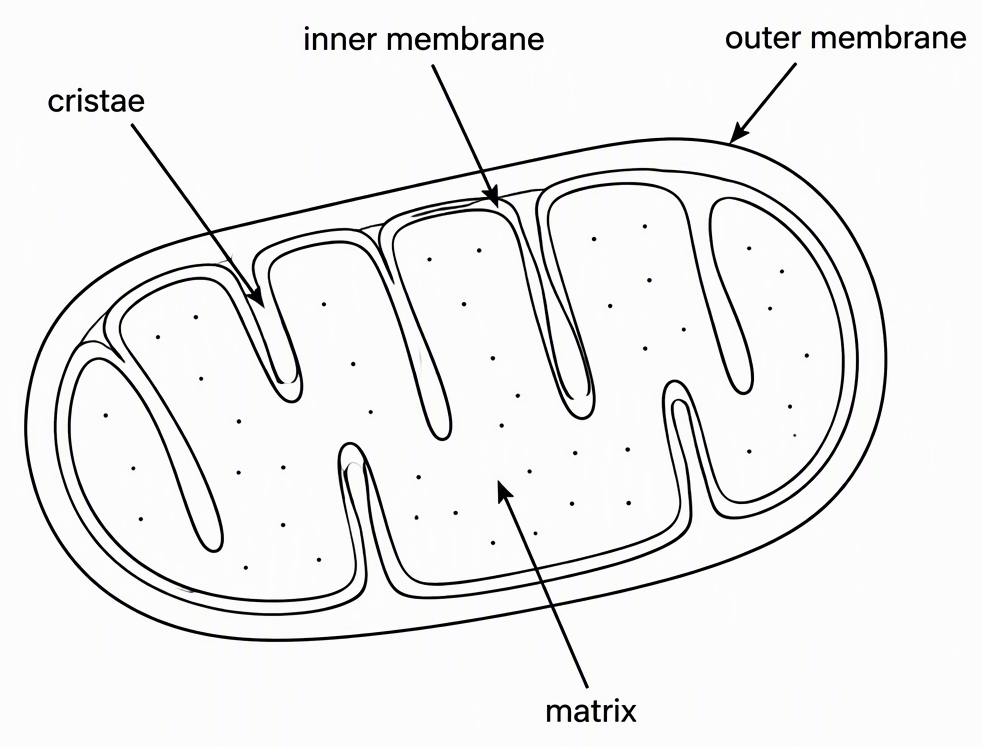
Original single-correct question: Which structure is bounded by two membranes, has inner-membrane folds called cristae and contains its own DNA?
- A. Golgi apparatus
- B. Mitochondrion
- C. Lysosome
- D. Ribosome
Before evaluating the options, state the evidence: “Cristae are mitochondrial inner-membrane folds.” Therefore, B is correct.
- A: Golgi cisternae are single-membrane-bound.
- C: Lysosomes are single-membrane-bound.
- D: Ribosomes are non-membranous.
Two membranes and their own DNA do not uniquely identify mitochondria. Chloroplasts share those features; cristae provide the decisive clue here.
Use the sketch as answer evidence by pointing to the membrane that forms each fold. If you chose by function alone, reconstruct the organelle comparison using structural clues before attempting another question.
How do I use an enzyme fact to predict an answer?
Increasing substrate concentration can reduce competitive inhibition. First identify the roles: succinic dehydrogenase is the enzyme, succinate is its substrate and malonate is the competitive inhibitor. These roles explain the prediction; merely remembering the name “malonate” does not.
Original single-correct question: Malonate competitively inhibits succinic dehydrogenase. At a fixed malonate concentration, which change can reduce its inhibitory effect?
- A. Increase succinate concentration
- B. Decrease succinate concentration
- C. Denature the enzyme
- D. Remove the enzyme
Malonate resembles the substrate and competes for the enzyme’s substrate-binding site. Increasing succinate gives the substrate more opportunity to occupy that site, so A is correct.
- B: Less substrate does not counter the competition.
- C: Denaturation disrupts enzyme activity rather than restoring it.
- D: Removing the enzyme prevents its catalytic activity.
Recognising the named example is recall; predicting the effect of more substrate is application. For repair, write four columns on paper: enzyme, substrate, inhibitor and predicted effect. Fill them from memory without adding kinetic derivations.
For fresh application questions, NEET JEEnius AI’s practice mode offers topic sets that skip questions already seen, with 60 free sets a month.
How do I count chromosomes and DNA molecules during mitotic anaphase?
Count chromosomes by centromeres, and establish whether the question means the whole cell or one pole. DNA replication does not itself double chromosome number. Use this hypothetical diploid cell, an illustrative value rather than an exam statistic:
Original single-correct question: During mitotic anaphase, after sister chromatids separate but before cytokinesis, how many chromosomes and DNA molecules are present in the whole cell?
- A. 4 and 4
- B. 4 and 8
- C. 8 and 8
- D. 8 and 16
- Identify the stage: mitotic anaphase, after sister-chromatid separation.
- Identify the counting unit: the whole cell, not one pole.
- Count chromosomes by centromeres: separation makes each former sister chromatid a daughter chromosome.
C is correct. Check the counts across stages:
- G1, whole cell: 4 chromosomes; 4 DNA molecules.
- Metaphase, whole cell: 4 chromosomes; 8 DNA molecules.
- Anaphase, whole cell: 8 chromosomes; 8 DNA molecules.
- Each daughter cell after division: 4 chromosomes; 4 DNA molecules.
S phase doubles DNA quantity without doubling chromosome number. Anaphase separation changes chromosome number within the still-undivided cell, not DNA quantity.
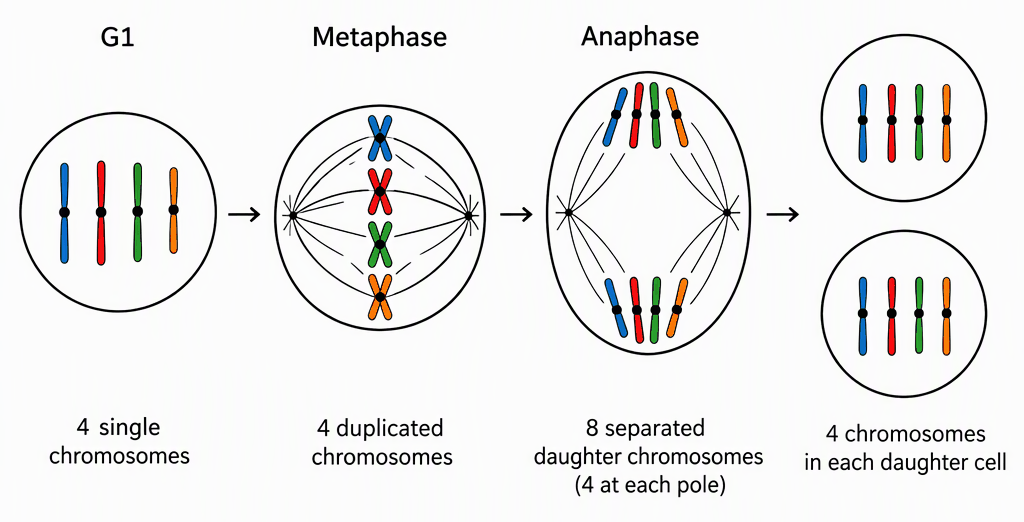
Each anaphase pole receives 4 chromosomes and 4 DNA molecules, explaining option A’s trap. B describes metaphase counts; D incorrectly doubles DNA again.
For repair, redraw these stages with centromere dots rather than memorising C. Do not transfer this result blindly to meiosis I: homologous chromosomes separate in meiosis I; sister chromatids separate in meiosis II.
What should I practise after these three Cell Biology examples?
Use three topic-wise passes, then a mixed set to practise choosing the method without a category label. Class 11 students should build comparison sheets while learning; Class 12 students and droppers should begin with a diagnostic mixed set and reread the subsections their errors expose.
- Organelles and unlabelled diagrams: distinguish mitochondria from chloroplasts, then locate the chloroplast envelope, stroma, grana and stroma lamellae. After chloroplast revision, try Photosynthesis: Photorespiration Answer Explained as optional transfer practice, not a substitute for Cell Biology questions.
- Biomolecule and enzyme statements: explain why each statement is true or false. For a false statement, replace the exact word or relationship that makes it wrong.
- Division stages and counts: vary the stage while keeping “whole cell” fixed. Then keep the stage fixed and switch between whole cell and one pole before mixing both changes.
Next, attempt the mixed set. Check readiness by testing whether you can reproduce the relevant diagram, explain the answer and reject the distractors without notes.
At the next session, retrieve the repaired rule before reopening the explanation. Then attempt a fresh question on that distinction; NEET JEEnius AI’s daily practice problems provide a fresh set on a topic every day, with 20 free attempts a month.
Next step: daily practice problems on NEET JEEnius AI and get a fresh set on a topic every day (20 free attempts a month).
Frequently asked questions
Which NCERT chapters should I study for Cell Biology in NEET?
Use Cell: The Unit of Life, Biomolecules, and Cell Cycle and Cell Division as your working scope, and check it against the current official NEET syllabus. Study cell structures first, biomolecules next and cell division last; this is a recommended learning sequence, not an official requirement.
How do I remember cell organelles for NEET?
Compare organelles using four fields: membrane number, occurrence, structural clue and function. After reading a bounded NCERT subsection, close the book and label an unlabelled sketch from memory. Use specific structural evidence, such as mitochondrial cristae, rather than relying only on familiar functions.
How do I count chromosomes and DNA molecules in anaphase?
Count chromosomes by centromeres and first establish whether the question asks about the whole cell or one pole. In a hypothetical cell with 2n = 4, mitotic anaphase after sister-chromatid separation has 8 chromosomes and 8 DNA molecules in the whole cell, with 4 of each at each pole. S phase doubles DNA quantity without doubling chromosome number; anaphase separation changes chromosome number without increasing DNA quantity.
How should I revise mistakes in Cell Biology MCQs?
Classify each mistake as a missing fact, confused pair, diagram error, counting-rule error or misread qualifier. Record the corrected distinction rather than just the answer letter, then close the explanation and recall it. At your next session, retrieve that distinction before rereading and test it with a fresh question.