What is the answer to the photosynthesis NEET 2026 photorespiration question?
Option B, statements (c) and (d) only, is correct for this photosynthesis NEET 2026 question: phosphoglycolate forms, but neither ATP nor NADPH is synthesised. The source is NEET UG 2026, the re-held examination on 2026-06-21 (21 June), Code-50, Biology. “Medium difficulty” is the question bank’s classification, not an official NTA rating.
Select the valid claims about photorespiration. The complete question is paraphrased below:
The answer choices retain their original mapping:
Judge each claim separately before choosing a pair. Start with RuBisCO’s oxygenase reaction, which directly establishes statement (c).
How does RuBisCO’s oxygenase reaction prove statement (c)?
RuBisCO oxygenates RuBP to form one molecule of 3-PGA and one molecule of 2-phosphoglycolate, making statement (c) true. The supplied official solution cites NCERT Class 11 Biology, Chapter 13, Photosynthesis in Higher Plants. High oxygen and low carbon dioxide favour RuBisCO functioning as an oxygenase in C3 plants.
The five-carbon substrate splits into a three-carbon compound and a two-carbon compound. Track both products, not just the familiar 3-PGA.
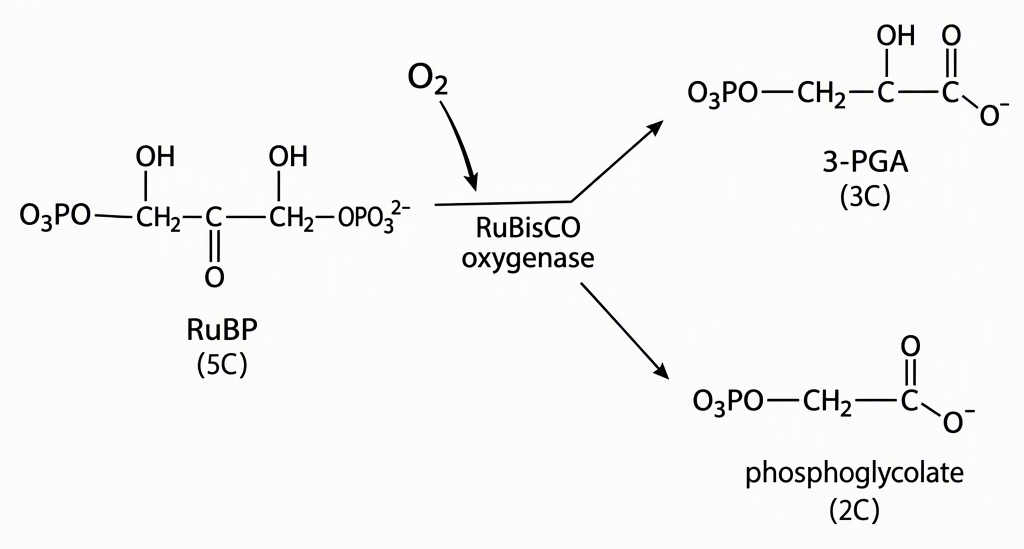
The carbon check is:
Oxygenating two RuBP molecules gives two molecules of each product:
All ten carbon atoms are accounted for. 2-phosphoglycolate is the phosphoglycolate named in the question, so the initiating reaction itself proves statement (c).
What happens to gases and energy during photorespiration?
Photorespiration consumes oxygen, releases carbon dioxide and produces no sugar. Following the supplied official explanation, it consumes ATP and NADPH but synthesises neither. Statement (d) is therefore true: no synthesis does not mean no energy expenditure.
The pathway involves three organelles, not just the site of RuBisCO:
- Chloroplast: RuBisCO’s initiating oxygenase reaction occurs here.
- Peroxisome: processes compounds formed during the pathway.
- Mitochondrion: participates in the pathway, including carbon dioxide release.
Keep the initiating reaction separate from the complete pathway. Oxygen enters the displayed RuBisCO reaction, but carbon dioxide is released later during the pathway, not in that displayed reaction. The reaction alone establishes the phosphoglycolate product; the full pathway explains carbon loss and energy use.
Photorespiration occurs in C3 plants, which makes statement (a) false. It is negligible in C4 plants because their carbon dioxide-concentrating mechanism limits RuBisCO’s oxygenase activity.
Why does the statement check give option B?
The verdict is false, false, true, true, leaving only statements (c) and (d). Attach one biological reason to every verdict rather than memorising the answer pair.
Rejecting statement (b) removes options C and D. Rejecting statement (a) removes option A, leaving B.
How can a gas-exchange mix-up lead to option C?
Option C can result if you accept statement (d) but import the carbon-dioxide-in, oxygen-out description of photosynthesis into statement (b). That makes the pair (b) and (d) look valid. The method mistake is judging a pathway by its similar-sounding name instead of tracking its actual reactants and products.
Separate these processes:
- Carbon fixation: consumes carbon dioxide.
- Light reactions: release oxygen and generate ATP and NADPH.
- Photorespiration: consumes oxygen, releases carbon dioxide and synthesises neither ATP nor NADPH.
Photosynthesis couples light reactions with carbon fixation; photorespiration begins with RuBisCO acting as an oxygenase. Checking every statement independently also prevents overlooking the verified phosphoglycolate product in (c).
Use this check: identify the enzyme activity, write the products, then check gases and energy before selecting a pair.
Can you solve three related photosynthesis questions using the same method?
Use the reaction-first method to check products, organelles and the C4 mechanism. These are original chapter practice questions, not additional verified NEET PYQs.
Question 1: What is formed immediately when RuBisCO oxygenates one RuBP molecule?
Answer: B. Oxygenation divides the five-carbon substrate into one three-carbon product and one two-carbon product:
Carboxylation instead incorporates one carbon from carbon dioxide and produces two three-carbon 3-PGA molecules:
Question 2: Which set of organelles participates in photorespiration?
Answer: A. The initiating chloroplast reaction is only part of the complete pathway. Processing the oxygenation product involves the peroxisome and mitochondrion too, so the location of RuBisCO alone cannot answer an organelle question.
Question 3: Why is photorespiration negligible in C4 plants?
Answer: B. C4 plants have RuBisCO. Concentrating carbon dioxide around it favours carboxylation rather than oxygenation, limiting entry into photorespiration.
Cover the answers and distinguish oxygenation from carboxylation using their carbon counts. Then name the three organelles and explain why C4 plants suppress oxygenase activity.
Next step: photograph a doubt on NEET JEEnius AI and photograph any question you are stuck on and get a step-by-step solution across Physics, Chemistry and Biology (20 free a month).
Keep going with Hydrocarbons NEET 2007: HCl and HI Addition to But-1-yne.
Frequently asked questions
What is the answer to the NEET 2026 photorespiration question?
For the Code-50 question from the NEET UG 2026 re-held examination, option B, statements (c) and (d) only, is correct. Photorespiration forms phosphoglycolate and synthesises neither ATP nor NADPH. It occurs in C3 plants and consumes oxygen while releasing carbon dioxide, making statements (a) and (b) false.
What does RuBisCO form when it oxygenates RuBP?
Oxygenation of one RuBP molecule forms one 3-PGA molecule and one 2-phosphoglycolate molecule. The five-carbon substrate splits into a three-carbon product and a two-carbon product, giving the carbon check 5 = 3 + 2.
Does photorespiration produce ATP or NADPH?
Photorespiration synthesises neither ATP nor NADPH and produces no sugar. Lack of ATP or NADPH synthesis does not mean the pathway has no energy expenditure.
Which organelles are involved in photorespiration?
Photorespiration involves the chloroplast, peroxisome and mitochondrion. RuBisCO's initiating oxygenase reaction occurs in the chloroplast, while later processing involves the other two organelles, including carbon dioxide release in the mitochondrion.
Why is photorespiration negligible in C4 plants?
C4 plants concentrate carbon dioxide around RuBisCO, favouring carboxylation over oxygenation. They do have RuBisCO; their carbon dioxide-concentrating mechanism limits its oxygenase activity and suppresses photorespiration.