What is the variable-friction question in Work, Energy and Power NEET 2026?
A particle of mass labelled M travels rightwards over a horizontal surface from the origin to a distance labelled L, with kinetic friction weakening along its path. In this Work, Energy and Power NEET 2026 question, option D gives the magnitude coefficient, but the frictional work itself is negative.
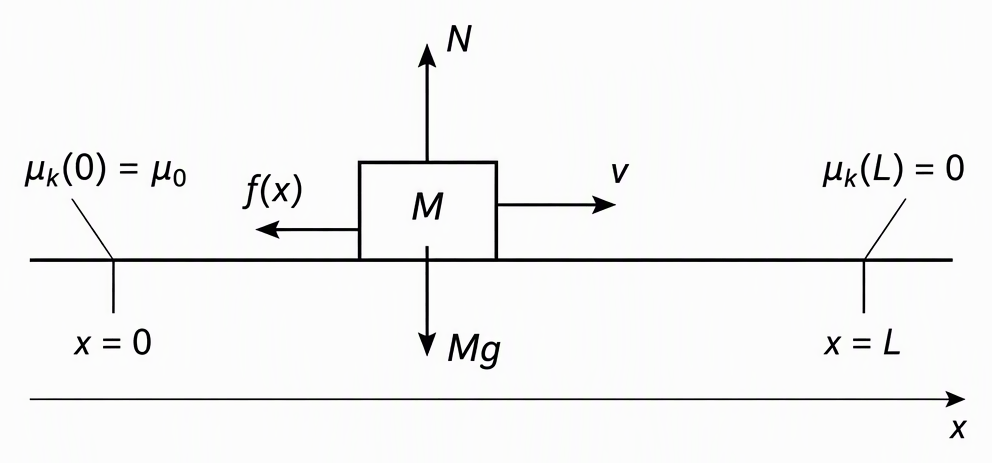
The coefficient decreases linearly and becomes zero at the endpoint:
The question expresses the total frictional work using the following factor and asks for its coefficient:
The supplied options are:
This is a NEET 2026 Physics MCQ from Work, Energy and Power. Medium difficulty and 90-second expected solve time are question-bank labels, not measured student performance. No initial speed or constant-speed assumption is supplied or needed.
How do you write the friction force and eliminate the unknown constant?
The normal reaction equals the particle’s weight because vertical acceleration is zero and the vertical forces shown balance. Use this balance to write the friction magnitude:
Here, the friction function is the non-negative magnitude of kinetic friction. At the right endpoint, the coefficient is zero, which fixes the rate constant:
Magnitude and direction must remain separate. Since motion is rightwards, the signed horizontal friction force is:
The initial coefficient is dimensionless, while the rate constant has dimensions of inverse length. Multiplying that rate constant by position therefore gives a dimensionless quantity:
How do you integrate the frictional work over the full path?
Integrate the signed force over the entire displacement because friction changes continuously with position. Multiplying one endpoint’s friction by the full distance would incorrectly treat that force as constant. The official solution keeps the position dependence inside the integral.
For a small rightward displacement, friction points leftwards. That opposition gives the minus sign:
Add these small contributions from the origin to the endpoint:
Integrate the constant term and the term proportional to position separately:
Evaluate both limits explicitly. Every term at the lower limit is zero:
Substitute the rate constant obtained from the endpoint condition:
The signed work is therefore:
The minus sign records energy transferred out of the particle’s motion by friction. It cannot be discarded just because the options are positive.
The dimensional check also passes: the coefficient is dimensionless, and weight multiplied by distance has units of joules.
Why is option D correct if friction does negative work?
Option D is correct under the official magnitude interpretation. Keep signed work and its magnitude separate:
The official solution compares the magnitude with the given factor:
The wording says “work done”, but the supplied positive options and official comparison use its magnitude. Read literally as a signed equality, the stated expression would require a negative coefficient:
That negative coefficient is not among the supplied choices. Final answer: D) one-half, under the official magnitude interpretation. Friction does not do positive work on the particle in this stationary-surface setup.
Zero friction at the endpoint does not erase the negative work accumulated earlier. It only means the friction force has fallen to zero there.
What incorrect method produces option B?
Option B follows from treating the initial coefficient as constant throughout the journey. The invalid step is replacing the position-dependent friction magnitude with its initial value over the entire interval:
This produces option B. Its magnitude is twice as large as the integrated result:
Before using the following constant-force expression, check whether the force component along the displacement changes with position:
If it changes, retain that dependence and integrate. Use the initial force only at the initial position, not across the whole path.
How do you solve two related variable-friction questions?
Use the same signed-force integral, changing only the travel limit or the endpoint condition. These are original practice variations, not additional verified NEET PYQs. Both reuse the horizontal arrangement from the Work, Energy and Power NEET 2026 question.
Question 1: What is the signed work over only the first half of the path?
Keep the original coefficient and integrate only to the halfway point. The force law stays unchanged; only the upper limit changes:
Half the distance does not mean half the total work magnitude. The first half has greater friction than the second half.
Question 2: What if the final coefficient is half its initial value?
The work magnitude is larger because friction no longer falls to zero. Retain a linear decrease and the original starting coefficient, but change the endpoint condition:
First determine the new rate constant, then integrate over the full path:
Friction is greater at every position after the start, so the magnitude exceeds that of the original signed work:
For a numerical check, use these practice values:
Now cover both worked answers and redo them. Change the upper limit in Question 1, but recalculate the rate constant in Question 2.
Next step: the past-paper archive on NEET JEEnius AI and search past NEET papers by year, subject or chapter, each with a worked solution (100 free searches a month).
If that step was the hard part, work through How to Study Animal Kingdom NEET: Six NCERT Steps.
Frequently asked questions
How do you calculate work done by linearly decreasing friction?
For rightward motion on this horizontal surface, the signed friction force is Fₓ = −(μ₀ − αx)Mg. The endpoint condition μₖ(L) = 0 gives α = μ₀/L. Integrating Fₓ from x = 0 to x = L gives W = −μ₀MgL/2.
Why is option D correct if friction does negative work?
Option D gives 1/2, the coefficient of the work magnitude |W| = μ₀MgL/2 under the official interpretation. The signed work is negative because friction opposes the displacement. If W = nμ₀MgL is read literally as signed work, n = −1/2, which is absent from the options.
Why can't I use the initial friction force times the distance?
The friction force decreases with position, so its initial value does not apply over the whole path. Using W = −μ₀MgL gives twice the correct work magnitude and produces option B. Retain the position dependence and integrate the signed force instead.
What is the frictional work over the first half of the path?
For μₖ(x) = μ₀(1 − x/L), integrating the signed friction force from 0 to L/2 gives W = −3μ₀MgL/8. This is three-quarters of the full-path work magnitude, not half, because friction is greater in the first half.