
What is the silvered lens NEET 2000 question asking?
The answer to the silvered lens NEET 2000 question is A) 10 cm, not the unsilvered lens’s 20 cm. The question asks for the focal length of the complete reflecting system, so calculating the lens’s focal length is only the first step.
A plano-convex lens has refractive index 1.5 and curved-surface radius 10 cm. Its flat face receives a reflecting coating. Incident light enters through the curved face, reaches the silvered plane face, and returns through the lens.
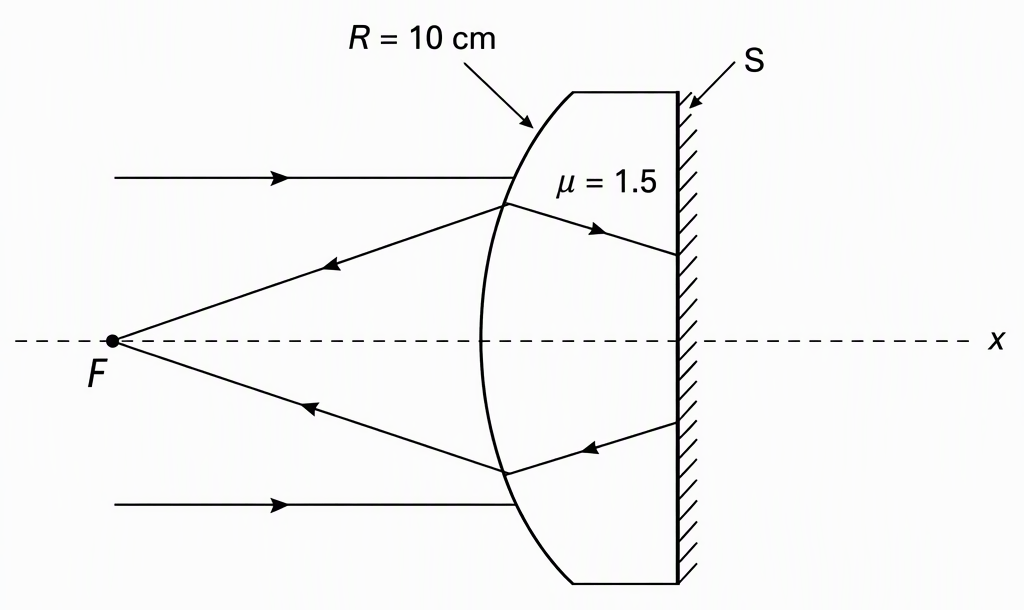
The supplied choices are:
The distinction is between one passage through the lens and the complete outward-and-return path. This question bank tags the problem as hard and gives it a 90-second target; neither is an official exam classification.
How do you calculate the focal length of the lens alone?
The unsilvered lens has a focal length of 20 cm. Start with the lens-maker relation, before accounting for reflection. The plane face has zero curvature, so its contribution to the curvature difference is zero.
Define the lens-alone focal length:
For a thin plano-convex lens in air, the relation becomes:
Substitute the curved-surface radius and refractive index, keeping the focal-length calculation in centimetres:
This is an intermediate result, not the silvered system’s answer. It describes the converging action of one passage through the lens.
Why does silvering the plane face make the focal length 10 cm?
Silvering makes light pass through the lens twice, doubling its converging power in the thin-lens model used by the supplied solution. The flat coating adds no focusing power of its own. It sends light back through the lens, where refraction acts again.
Follow the path in this order:
- Light passes through the lens.
- The plane coating reflects it.
- Light makes a second passage through the lens.
A plane mirror has zero optical power, not zero focal length. Its focal length is infinite: a parallel bundle reflected by a plane mirror alone stays parallel.
The equivalent power is therefore:
The first lens-power term belongs to the incoming passage. The zero belongs to the plane mirror, and the second lens-power term belongs to the return passage. Using reciprocal focal length with consistent units:
Thus, option A is correct. The initially parallel rays return and meet on the incident side of the system. The options request the focal-length magnitude, which is 10 cm. As a qualitative check, doubling converging power halves the focal-length magnitude.
Why does stopping early give option B instead of option A?
Option B follows from correctly finding the lens-alone focal length and then reporting it as the final answer. That incomplete method gives 20 cm but leaves out the second passage through the lens. The error is in counting the optical actions, not in the subtraction in the lens-maker formula.
The faulty inference is: “The plane mirror has zero power, so silvering changes nothing.” The mirror adds no focusing power, but it creates the return passage.
Use this exam check:
- Identify which face is silvered.
- Trace the full light path.
- Calculate the lens-alone focal length.
- Combine the powers along that path.
Trace first, halve second. The halving rule applies to the plane-silvered thin-lens arrangement used here. A curved reflecting surface cannot be assigned zero power, so halving every silvered lens’s focal length is not a valid method.
Can you solve two related questions using the same method?
The same method gives 5 D before silvering and 10 D after silvering for the first question, and a 20 cm curved-surface radius for the second. These are original same-chapter practice questions, not verified historical PYQs. Their answers are calculated values, not additional claims about the original paper.
Question 1: For the same lens, find the optical power before silvering and the equivalent power after its plane face is silvered.
First convert the lens-alone focal length into metres:
One dioptre means one reciprocal metre. Using centimetres directly in this power calculation would give the wrong numerical value.
The two passages give:
Converting back checks the original answer:
Question 2: With refractive index still 1.5, what curved-surface radius gives a plane-silvered plano-convex lens an equivalent focal length of 20 cm?
Reverse the two-pass relation first. The unsilvered lens must have twice the required system focal length:
Now rearrange the same plano-convex lens formula:
The required radius is 20 cm. In reverse problems, recover the lens-alone focal length before using the lens-maker relation.
Next step: the past-paper archive on NEET JEEnius AI and search past NEET papers by year, subject or chapter, each with a worked solution (100 free searches a month).
If that step was the hard part, work through How to Study Anatomy of Flowering Plants NEET: Six-Step NCERT Plan.
Frequently asked questions
What is the answer to the silvered lens NEET 2000 question?
The correct answer is option A, 10 cm, for the complete reflecting system. The unsilvered lens has focal length 10/(1.5 − 1) = 20 cm. Silvering its plane face creates a second passage through the lens, halving the equivalent focal-length magnitude to 10 cm.
Why does silvering the plane face double the lens power?
Light passes through the lens, reflects from the plane coating and passes through the lens again. In the thin-lens model, the two passages contribute equal converging power, so the equivalent power is twice the lens-alone power. The plane mirror itself contributes zero focusing power.
Does a plane mirror have zero focal length?
No, a plane mirror has infinite focal length and zero optical power. A parallel bundle remains parallel after reflection from a plane mirror alone. In this silvered lens, the mirror changes the light path rather than adding focusing power.
Can I halve the focal length for every silvered lens?
No, the halving rule applies to the plane-silvered thin-lens arrangement used in this question. A curved reflecting surface has its own optical power and cannot be treated as a plane mirror. Identify the silvered face and trace the complete light path before combining powers.