
What is the answer to the Laws of Motion NEET 2004 wedge question?
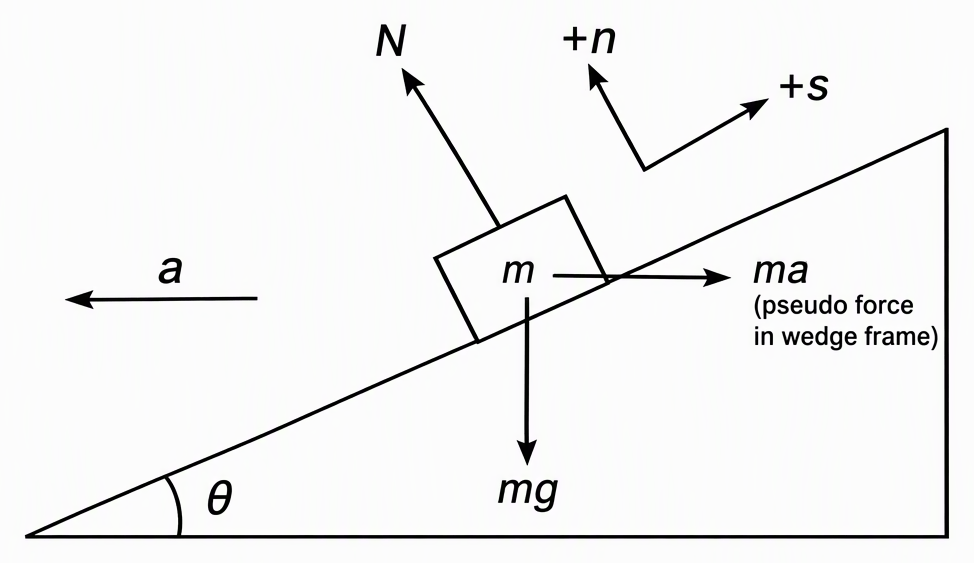
Option C is correct because the pseudo force also presses the block into the wedge. In this Laws of Motion NEET 2004 question, a block rests on a frictionless inclined wedge that accelerates horizontally just enough to keep the block stationary relative to its surface. Find the contact force exerted by the wedge on the block. Take the incline as rising to the right, with the wedge accelerating left.
The supplied options are:
The question bank tags this problem hard and gives an expected solve time of 90 seconds. These are the bank’s classification and estimate, not measured student performance.
Why should you choose the wedge frame first?
The block is at rest relative to the wedge, so use force balance in the wedge’s accelerating frame. This is a non-inertial frame, so the balance must include a pseudo force. Keep the entire derivation in this frame.
Smooth means frictionless. The wedge therefore exerts only the normal reaction on the block, with no friction along the surface.
The force inventory is:
- Weight, vertically downward.
- Normal reaction, perpendicular to the surface and outward.
- Pseudo force, horizontally right because the wedge accelerates left.
No slipping means zero acceleration relative to the wedge, not relative to the ground. The pseudo force belongs to the accelerating-frame analysis; it is not another contact force exerted by the wedge.
How does the no-slip condition give the required acceleration?
The uphill pseudo-force component must balance the downhill weight component. Take uphill along the incline as positive. The normal reaction has no component along the surface.
The horizontal pseudo force makes the incline angle with the uphill direction. Its projection along the slope therefore contains cosine, while the downhill weight component contains sine:
Move the weight component to the other side:
Cancel the mass and divide by the cosine:
The mass cancels because both forces are proportional to it. This acceleration is the intermediate no-slip constraint, not the requested answer. The contact force still requires the perpendicular balance.
How do you calculate the normal reaction on the block?
The normal reaction balances two inward components: one from weight and one from the pseudo force. Take outward perpendicular to the surface as positive. Both gravity and the rightward pseudo force have components pointing into this right-rising surface.
The perpendicular force balance is:
Therefore:
The plus sign matters: the pseudo force increases the inward load that the normal reaction must balance. Substitute the acceleration obtained from the no-slip condition:
Write tangent as sine divided by cosine, then combine the terms:
Use the identity:
Hence, option C:
Two checks support the result without changing frames. As the incline becomes horizontal, the required acceleration vanishes and the reaction becomes the weight:
For an acute, nonzero incline, cosine is less than one, so the contact force exceeds the weight:
Why is option D an incomplete force balance?
Option D drops the perpendicular component of the pseudo force. The faulty method resolves only gravity perpendicular to the surface and writes:
That expression is valid for a stationary straight wedge when the block maintains contact and has zero perpendicular acceleration. Importing it unchanged into this accelerating wedge frame leaves out the inward pseudo-force component:
For the no-slip accelerating wedge, the complete expression is:
Frictionless means no friction, not a fixed formula for the normal reaction. The chosen frame and the perpendicular acceleration condition determine the balance. Remaining fixed relative to the wedge does not make that frame inertial.
Before resolving forces in an accelerating frame, add the pseudo force opposite the frame’s acceleration. Then check its projection along both axes, not only along the slope.
How do you solve three variations of the same wedge question?
Keep the same right-rising smooth wedge and change only the stated condition. These are original practice variations, not verified past-paper questions; no additional related PYQs were supplied. Check which force or constraint changes before choosing a formula.
What is the normal force if the wedge is stationary and the block slides?
The reaction equals the perpendicular component of weight. The wedge frame is now inertial, so there is no pseudo force. Contact with the straight surface gives zero perpendicular acceleration:
The original no-slip requirement has been removed. The block can accelerate downhill while its perpendicular acceleration remains zero.
What inclination keeps the block fixed for a given leftward acceleration?
Choose the angle whose tangent equals the acceleration divided by gravity. The wedge-frame uphill balance remains:
Divide by the mass, gravity and cosine:
What are the acceleration and contact force at 45 degrees?
The required acceleration equals gravity, and the contact force is about 1.414 times the weight. This is a calculated practice example, not an extra fact about the original exam question:
Cover the solution and write both force balances again. Before simplifying, check that the perpendicular equation includes the inward pseudo-force component.
Next step: the past-paper archive on NEET JEEnius AI and search past NEET papers by year, subject or chapter, each with a worked solution (100 free searches a month).
If that step was the hard part, work through Evolution Practice Questions NEET: 6 MCQs Explained.
Frequently asked questions
What is the answer to the Laws of Motion NEET 2004 wedge question?
Option C is correct: the contact force is N = mg/cosθ. The smooth wedge exerts only a normal reaction, which balances the inward components of both gravity and the pseudo force in the wedge frame.
What acceleration keeps a block stationary on a smooth wedge?
For an incline rising to the right, the wedge must accelerate left with a = g tanθ. In the wedge frame, the uphill pseudo-force component balances the downhill weight component: ma cosθ = mg sinθ. The block has zero acceleration relative to the wedge, not relative to the ground.
Why is N = mg cosθ wrong for the accelerating wedge?
It omits the inward perpendicular component of the pseudo force. For the right-rising wedge accelerating left, the complete wedge-frame balance is N = mg cosθ + ma sinθ. Substituting the no-slip acceleration a = g tanθ gives N = mg/cosθ.
What are the acceleration and normal force for a 45-degree wedge?
For a smooth right-rising wedge that keeps the block fixed relative to its surface, the required leftward acceleration is a = g tan45° = g. The normal force is N = mg/cos45° = √2 mg, approximately 1.414 times the block's weight.