
What is the answer to the Oscillations and Waves NEET 2004 car-and-cliff question?
Option A, one-third of the speed of sound, is correct for the oscillations and waves NEET 2004 car-and-cliff question. The echo requires two Doppler steps: first find what the stationary cliff receives, then what the moving driver hears.
A car approaches a stationary high cliff while its driver sounds the horn. The driver hears the reflected sound at twice the horn’s frequency. Find the car’s speed in terms of the speed of sound in air, using u for car speed and v for sound speed.
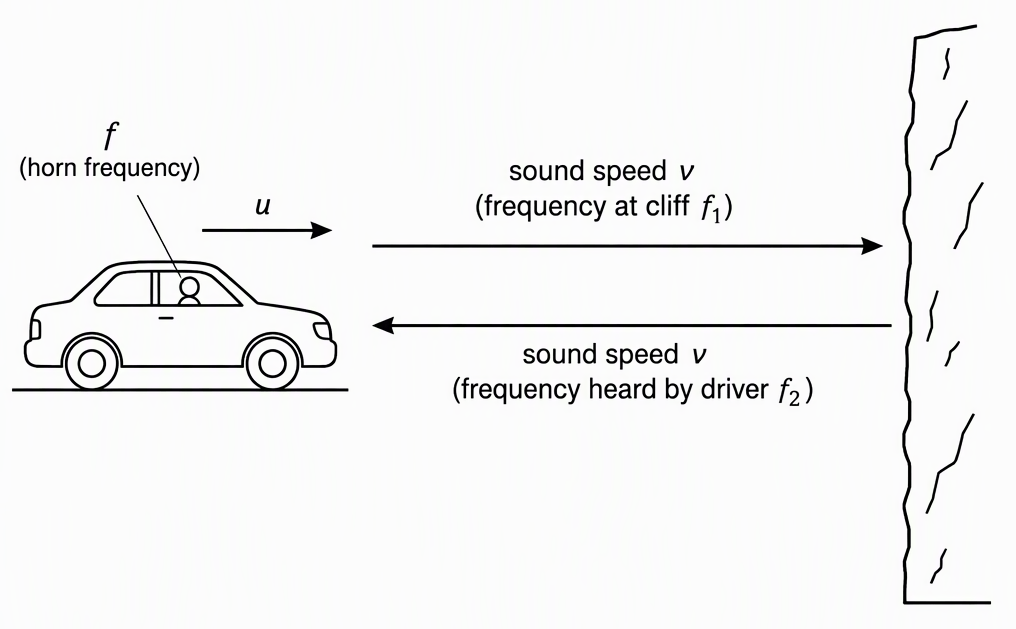
The horn and echo frequencies are:
The supplied options are:
How do you find the frequency reaching the stationary cliff?
The horn is the moving source, and the cliff is the stationary receiver on the outward journey. Since the horn moves towards the cliff at the car’s speed, the cliff receives a frequency higher than the emitted frequency. The driver’s reception of the echo does not enter this first calculation.
For a source approaching a stationary receiver:
Substituting the horn frequency and car speed gives:
The denominator subtracts the source speed because the horn moves closer to the cliff between successive wavefront emissions. This compresses the wavefront spacing ahead of it, producing a higher received frequency.
Check the sign physically:
This is the frequency at the cliff, not yet the frequency heard by the driver. Keep that receiver label attached to the result.
How does the reflected sound give a car speed of one-third of sound speed?
The stationary cliff reflects the incident frequency unchanged in the stationary air-and-cliff frame. It acts as a stationary effective source, while the driver becomes an observer moving towards the returning wave. That observer motion raises the received frequency again, even though the reflector never moves.
For this second stage:
The plus sign belongs to the approaching observer. The driver meets returning wavefronts faster than a stationary observer would.
Substitute the first-stage result:
Use the doubled echo condition:
The answer is option A. Car speed and sound speed must use the same velocity units.
At this speed, the outgoing and returning factors give:
For a numerical check, use these illustrative values, not extra data from the original question:
For a stationary car:
A stationary wall alone does not double frequency. The two shifts here come from the car’s motion as source and then observer.
Why does a one-step solution give the wrong option C?
Option C results from treating the frequency received by the cliff as the echo frequency measured by the driver. The first Doppler formula is valid, but assigning the doubled frequency to that stage is not. Stopping there omits the driver’s motion as an observer on the return journey.
The incorrect equation gives:
The algebra is correct, but the receiver has been misidentified. The question gives the frequency heard by the driver after reflection, not the frequency received by the stationary cliff.
Choose receiver labels over a memorised double-Doppler shortcut: they expose where the missing factor belongs. Before substituting any measured frequency, name the receiver at that stage, cliff first, driver second.
How can you check the method with two related Doppler questions?
Change the echo ratio in one problem and reverse the car’s direction in another. These test carrying both Doppler factors through the algebra and choosing signs from the motion. Both questions below are original practice variations, not additional verified PYQs.
What is the car speed if the approaching driver hears three times the horn frequency?
The car must move at half the speed of sound. Keep the same approaching-car and stationary-cliff arrangement, but replace the doubled echo with:
Use the same two stages:
Half the sound speed is correct for an echo ratio of three, not the original ratio of two. The method is unchanged; only the measured echo ratio differs.
What echo frequency does a driver hear while moving away at one-third of sound speed?
The driver hears half the horn frequency. The car now moves away from the same stationary cliff while sounding its horn at the original frequency. The horn recedes from the cliff, and the driver moves in the same direction as the returning wave, meeting fewer wavefronts per second.
The receding-source and receding-observer equations are:
Substitute the given speed:
Before accepting either answer, check the direction of the shift. Approach raises the echo frequency above the horn frequency, while recession lowers it below the horn frequency.
Next step: photograph a doubt on NEET JEEnius AI and photograph any question you are stuck on and get a step-by-step solution across Physics, Chemistry and Biology (20 free a month).
If that step was the hard part, work through How to Study Aldehydes Ketones NEET: 6-Step NCERT Revision.
Frequently asked questions
What is the answer to the NEET 2004 car-and-cliff Doppler question?
Option A is correct: the car speed is one-third of the speed of sound. For car speed u and sound speed v, the approaching driver hears an echo frequency f(v + u)/(v - u). Setting this equal to twice the horn frequency f gives u = v/3.
Why are two Doppler steps needed for the car-and-cliff echo?
On the outward journey, the moving horn is the source and the stationary cliff receives frequency f₁ = fv/(v - u). The cliff reflects that frequency unchanged in the stationary air-and-cliff frame. On the return journey, the moving driver receives frequency f₂ = f₁(v + u)/v.
Why is v/2 the wrong answer when the echo frequency doubles?
The result v/2 comes from incorrectly setting the frequency received by the cliff equal to twice the horn frequency. The question specifies the echo heard by the moving driver, so the return-journey Doppler factor must also be included. With both factors, the car speed is v/3.
What echo frequency is heard when the car moves away from the cliff at v/3?
The driver hears half the horn frequency, where v is the speed of sound. For a car receding at speed u, the echo frequency is f(v - u)/(v + u). Substituting u = v/3 gives f/2.