
Should I start Evolution revision with chapter MCQs, PYQs or mocks?
For students revising Evolution, fresh NCERT-aligned Evolution practice questions for NEET are the best starting point because they keep the task focused on the chapter. Use verified PYQs to inspect actual exam framing, not predict chapter question counts.
Choose full-length mocks when testing whole-paper performance rather than repairing one chapter. An original free mini-set follows, with answers and explanations. These are author-created questions, not official PYQs.
How do chapter MCQs, verified PYQs and full-length mocks compare?
Chapter MCQs expose concept gaps, verified PYQs reveal historical exam framing, and full mocks expose execution problems across subjects. Choose by the mistake you need to uncover, not by which format produces the most comfortable score.
Each comparison below follows this order: original NCERT-aligned chapter MCQs; verified Evolution PYQs; full-length NEET mocks.
- Main purpose: Isolate conceptual weaknesses; inspect authentic past framing; test mixed-subject execution and time management.
- Chapter focus: Entirely Evolution; Evolution questions selected from past papers; whole-paper practice, with no guaranteed Evolution coverage.
- Question provenance: Newly written practice questions; questions traceable to actual papers and official keys; independently assembled practice papers, not official examinations.
- Feedback needed: Accurate wording and concept explanations; verified answers with reasoning; scored subject results plus review of reading and timing errors.
- Blind spot: Quality depends on accurate wording and explanations; repeated exposure can make answer recognition look like mastery; a total score can hide a chapter weakness.
- Best point in preparation: While checking or repairing chapter understanding; after understanding the concepts; when testing performance across the paper.
This article includes six original questions and their explanations free. Externally sourced PYQs need separate checks for authenticity and access; a “free” label establishes neither. For whole-paper practice, NEET JEEnius AI offers 30 free full-length mocks a month.
Which format fits my current preparation problem?
Use unfamiliar chapter questions when you cannot explain an answer; choose full mocks when errors appear mainly in mixed papers. Your class label alone does not decide the format. A dropper who remembers answers may need concept repair more than another familiar PYQ session.
- Class 11, studying Evolution ahead of school: Read the relevant theory first, then attempt chapter MCQs. An early result shows what needs teaching or revision; it is not a verdict on NEET readiness.
- Class 12, just completed Evolution: Start with the original mini-set below. Review the concepts behind errors before increasing the number of questions.
- Dropper, remembers PYQ answers: Choose unfamiliar chapter questions. Explain why each distractor is wrong before returning to familiar PYQs.
- Correct in chapter practice, weaker in mixed papers: Prioritise full mocks. Separate missing knowledge from misreading, poor time allocation and answer-transfer errors.
If you cannot explain a concept, return to the relevant NCERT passage rather than blindly repeating similar questions. Then attempt a fresh question to check whether you can apply the corrected rule.
Where can I attempt free Evolution MCQs for NEET?
Attempt the six questions below before opening the key. They are original, author-created, NCERT-aligned practice, not previous-year questions. Choose one answer per question without notes and mark each response confident, uncertain or guessed before checking. Answers and explanations appear in the next section.
1. Which comparison correctly identifies homology and analogy at the stated structural level?
- A. Human arms and whale flippers are analogous because their functions differ.
- B. Human arms and whale flippers are homologous as vertebrate forelimbs; bird and butterfly wings are analogous as flight organs.
- C. Bird and butterfly wings are homologous because both enable flight.
- D. Human arms and whale flippers are unrelated because one works in water.
2. A bacterial population already contains a few bacteria with heritable antibiotic resistance. After antibiotic exposure, resistant bacteria become more common. Which explanation fits natural selection?
- A. The antibiotic creates useful mutations because the bacteria need them.
- B. Sensitive bacteria deliberately develop resistance during treatment.
- C. Resistant bacteria are more likely to survive and reproduce.
- D. Every exposed bacterium becomes resistant, but at a different speed.
3. A chance flood leaves a random few beetles alive. Survival is unrelated to their colour, but the survivors have different colour-allele frequencies from the original population. What best explains this change?
- A. Genetic drift caused by chance survival.
- B. Natural selection favouring a protective colour.
- C. A useful mutation directed by the flood.
- D. Adaptive radiation into different feeding niches.
4. A large population initially satisfies Hardy–Weinberg assumptions. Mating remains random. Which change nevertheless violates an assumption of equilibrium?
- A. Individuals continue pairing independently of genotype.
- B. The population remains large.
- C. No new mutations occur.
- D. Migrants with different allele frequencies enter and breed.
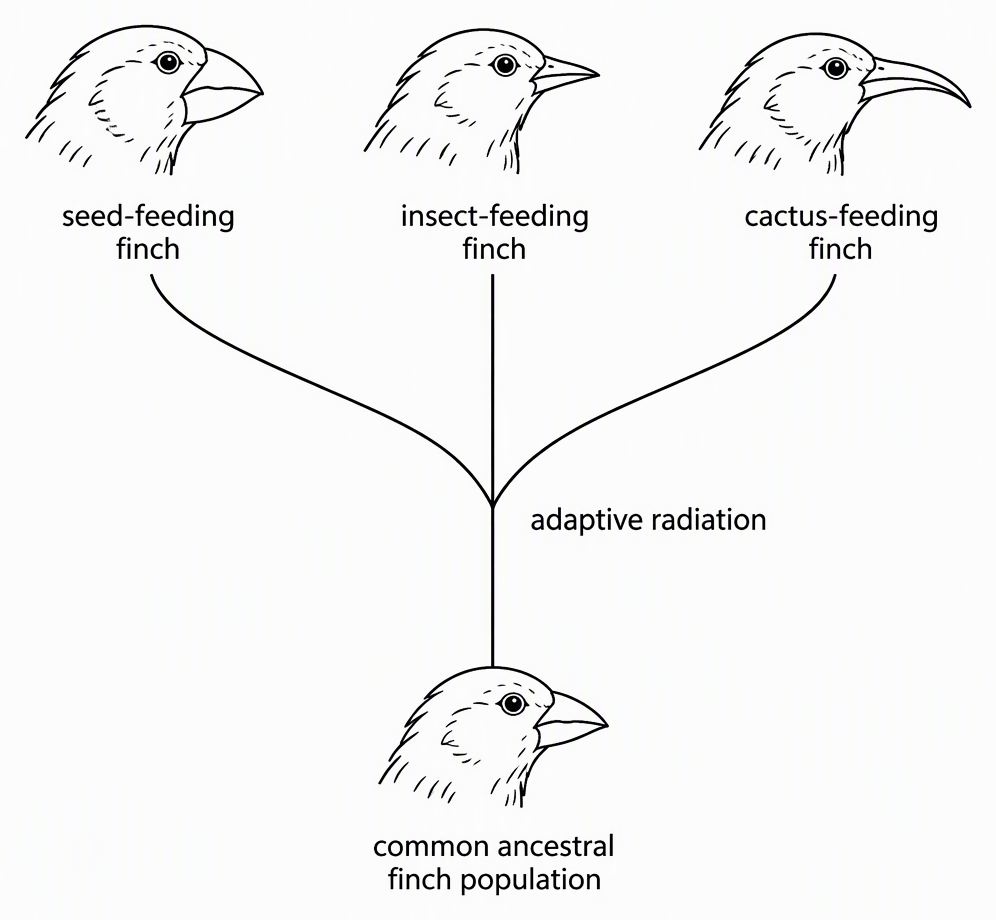
5. Several Darwin’s finch species diversified from a common ancestral population into different feeding niches. Which interpretation best fits this pattern?
- A. Convergence among unrelated ancestral groups.
- B. Adaptive radiation from a common ancestor.
- C. Organisms acquiring required beaks through use alone.
- D. All species remaining unchanged despite different niches.
6. Which conclusion is supported by the Miller experiment?
- A. Living cells were created from inorganic gases.
- B. The exact composition of Earth’s early atmosphere was proved.
- C. Organic compounds could form under the simulated conditions.
- D. Natural selection was shown to operate without reproduction.
What do the answers reveal about my Evolution concepts?
The key is 1 B, 2 C, 3 A, 4 D, 5 B, 6 C. Your reason must match the governing concept, not just the correct letter. Review correct guesses and any option you rejected only because it seemed unfamiliar.
1. Homology concerns common ancestry and underlying structure. Human arms and whale flippers share the vertebrate forelimb plan despite different functions. Bird and butterfly wings are analogous as flight organs: their similar function arose independently. C mistakes shared function for shared ancestry; A wrongly rejects homology because functions differ, while D ignores structural evidence.
2. Selection acts on heritable variation. Resistant bacteria survive and reproduce more successfully under antibiotic exposure. A is tempting because treatment precedes the population change, but need does not direct a useful mutation. B assigns intention to bacteria; D wrongly assumes every exposed individual becomes resistant.
3. Chance survival indicates genetic drift. The flood changes allele frequencies through random sampling of survivors. B would require survival linked to an advantageous trait, which the question excludes. C invents directed mutation; D confuses a population change with diversification into ecological niches.
4. Random mating alone is insufficient. Migrants with different allele frequencies introduce gene flow, which can change population frequencies despite random mating. A may tempt you if you recall only random mating, but A, B and C preserve equilibrium assumptions. Hardy–Weinberg provides a baseline for detecting evolutionary change, not just a formula to memorise.
5. Adaptive radiation is diversification from common ancestry. The finches diverged from an ancestral population into different feeding niches. A reverses the pattern: convergence involves independently evolved similarities. C invokes inheritance through use; D denies the diversification stated in the question.
6. Organic synthesis is not the creation of life. The experiment produced organic compounds under simulated conditions, not living cells. A crosses that boundary; B treats an experimental model as proof of the exact early atmosphere. D introduces selection without the reproducing populations needed for it.
What else should I know about free Evolution practice?
The original MCQs and explanations are fully available in this article, with no paywall to complete the set. The separately offered full-length mocks test whole-paper performance and are not required for this practice.
Are PYQs enough if I remember the answers?
No. Verified PYQs show authentic historical framing, but familiar answers alone do not establish understanding. Explain the correct answer and reject the distractors without relying on memory.
How many Evolution questions will appear in NEET?
A reliable fixed number cannot be promised from the supplied evidence. Past papers show historical framing, not guaranteed future chapter weightage. Check neet.nta.nic.in for official exam information.
Should I read NCERT or solve Evolution practice questions?
Do both: NCERT supplies the concepts, while questions test whether you can apply them. If an explanation exposes a gap, reread the relevant passage before attempting another question on that concept.
How should I choose my next session from my mistakes?
Use your confidence marks and error types, not just the total. A confident wrong answer may expose a firm misconception; a correct guess still needs review. Classify each problem as a concept gap, confused terminology, misread condition or unsupported guess before deciding what to practise next.
Record a simple review entry:
- Question topic: Genetic drift.
- Reason for error: Treated every survival difference as selection.
- Corrected rule: Chance-driven allele-frequency change is drift; selection involves differences in reproductive success linked to heritable traits.
- Next practice: Reread the NCERT discussion, then attempt a fresh drift-versus-selection question.
Apply the official marking rule: 4 marks for a correct answer, minus 1 for a wrong answer, and 0 for an unattempted question. Do not turn this small chapter-set result into a predicted NEET score or rank.
For weak concepts, reread the relevant NCERT passage and answer an unfamiliar question on the same idea. For problems that appear only in mixed papers, move to full-mock practice and separately record knowledge, reading, timing and answer-transfer errors. A scored per-subject breakdown is not an Evolution-specific diagnostic, and Evolution coverage is not guaranteed.
For that purpose, NEET JEEnius AI provides 30 free full-length mocks a month. Each has 180 questions, 720 marks and 180 minutes, with 45 Physics, 45 Chemistry and 90 Biology questions, plus a scored per-subject breakdown.
Next step: full-length mock tests on NEET JEEnius AI and sit a full 180-question, 720-mark, 180-minute paper, 45 Physics, 45 Chemistry and 90 Biology, and get a scored per-subject breakdown (30 free a month).
Related on NEET JEEnius AI: Tapetum and Microsporangium NEET 2026: Why Option C Is Correct.
Frequently asked questions
Where can I practise free Evolution MCQs for NEET?
This article provides six original, NCERT-aligned Evolution MCQs with answers and explanations, with no paywall to complete the set. They are author-created practice questions, not official PYQs. Attempt them without notes and mark each answer as confident, uncertain or guessed before checking.
Are Evolution PYQs enough if I already remember the answers?
No. Remembering an answer does not establish that you understand the concept. Attempt unfamiliar chapter questions and explain why each distractor is wrong before returning to verified PYQs.
Should I read NCERT or solve Evolution practice questions?
Do both: NCERT supplies the concepts, while questions test whether you can apply them. When an explanation exposes a gap, reread the relevant NCERT passage. Then attempt a fresh question on the same concept.
How many Evolution questions will appear in NEET?
A fixed number cannot be reliably promised. Past papers show historical question framing, not guaranteed future chapter weightage. Check neet.nta.nic.in for official exam information.