
Should I use worked Polymers questions or a full NEET mock?
Use worked Polymers practice questions for NEET concept revision, not a full mock, but check syllabus relevance first. Consult the official syllabus for your target examination year at neet.nta.nic.in. An old question bank does not establish current relevance. Choose this article’s free original worked MCQs for immediate concept checking, a checked PDF or legacy PYQ collection for further written practice, and a full-length mock for whole-paper assessment.
The supplied information does not verify whether Polymers is included in or excluded from your target-year syllabus. Check the actual syllabus wording before giving this topic substantial NEET preparation time.
The questions, answers and explanations are available directly in this article. There is no download to wait for, and the set is deliberately small.
Which free Polymers practice format should I choose?
Use the worked set to check concepts, a checked collection to extend written practice, and a mock to assess a complete paper. Targeted concept practice and whole-paper assessment are different tasks. Compare explanation quality, syllabus context and access before choosing a resource, rather than assuming that every collection labelled “free” offers the same thing.
- Purpose
- This article’s original worked MCQs: Check a few common Polymers misconceptions immediately.
- Existing PDFs or legacy PYQ collections: Provide further written practice after their content has been checked.
- NEET JEEnius AI full-length mocks: Assess performance across a complete paper.
- Explanation availability
- Article: Answers and explanations appear below the question set.
- PDFs or PYQ collections: Quality varies. Check whether the resource explains the chemistry rather than printing only answer letters.
- Full-length mocks: The verified output is a scored per-subject breakdown. The supplied offer does not establish worked solutions.
- Syllabus checks needed
- Article: These are original concept-revision questions, not actual NEET questions or evidence of target-year syllabus coverage.
- PDFs or PYQ collections: Check the syllabus context, especially for older material.
- Full-length mocks: Use the applicable official syllabus to guide preparation. The offer alone does not establish coverage of a particular chapter.
- Chapter targeting
- Article: Every question concerns Polymers, but the sample is not comprehensive.
- PDFs or PYQ collections: Check the actual questions, not just the filename or cover.
- Full-length mocks: Whole-paper practice. The verified offer does not establish a Polymers-only test or a downloadable chapter PDF.
- Cost and access certainty
- Article: Free to attempt directly on this page.
- PDFs or PYQ collections: Access conditions and question provenance vary. Check each resource before depending on it.
- Full-length mocks: The verified offer is 30 free full-length mocks a month, each containing 180 questions for 720 marks in 180 minutes: 45 Physics, 45 Chemistry and 90 Biology questions, followed by a scored per-subject breakdown.
- Main limitation
- Article: Too small to establish complete chapter coverage.
- PDFs or PYQ collections: Reliability must be checked resource by resource.
- Full-length mocks: Not the right tool for isolating one Polymers misconception.
What should Class 11 students, Class 12 students, droppers and parents choose?
Choose according to your syllabus, school requirement and the problem you need to fix. A school assignment can justify Polymers practice independently of NEET coverage. An unfamiliar chapter in an old module is not, by itself, a reason to add another revision task.
- Class 11 students: Check syllabus relevance first. Before adding a legacy chapter, make sure you understand monomers, functional groups and the basic difference between addition and condensation.
- Class 12 students with a school or board assignment: Attempt the worked set below. If you need more written practice, use a checked printable resource that matches what your school is teaching.
- Droppers using older coaching modules: Distinguish retained legacy coverage from material explicitly required by your target-year NEET syllabus. A familiar module is not an official syllabus document.
- Students who know the concepts but struggle across a complete paper: Choose a full-length mock. Another isolated worksheet cannot assess subject balance or pacing across the paper.
- Parents evaluating free resources: Look for visible explanations, traceable question sources and honest scope. Question volume and the word “NEET” do not prove usefulness.
Stop rule: if the topic is absent from the applicable official syllabus and there is no separate school requirement, do not expand it into a major NEET revision task. Return to topics that your examination actually requires.
Can I try free Polymers MCQs with answers now?
Attempt these five original, single-correct concept-revision MCQs before reading the explanations. They are not NEET PYQs, predicted questions or evidence of current syllabus coverage. This diagnostic sample checks selected relationships that are easy to confuse, not the whole chapter.
How should I attempt the questions before checking the answers?
Choose one option for each question, and keep the answer block below out of view until you finish. Record a short reason, such as “two functional groups react.” If you cannot give a reason, mark the answer as uncertain even if the name looks familiar.
1. Which monomer is used to prepare PTFE?
- A. Ethene
- B. Chloroethene
- C. Tetrafluoroethene
- D. Styrene
2. Which pairing correctly distinguishes nylon-6 from nylon-6,6?
- A. Nylon-6: caprolactam; nylon-6,6: hexamethylenediamine and adipic acid
- B. Nylon-6: hexamethylenediamine and adipic acid; nylon-6,6: caprolactam
- C. Nylon-6: ethylene glycol and terephthalic acid; nylon-6,6: caprolactam
- D. Nylon-6: caprolactam; nylon-6,6: ethylene glycol and terephthalic acid
3. Which statement correctly compares polyethene and nylon-6,6 formation?
- A. Both form by condensation with elimination of water.
- B. Polyethene forms by addition; nylon-6,6 forms by condensation with elimination of water.
- C. Polyethene forms by condensation; nylon-6,6 forms by addition without small-molecule elimination.
- D. Both form by addition without small-molecule elimination.
4. Which pair of monomers forms Buna-S?
- A. Buta-1,3-diene and acrylonitrile
- B. Chloroprene and styrene
- C. Ethene and styrene
- D. Buta-1,3-diene and styrene
5. Which statement correctly distinguishes polyethene from cured Bakelite?
- A. Both are thermoplastics because both contain long polymer chains.
- B. Polyethene is thermosetting because its chains are extensively cross-linked.
- C. Polyethene is thermoplastic; cured Bakelite has a cross-linked network that prevents repeated heat-softening and remoulding.
- D. Cured Bakelite is thermoplastic because cross-links break reversibly on heating.
What are the correct answers, and why are the other choices wrong?
The correct choices are 1 C, 2 A, 3 B, 4 D and 5 C. Check your reason against each explanation, including for correct guesses. The task is to connect each polymer to its starting material, formation process or structure, not just recognise its name.
1. C: Tetrafluoroethene forms PTFE. Ethene instead forms polyethene. Chloroethene forms PVC, while styrene forms polystyrene; the error is remembering “ethene” but overlooking the substituents that identify the actual monomer.
2. A: Nylon-6 is prepared from caprolactam; nylon-6,6 uses hexamethylenediamine and adipic acid. Caprolactam is a cyclic starting material that undergoes ring-opening polymerisation. The similar names do not make the monomers interchangeable, and ethylene glycol with terephthalic acid gives a polyester rather than either nylon listed here.
3. B: Polyethene forms by addition, while nylon-6,6 forms by condensation. Ethene molecules join without eliminating a small molecule. In nylon-6,6 formation from the stated diamine and dicarboxylic acid, amide-link formation releases water; “many molecules join” is not enough to identify the mechanism.
4. D: Buna-S uses buta-1,3-diene and styrene. Buta-1,3-diene with acrylonitrile corresponds to Buna-N, while chloroprene forms neoprene. Ethene cannot replace buta-1,3-diene in the Buna-S monomer pair.
5. C: Polyethene is thermoplastic; cured Bakelite is thermosetting. Polyethene can soften on heating and be reshaped under suitable conditions. Bakelite’s extensive covalent cross-links create a network that prevents this repeated remoulding.
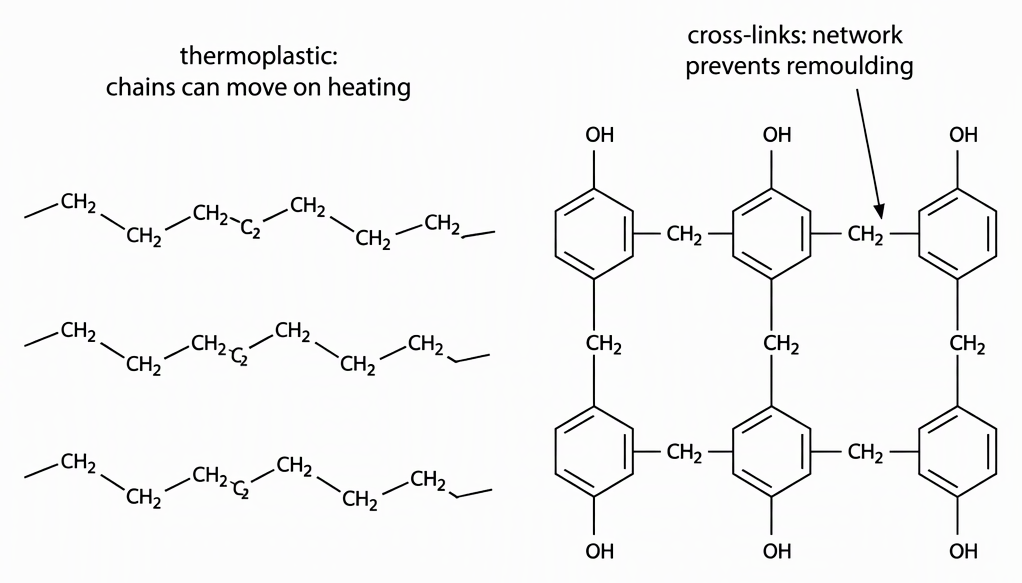
Having long chains does not make every polymer thermoplastic. Strong heating does not reversibly break cured Bakelite’s cross-links to permit remoulding; it can instead cause degradation.
How can I check a Polymers PDF or PYQ collection before using it?
Check attribution, explanations and syllabus context before committing to a collection. A trustworthy worksheet states where its questions come from and explains why its answers are correct. Neither an NCERT-derived question nor an authentic older PYQ proves that a standalone chapter belongs in your target-year NEET syllabus.
- Identify the question type. Does the resource separate original practice from actual previous-year questions?
- Trace any PYQ claim. Look for an identifiable examination year and a traceable paper or official answer key. A “PYQ” label alone is insufficient.
- Inspect explanations. Choose a question with similar names, such as nylon-6 and nylon-6,6. Check whether the explanation distinguishes them correctly.
- Check syllabus context. Look for the examination or school course the material addresses, then compare it with the applicable official syllabus.
- Confirm access conditions. Check whether the questions and answers you need are accessible before building a study session around them.
Use your mistakes from the sample to decide what to revise. Classify the error before choosing more questions:
- Monomer recall: Errors in Questions 1 or 4. Revise the exact monomer-to-polymer pairing, including the nearby distractor.
- Similar-name confusion: An error in Question 2. Write the starting materials for nylon-6 and nylon-6,6 separately.
- Polymerisation mechanism: An error in Question 3. Explain what joins and whether a small molecule is eliminated.
- Structure-property confusion: An error in Question 5. Connect cross-linking to the inability to remould a thermoset.
Repair the mistaken relationship before attempting more questions. Then try a different question testing that relationship, rather than repeating the original until its answer letter feels familiar.
When should I stop chapter practice and take a full NEET mock?
Take a full mock when you need to assess subject balance, pacing and accuracy across a complete paper. Do not use it to diagnose one confused monomer pair. A scored per-subject breakdown can show that Chemistry needs attention, but it does not constitute a verified chapter-level diagnosis.
The supplied current pattern is 180 compulsory single-correct questions in 180 minutes, for 720 marks, with no optional section. It contains 45 Physics, 45 Chemistry and 90 Biology questions. The marking scheme is:
For the choice between focused Chemistry practice and a complete paper, read Free NEET Chemistry Mock Test: Choose the Right Format. Decide what you want the attempt to reveal before starting it.
NEET JEEnius AI offers 30 free full-length mocks a month, with the stated question split, duration and marks, followed by a scored per-subject breakdown. Use one when whole-paper assessment is the task.
If Polymers is relevant to your syllabus or school requirement, use the worked set for concept revision and a checked worksheet for further targeted practice. If your difficulty is performance across the complete paper, take a mock instead.
Next step: full-length mock tests on NEET JEEnius AI and sit a full 180-question, 720-mark, 180-minute paper, 45 Physics, 45 Chemistry and 90 Biology, and get a scored per-subject breakdown (30 free a month).
Frequently asked questions
Where can I practise free Polymers MCQs with answers?
This article provides five free, original, single-correct Polymers MCQs with answers and explanations directly on the page. They test selected monomer pairings, polymerisation mechanisms and structure-property relationships. Attempt them before reading the explanations; no download is needed.
Are these Polymers questions actual NEET PYQs?
No. These are original concept-revision questions, not NEET PYQs or predicted questions. They do not establish target-year syllabus coverage or provide comprehensive chapter practice.
Should I study Polymers for my target-year NEET exam?
Check the applicable official syllabus at neet.nta.nic.in before allocating substantial preparation time. This article does not verify whether Polymers is included in your target-year syllabus. If it is absent and you have no separate school requirement, do not make it a major NEET revision task.
Should I use Polymers practice questions or a full NEET mock?
Use worked Polymers questions to check specific concepts when the topic is relevant to your syllabus or school requirement. Use a full-length mock to assess subject balance, pacing and accuracy across the complete paper. A scored per-subject breakdown does not establish a chapter-level diagnosis.