
Should I practise chapter questions or full mocks for Work, Energy and Power?
Start with chapter questions to repair mistakes; use full mocks to test whole-paper performance. For Work, Energy and Power practice questions for NEET, choose concept drills if you cannot identify the principle, mixed chapter MCQs to practise selecting it, and full mocks for whole-paper pressure.
Full mocks cannot substitute for repairing a specific chapter misconception. Six original free MCQs with worked answers follow on this page, with no download or registration.
How do concept drills, mixed chapter MCQs and full mocks compare?
Concept drills isolate a weakness, mixed chapter questions test method selection, and full mocks test pacing and subject switching. Choose by the mistake you need to fix. This is a comparison of practice formats, not a claim that NEET JEEnius AI provides chapter-drill or mixed-chapter products.
- Best use: Concept-by-concept drills: repair one principle. Mixed Work, Energy and Power MCQs: choose between principles. Full-length NEET mocks: apply knowledge across a complete paper.
- Does the topic reveal the method? Drills: often. Mixed chapter MCQs: less directly. Full mocks: no chapter label guides you.
- Breadth of feedback: Drills: one skill. Mixed chapter MCQs: connections within the chapter. Full mocks: performance across subjects.
- Main limitation: Drills can reward formula recognition without independent selection. Mixed chapter sets cannot establish readiness across the full Physics paper. Full mocks provide less concentrated chapter practice.
- When to move on: Drills: when you can explain the method without a topic cue. Mixed sets: when selection stays reliable. Full mocks: continue reviewing, returning to targeted practice whenever a misconception appears.
Which practice format should I pick right now?
Your demonstrated mistake matters more than your class or attempt number. A dropper may need basic direction drills, while a Class 11 student may already handle mixed chapter questions well. Use your written reasoning as evidence, not confidence or formula familiarity.
- Class 11 example: You treat force multiplied by distance as universally valid. Start with direction, displacement and work-sign drills, including perpendicular forces and forces opposing motion.
- Class 12 example: You know the formulas but confuse net work with work done by one force. Repair that distinction first, then use mixed chapter questions where several forces act.
- Dropper example: You solve chapter questions correctly but rush them during a full paper. Prioritise full-mock review, including where you started guessing or skipping checks, rather than collecting another formula list.
Attempt the following six questions before viewing the solutions. For each, write the principle you chose beside your answer. Choose your next practice format from the type of error, not an arbitrary score cutoff.
Can I try six free Work, Energy and Power practice questions for NEET now?
The six questions below are original, single-correct practice MCQs, not NEET previous-year questions or predictions. Their numerical values are teaching inputs, not exam statistics. Attempt them on paper, record one option per question, and leave the worked answers covered until you finish.
Q1. A constant force of 10 N acts at an angle of 60 degrees to a displacement of 2 m. What is the work done by this force? Consider only the stated force, not net work.
- A: 0 J
- B: 10 J
- C: 20 J
- D: 40 J
Q2. A particle moves along the x-axis from 1 m to 3 m. The x-component of a position-dependent force is given below. What work does this force do over that interval?
- A: 4 J
- B: 6 J
- C: 8 J
- D: 12 J
Q3. A body of constant mass 2 kg initially moves at 3 m/s. The total work done by all forces on it is positive 16 J. What is its final speed?
- A: 4 m/s
- B: 5 m/s
- C: 7 m/s
- D: 8 m/s
Q4. A block slides at 5 m/s on a rough horizontal surface. The coefficient of kinetic friction is 0.25. Take gravitational acceleration as 10 m/s². Only gravity, the normal reaction and kinetic friction act. How far does it travel before stopping?
- A: 2.5 m
- B: 5 m
- C: 10 m
- D: 20 m
Q5. A 1 kg block is attached to an ideal massless horizontal spring of force constant 200 N/m, fixed at its other end. Released from rest at 0.10 m compression on a frictionless surface, what is its speed at natural length?
Q6. At a particular instant, a force of 20 N makes an angle of 60 degrees with a body's velocity of 3 m/s. What instantaneous power does this force deliver to the body?
- A: 0 W
- B: 30 W
- C: 60 W
- D: 120 W
What are the worked answers, and which principle does each question need?
Answer key:
Check the governing principle before checking your arithmetic. A correct option reached through an invalid method still needs correction.
Why is the work in Q1 only 10 J?
Only the force component parallel to displacement contributes to work. The perpendicular component does no work because there is no displacement in its direction.
For a constant force, use displacement, not total distance travelled along an arbitrary path. Multiplying the full force by 2 m gives 20 J and wrongly treats the force as parallel to motion.
How do I calculate work when the force changes in Q2?
Use the area under the force–position graph, or its equivalent integral. Here the force rises linearly, so the relevant area is a trapezium, not a rectangle at the final force.
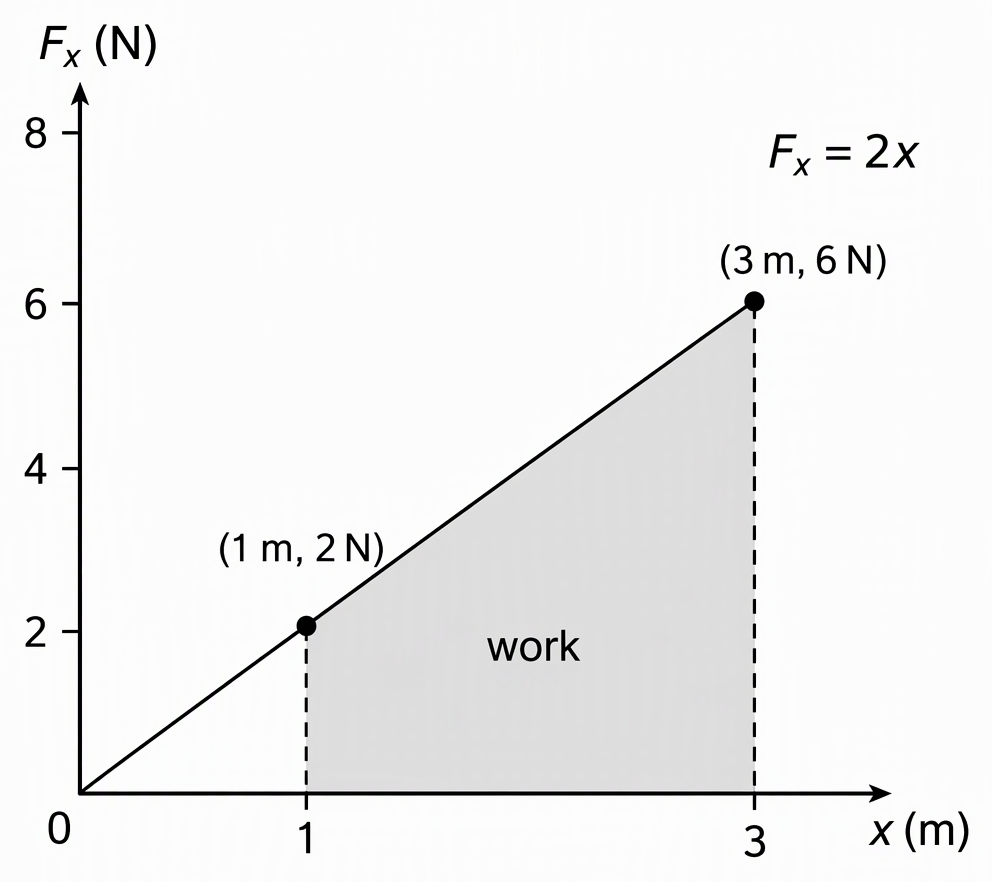
Using the final force throughout gives 12 J. That overestimates work because the force was smaller earlier.
Why does Q3 give a final speed of 5 m/s?
Net work equals the change in kinetic energy, not the final kinetic energy alone. The body already has energy before the stated work is done.
Setting final kinetic energy equal to 16 J discards the initial energy. The theorem requires the combined work of all forces.
Why does the mass cancel in Q4?
Both kinetic energy and frictional work are proportional to mass, so it cancels. Friction does negative work, removing the block's kinetic energy. On this horizontal surface, the normal reaction equals the weight; gravity and the normal reaction do no work.
Using magnitudes:
Treating frictional work as positive reverses the energy transfer. It predicts an energy gain instead of stopping.
Why is the spring answer in Q5 the square root of two?
The block–spring system conserves mechanical energy under the stated frictionless conditions. At natural length, spring potential energy is zero, so the initial stored energy has become kinetic energy.
Mechanical energy is conserved; kinetic energy is not. Assuming kinetic energy stays constant would incorrectly leave the block at rest.
Why is the instantaneous power in Q6 only 30 W?
Instantaneous power is the dot product of force and velocity. Only the force component along the instantaneous velocity transfers energy at that instant.
Multiplying magnitudes alone gives 60 W. That shortcut applies when force and velocity point in the same direction, which they do not here.
How should my mistakes determine the next question set?
Choose the next set by the failed step, not your total score. These Work, Energy and Power practice questions for NEET sample six skills; they are neither exhaustive chapter coverage nor a predictor of NEET marks. A principle error needs different practice from a dropped unit, multiplication slip or misread question.
- Q1 or Q6 errors: Practise angles, directions and dot products. Include forces parallel, perpendicular and opposite to motion.
- Q2 errors: Practise force–position graph work, including signed areas below the axis.
- Q3 errors: Separate net work from individual-force work. List every contributing force before applying the theorem.
- Q4 or Q5 errors: Practise system choice and energy accounting. State whether mechanical energy is conserved, and identify where energy goes when it is not.
Repeated calculation slips do not automatically justify relearning the entire chapter. Check whether your setup was correct before assigning more concept drills. Log each error in one sentence: “I chose work–energy, treated net work as final kinetic energy, and should have added the initial kinetic energy.”
After a principle error, solve a fresh question with changed conditions. A memorised reattempt is not evidence of mastery. Move to mixed chapter practice once you can explain why each method applies; use full mocks when maintaining that reasoning across a complete paper becomes the recurring problem.
Where do free full-length NEET mocks fit after chapter practice?
Full mocks belong after targeted repair, or alongside it when your main problem is whole-paper execution. They test pacing and subject switching, not just recall of this chapter. The paper-wide average is one minute per question, but that is not a compulsory one-minute limit for every Physics question.
Under the official marking scheme, a correct answer earns 4 marks, a wrong answer loses 1 mark, and an unattempted question earns 0. Review incorrect attempts as well as omissions: a rushed guess and a question you never reached need different fixes. For another chapter diagnostic, try Waves practice questions for NEET: 6 MCQs with worked answers.
When ready, NEET JEEnius AI provides 30 free full-length mock tests a month, each with 180 questions, 720 marks and 180 minutes:
- Physics: 45 questions.
- Chemistry: 45 questions.
- Biology: 90 questions.
You receive a scored per-subject breakdown. These are whole-paper mocks, not a verified Work, Energy and Power question bank; no fixed chapter count is promised. Use your next mock to check whether the specific error you repaired returns under pressure.
Next step: full-length mock tests on NEET JEEnius AI and sit a full 180-question, 720-mark, 180-minute paper, 45 Physics, 45 Chemistry and 90 Biology, and get a scored per-subject breakdown (30 free a month).
Frequently asked questions
Should I solve Work, Energy and Power chapter questions or full NEET mocks?
Start with concept drills if you cannot identify the governing principle, then use mixed chapter MCQs to practise selecting the method independently. Use full mocks to test pacing and subject switching across the paper. A full mock cannot substitute for repairing a specific chapter misconception.
Are these Work, Energy and Power questions NEET previous-year questions?
No. These are six original, single-correct practice MCQs, not NEET previous-year questions or predictions. All six include worked answers and can be attempted free without downloading anything or registering.
Does net work equal final kinetic energy?
Net work equals the change in kinetic energy, not final kinetic energy alone. Add the net work to the initial kinetic energy to find the final kinetic energy. The theorem requires the combined work done by all forces.
What should I practise after getting Work, Energy and Power questions wrong?
Choose practice by the failed step rather than your total score. Angle errors need direction and dot-product drills; variable-force errors need force–position graph practice. Net-work errors need force accounting, while friction and spring errors need system choice and energy accounting. After a principle error, attempt a fresh question with changed conditions rather than relying on a memorised reattempt.