
Which free NEET Chemistry mock test should you choose?
Choose a free NEET Chemistry mock test by the weakness you need to diagnose: a chapter test for a recently studied topic, a mixed Chemistry-only test for subject readiness, and a full NEET mock for Chemistry performance alongside Physics and Biology. Choose by what you need to check, not by the largest advertised question bank.
Use the smallest test that can expose the problem, then use full-paper practice to check performance across subjects. The verified free offering below is a full-paper option, not a verified standalone Chemistry test. Chapter and Chemistry-only access must be checked at the source.
How do chapter tests, Chemistry-only mocks and full NEET mocks compare?
Chapter tests reveal local gaps, mixed Chemistry papers test recall across chapters, and full mocks show how Chemistry holds up alongside Physics and Biology. A chapter score cannot establish whole-subject readiness, and a Chemistry-only score cannot establish full-paper performance. Compare coverage, timing and review access before choosing.
- Best use
- Chapter: Diagnose a recently studied topic or check a repaired weakness.
- Chemistry-only: Assess recall and problem-solving across Chemistry.
- Full NEET: Assess Chemistry alongside Physics and Biology, including competition for time.
- Syllabus breadth
- Chapter: Focused coverage of one chapter or a smaller topic.
- Chemistry-only: Mixed Chemistry chapters. Label restricted-syllabus sets honestly.
- Full NEET: All three subjects rather than Chemistry alone.
- Question structure
- Chapter: Provider-dependent length and question selection.
- Chemistry-only: Prefer 45 compulsory single-correct questions when simulating the Chemistry component. You can assemble these from legitimately accessible questions.
- Full NEET: 180 compulsory single-correct questions: 45 Physics, 45 Chemistry and 90 Biology.
- Timing
- Chapter: Provider-dependent, or a practice budget you choose.
- Chemistry-only: Record a chosen practice budget. The supplied official pattern specifies no Chemistry-only time limit.
- Full NEET: 180 minutes for the whole paper, not separate official subject durations.
- Scoring
- Chapter: Check the stated scheme and maximum score before starting.
- Chemistry-only: A 45-question simulation is scored out of 180 using the official marking scheme.
- Full NEET: 720 marks overall, with Chemistry contributing 180.
- What the result reveals
- Chapter: Local errors in concepts, recall or calculations.
- Chemistry-only: Whether you can select the right method without a chapter label acting as a hint.
- Full NEET: Your Chemistry result under whole-paper conditions.
- What it cannot establish
- Chapter: Whole-subject readiness.
- Chemistry-only: Chemistry performance after time spent on other subjects.
- Full NEET: The cause of each lost mark from the subject score alone.
- Verified free access
- Chapter: Source-dependent. Check test and review access separately.
- Chemistry-only: Source-dependent, including access to questions used for a self-assembled set.
- Full NEET: For full-paper practice, NEET JEEnius AI offers 30 free full-length mocks a month with a scored per-subject breakdown. This verifies a full-paper option, not standalone Chemistry tests, explanations or topic-level analysis.
Which format suits Class 11, Class 12 and droppers?
Choose chapter practice for a narrow weakness, mixed Chemistry practice for completed topics across chapters, and full mocks when Chemistry slips under whole-paper conditions. Your completed syllabus and error pattern matter more than your class label. Repeated errors call for repair, not automatically a longer test.
- Class 11, just studied mole calculations or gas laws: Choose the relevant chapter test. Untaught Chemistry should not count as evidence of weak subject readiness.
- Class 12, revising completed Class 11 and Class 12 topics: Choose mixed Chemistry practice. A chapter title hints at the method; a mixed paper makes you identify it yourself.
- Dropper, strong in isolated Chemistry but weaker in full mocks: Choose full-paper practice. Record subject order, time allocation and when concentration starts slipping.
- Any student repeating the same error: Return to targeted revision and chapter practice. Another full-mock score does not correct a misunderstood mole ratio or a forgotten reaction condition.
For incomplete coverage, separate not yet studied from studied but answered incorrectly. The first needs teaching or first-pass study; the second needs diagnosis and repair.
Parents should look for mistakes that have stopped recurring. More completed tests are not, by themselves, evidence of improvement.
What should you check before starting a “free” test?
Check whether the attempt, score, answer key and explanations have separate access conditions. Then check the syllabus, question source and paper pattern. A free NEET Chemistry mock test is useful only if its questions fit your purpose and you have a workable way to check your answers.
- Check each access condition separately. Can you take the test, see the score and access the key or explanations? Verify these conditions without assuming restrictions at any named provider.
- Identify the question source and answer key. A chapter label alone does not establish exam relevance. You need a checkable basis for deciding whether your answer was wrong.
- Check syllabus alignment. Compare coverage with the official syllabus at neet.nta.nic.in rather than trusting an old title or thumbnail.
- Check the simulation format. For the Chemistry component, look for 45 compulsory single-correct questions. Award four marks for a correct answer, deduct one for a wrong answer, and award zero for an unattempted question.
- Reject outdated layouts as current-pattern simulations. The optional Section B format used from 2021 to 2024 was discontinued from 2025. Older questions can remain useful practice without making that layout a current-format mock.
- Separate online practice from official exam mode. NEET was offline pen-and-paper OMR through 2026. A move to computer-based testing from 2027 is not confirmed. Check neet.nta.nic.in for official updates; an online mock does not establish an exam-mode change.
If review access is limited, decide before the attempt how to check disputed answers. An unexplained score leaves the revision task unidentified.
How can you build a Chemistry-only practice test yourself?
Use legitimately accessible questions with a checkable answer key, such as an available past paper or your existing study material. Assemble 45 single-correct Chemistry questions for a subject simulation. This gives you control over coverage, but a self-selected set is not a standardised benchmark.
- State the purpose. For revision diagnosis, choose completed topics. Label it “completed-topics Chemistry practice” rather than calling it full-syllabus.
- Check the coverage. For full-syllabus practice, include Physical, Organic and Inorganic Chemistry. There is no official branch-wise quota in the supplied pattern.
- Keep the key out of view. Avoid reading solutions while selecting questions. If possible, select from an index or question list before opening the answers.
- Choose and record a time budget. This is your practice setting, not an official Chemistry duration. Record whether you finished within it.
- Use the official marking scheme. Score only after ending the attempt, then review uncertainty as well as mistakes.
Previously solved questions are retrieval practice, not an unseen benchmark. Remembering an answer and rebuilding its reasoning are different achievements.
A self-assembled paper may have uneven difficulty or reflect your selection preferences. It cannot establish a rank, percentile or reliable equivalence to another test.
How do you tell a Chemistry weakness from a full-paper problem?
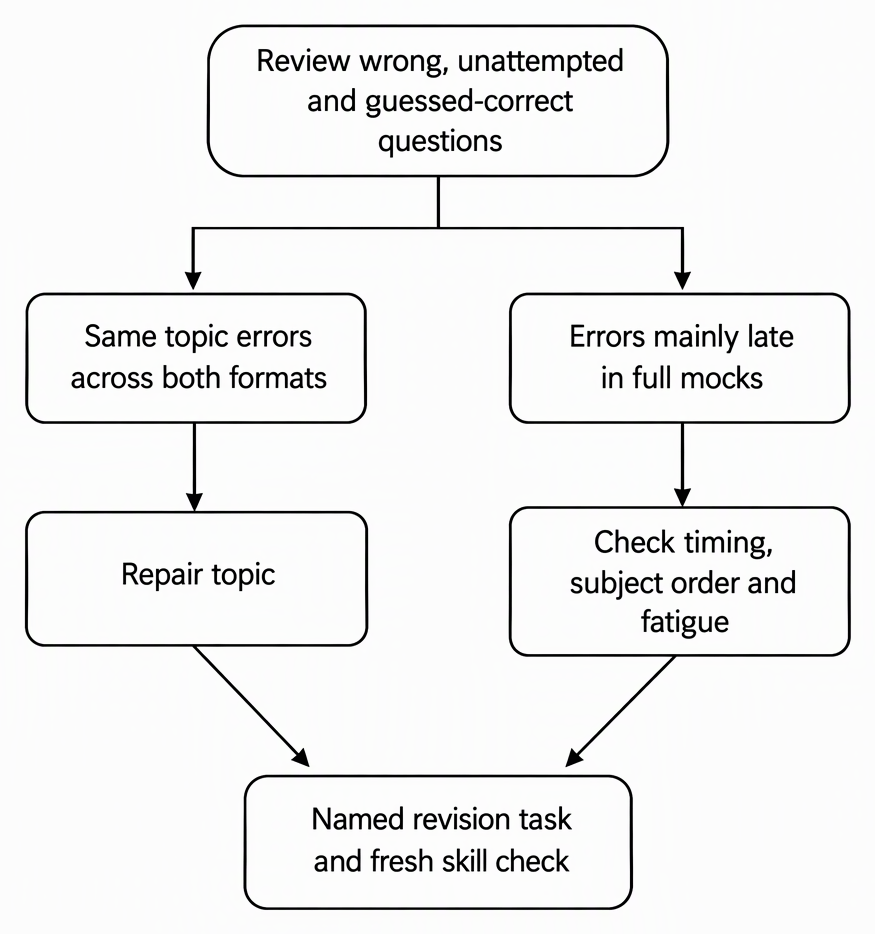
Compare error causes and attempt conditions, not just total marks. Repeated errors on the same topic in both standalone and full-paper practice point towards topic repair. Errors appearing mainly late in full mocks justify checking time pressure, subject order and fatigue too. A lower full-mock Chemistry score alone does not prove that fatigue caused it.
For a 45-question Chemistry paper, use the following scoring formula. The maximum is 180 marks.
Review wrong answers, unattempted questions and guessed-correct answers. Unattempted questions contribute zero but still need review; a correct guess is not proof of mastery. Give each reviewed question a primary cause:
- Concept gap: You could not explain the principle or choose the correct relationship.
- Recall gap: You could not retrieve a fact, reagent, condition or formula.
- Calculation or unit error: Your method was suitable, but arithmetic, conversion or units failed.
- Misreading: You missed a qualifier, sign, condition or the quantity being asked.
- Time-pressure error: Rushing changed a step you could otherwise perform correctly.
- Deliberate skip: You chose not to attempt. Record why rather than treating every skip as ignorance.
Beside each cause, record the topic and test conditions. For a full mock, note whether Chemistry came early or late and whether earlier subjects consumed its planned time.
Different sets can have different difficulty, so a raw score difference does not prove improvement or fatigue. Look for repeated error patterns and rework suspect questions without pressure before assigning a cause.
For mole-ratio or gas-volume mistakes, use Stoichiometry and Gas Laws: CO and CO₂ Volumes for a named task: rebuild the balanced-equation ratio and check the gas conditions. Then attempt fresh questions requiring that same skill.
For activation-energy or Arrhenius-relation mistakes, use Arrhenius Equation: Activation Energy Solution to revisit temperature units, logarithms and the relation you chose. End with a fresh activation-energy problem, not simply “take another mock”.
What should you do before your next test?
Assign the next attempt to the problem: a narrow topic gap needs chapter practice; uncertainty across Chemistry needs mixed subject practice; Chemistry slipping during a full paper needs a full NEET mock. If your review has already identified a specific error, repair it before testing again.
For the full-paper case, NEET JEEnius AI offers 30 free full-length mocks a month, each with 180 questions, 720 marks, 180 minutes and a scored per-subject breakdown. That breakdown identifies your Chemistry result within the full paper. It does not establish topic-level diagnostic features or a standalone Chemistry test capability.
You do not need to use the entire allowance. Reviewed attempts are more useful than accumulated, unexplained scores.
Before your next attempt, write one task you can check: “Correct mole-to-volume conversion, then solve fresh questions without the key.” Complete that repair and skill check before collecting another score.
Next step: full-length mock tests on NEET JEEnius AI and sit a full 180-question, 720-mark, 180-minute paper, 45 Physics, 45 Chemistry and 90 Biology, and get a scored per-subject breakdown (30 free a month).
Frequently asked questions
Should I take a Chemistry chapter test or a full NEET mock?
Use a chapter test to diagnose a narrow topic gap and mixed Chemistry practice to check recall across completed chapters. Choose a full NEET mock when you need to assess Chemistry alongside Physics and Biology under whole-paper conditions. Repair an identified error before taking another test.
How many questions and marks should a NEET Chemistry mock have?
A simulation of the NEET Chemistry component should contain 45 compulsory single-correct questions, worth 180 marks. Award four marks for each correct answer, deduct one for each wrong answer and award zero for an unattempted question. Chapter tests may have different lengths, so check their scoring scheme before starting.
What is the time limit for a NEET Chemistry mock test?
The official pattern described in the article allows 180 minutes for the whole NEET paper, not a separate Chemistry duration. For Chemistry-only practice, choose and record your own time budget. Do not treat that practice budget as an official subject time limit.
Does NEET JEEnius AI offer free Chemistry-only mock tests?
The verified offering is 30 free full-length NEET mocks a month with a scored per-subject breakdown, not standalone Chemistry tests. Each full mock includes 45 Chemistry questions alongside Physics and Biology. Check standalone Chemistry access, answer keys and explanations separately at the source.
How should I review mistakes after a NEET Chemistry mock?
Review wrong answers, unattempted questions and guessed-correct answers. Record each question's topic and primary cause, such as a concept gap, recall gap, calculation error, misreading or time pressure. Repair the identified weakness, then attempt fresh questions requiring the same skill.