How should I study Animal Kingdom for NEET in six steps?
To study Animal Kingdom for NEET, learn the differences that eliminate options, not paragraphs you can recognise. Turn NCERT into comparison notes, then reconstruct those notes without looking. Use each revision activity below to practise a specific MCQ-solving action.
- Read the basis of classification before the phyla. Keep six criteria separate: organisation describes how cells form tissues or organs; symmetry describes body division; germ layers describe embryonic layers; coelom describes the body cavity; segmentation describes repeated body units; notochord is a supporting structure. These are different criteria, not interchangeable descriptions. Do not use symmetry to answer a body-cavity question.
- Build a non-chordate comparison grid. On paper, use columns for group, organisation, symmetry, germ layers, body cavity where applicable, diagnostic feature and NCERT examples. Write “not applicable” where a category does not apply, such as a true germ-layer classification for Porifera. Use this three-row extract as a model:
- Platyhelminthes: organ-level organisation; bilateral symmetry; triploblastic; acoelomate; dorsoventrally flattened body; examples: Taenia and Fasciola.
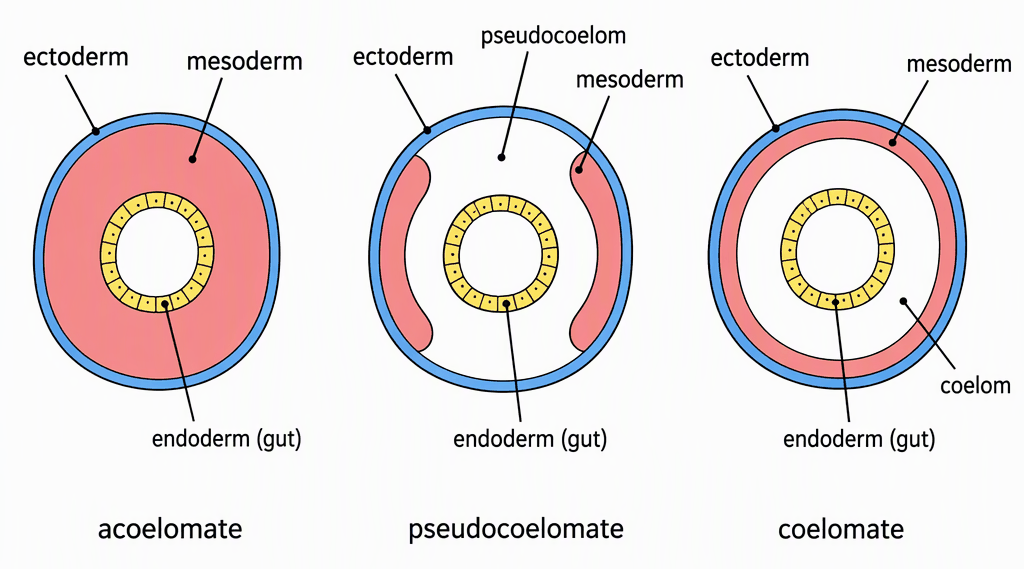
- Aschelminthes: organ-system organisation; bilateral symmetry; triploblastic; pseudocoelomate; circular body cross-section; examples: Ascaris and Wuchereria.
- Annelida: organ-system organisation; bilateral symmetry; triploblastic; coelomate; metamerically segmented; examples: Nereis and Pheretima.
This extract is a model, not a complete chapter summary. It puts shared features beside decisive differences. Acoelomates lack a body cavity; pseudocoelomates lack a complete mesodermal lining around the cavity; true coelomates have that lining.
- Keep vertebrate classes on a separate sheet. Compare body covering, respiration, heart, temperature regulation and reproduction. Preserve NCERT qualifiers such as “usually” instead of rewriting them as “always”. Use this sheet for class-comparison questions without crowding the non-chordate grid.
- Retrieve examples in both directions. Ask for the group from an animal name, then ask for examples and a distinguishing feature from the group. Practise this chain aloud: Ascaris belongs to Aschelminthes; Aschelminthes are pseudocoelomate. It connects name recall to feature-based elimination.
- Maintain a short exception ledger. Record the broad rule, its limit and the corrected statement. Reptilian hearts are usually three-chambered, but crocodiles have four chambers. Echinoderm symmetry needs a life-stage limit: adults are radial, larvae bilateral. Use these entries to test broad claims, not as another disconnected list.
- Use one MCQ routine. Mark the task word, especially “incorrect”; find the most discriminating clue; eliminate conflicting options; check exceptions and life stages; then select. Covering and reconstructing the grid is the learning test. Recognising a highlighted sentence during rereading is not evidence that you can retrieve it when options compete.
How do I identify an animal group from a diagnostic feature?
Choose the feature that separates the options, not the first familiar feature in the stem. Several groups share bilateral symmetry and three germ layers. In this question, body-cavity type is the deciding clue: use that column of your comparison grid to eliminate conflicting groups.
Original teaching question, not a previous-year NEET question:
An animal is bilaterally symmetrical, triploblastic and pseudocoelomate. Which group does it belong to?
- A. Platyhelminthes
- B. Aschelminthes
- C. Annelida
- D. Arthropoda
- Mark the task: identify the group.
- Set aside shared clues: bilateral symmetry and triploblasty do not distinguish these four options.
- Use the decisive clue: pseudocoelom points to Aschelminthes.
- Check the rejected options: Platyhelminthes are acoelomate; Annelida and Arthropoda are coelomate in the NCERT classification.
Correct answer: B, Aschelminthes. Attach it to a retrieval anchor: Ascaris is an NCERT example of Aschelminthes.
If you chose Annelida, repair the body-cavity comparison, not the whole chapter. Close the notes and reconstruct acoelomate, pseudocoelomate and coelomate, each with its group and example. Then explain why each rejected option fails.
How do I solve animal–group matching questions without confusing names?
Use accurate name-to-group recall first, then confirm your answer by correcting the other pairs. Elimination helps, but example-matching questions still require accurate recall of NCERT names. A sound-alike name or shared aquatic habitat is not a classification criterion, so neither is a substitute for recall.
Original teaching question, not a previous-year NEET question:
Which animal–group pair is correctly matched?
- A. Adamsia: Ctenophora
- B. Pleurobrachia: Cnidaria
- C. Balanoglossus: Hemichordata
- D. Ascidia: Cephalochordata
Correct answer: C, Balanoglossus: Hemichordata. Correct every distractor:
- Adamsia belongs to Cnidaria, not Ctenophora.
- Pleurobrachia belongs to Ctenophora, not Cnidaria.
- Ascidia belongs to Urochordata, not Cephalochordata.
For the last distinction, add a positive anchor: Branchiostoma belongs to Cephalochordata. Do not store only “Ascidia is not a cephalochordate”; store where both animals belong.
Turn a wrong answer into paired retrieval prompts:
- “Ascidia belongs to which group?”
- “Name an NCERT urochordate example.”
Then contrast Ascidia with Branchiostoma. In urochordates, the notochord occurs only in the larval tail; in cephalochordates, it extends from head to tail and persists throughout life.
Next session, reverse the prompts again. Remembering option C does not establish that you know the animal–group relationships.
How do I catch an exception in an “incorrect statement” question?
Mark “incorrect” before evaluating the biology, then test each statement exactly as written. A broad rule can become false when an option removes its exception or life-stage qualifier. Knowing the crocodile exception is not enough: applying it requires checking the exact claim and whether the question asks for a true or false statement.
Original teaching question, not a previous-year NEET question:
Which statement is incorrect?
- A. All reptiles have a three-chambered heart.
- B. Adult echinoderms are radially symmetrical, while their larvae are bilaterally symmetrical.
- C. Birds and mammals have a four-chambered heart.
- D. In Ascidia, the notochord is present only in the larval tail.
Correct answer: A. Crocodiles have a four-chambered heart, so “all reptiles” makes this statement false.
Apply the routine:
- Mark “incorrect” so you select the false statement.
- Inspect the universal claim in A.
- Retrieve the crocodile exception.
- Confirm that B retains the adult-versus-larval distinction, C is correct, and D retains “only in the larval tail”.
Words such as “all” are prompts to check biology, not automatic proof of an error. Reject the statement because of a real counterexample.
Review the crocodile exception in animal classification. Record the qualified rule in your ledger:
Reptilian heart: usually three-chambered; crocodiles: four-chambered.
What should I practise next to turn mistakes into targeted revision?
Start with feature-to-group identification, move to animal–group matches, then attempt mixed statements and exceptions. This sequence builds feature recall before combining it with names and qualifiers. It is a learning sequence, not a prediction of the exam’s question distribution.
After each set, review wrong answers and guessed correct answers. Label each error and apply its repair:
- Concept confusion: rebuild the relevant comparison.
- Example recall: practise the animal–group pair in both directions.
- Missed qualifier: add the corrected, qualified statement to your exception ledger.
- Misread question: mark the task word before answering.
Suppose you answer the three teaching questions with two correct and one wrong. Using NEET marking:
Correcting that wrong response would give:
This illustrates the marking rule, not a promised improvement. In your next session, reconstruct the notes on a blank page; repeat after a gap, then attempt unseen mixed questions. This is a suggested routine, not a scientifically exact timetable.
Readiness means justifying your answer and correcting rejected options without notes. A remembered answer letter does not count.
For fresh testing, NEET JEEnius AI practice mode offers topic sets that skip questions you have already seen, with 60 free sets a month.
Close NCERT now, rebuild the three-row body-cavity comparison, retrieve its examples, and attempt an unseen identification question.
Next step: daily practice problems on NEET JEEnius AI and get a fresh set on a topic every day (20 free attempts a month).
Frequently asked questions
How should I start studying Animal Kingdom for NEET?
Start with the six classification criteria: organisation, symmetry, germ layers, coelom, segmentation and notochord. Build a non-chordate comparison grid linking these criteria to diagnostic features and NCERT examples. Keep vertebrate classes on a separate sheet, then reconstruct both sheets without looking.
How do I memorise Animal Kingdom examples for NEET?
Practise recall in both directions: identify the group from an animal name, then name examples from the group. Add a distinguishing feature, such as Ascaris belonging to Aschelminthes, which are pseudocoelomate. Contrast confusing pairs such as Ascidia–Urochordata and Branchiostoma–Cephalochordata.
How do I avoid mistakes in Animal Kingdom incorrect-statement questions?
Mark the word “incorrect” before evaluating the options. Check each claim for exceptions and life-stage qualifiers: reptiles usually have three-chambered hearts, but crocodiles have four chambers. Treat words such as “all” as a reason to check the biology, not as automatic proof that an option is false.
How do I revise Animal Kingdom after getting MCQs wrong?
Review wrong answers and guessed correct answers, labelling each as concept confusion, example recall, missed qualifier or misread question. Repair the specific gap by rebuilding a comparison, reversing animal–group prompts, recording a qualified rule or marking the task word. After a gap, reconstruct the relevant notes and attempt unseen mixed questions.