
How should I study Alcohols, Phenols and Ethers for NEET in six steps?
For Alcohols, Phenols and Ethers in NEET, learn the substrate, reagent and condition together: a reagent name alone does not determine the product. Build a decision sheet from NCERT rather than memorising isolated equations.
- Repair only the prerequisites this chapter needs.
Revise resonance, inductive effect, conjugate-base stability and nucleophiles. Distinguish substitution, which replaces a group, from elimination, which removes groups from adjacent carbons to form a multiple bond.
Check your understanding with phenol versus ethanol. Phenoxide spreads its negative charge through resonance involving the aromatic ring; ethoxide lacks this resonance stabilisation. If you cannot explain that difference, repair resonance before memorising acidity orders.
- Classify the structure before learning its reactions.
An alcohol has its hydroxyl group attached to a saturated carbon. Phenol has it directly attached to an aromatic ring. An ether has this general structure:
Benzyl alcohol is an alcohol, not a phenol: its hydroxyl-bearing carbon lies outside the ring. Primary, secondary and tertiary alcohols have one, two and three carbon atoms, respectively, directly attached to the hydroxyl-bearing carbon. Do not count all carbons in the molecule.
- Read alcohols, then phenols, then ethers in NCERT.
For each family, separate physical properties and acidity from preparation methods and chemical reactions. Keep a small comparison box:
- Hydrogen bonding: alcohols and phenols self-associate; ethers accept hydrogen bonds from water but cannot donate them.
- Boiling point: compare molecular mass and branching before using hydrogen bonding. Not every alcohol boils above every ether.
- Water solubility: compare the hydrogen-bonding group with the size of the nonpolar carbon portion.
- Build a four-column decision sheet.
Head your notebook columns substrate, reagent, condition and product. Every reaction arrow must carry its conditions. Write entries in that order:
- Primary alcohol; PCC; anhydrous medium; aldehyde.
- Primary alcohol; excess acidified potassium dichromate; reflux; carboxylic acid.
- Phenol; bromine; water; 2,4,6-tribromophenol.
- Phenol; bromine; low-polarity solvent at low temperature; mainly ortho- and para-monobromophenols.
- Anisole; HI; heating; phenol and methyl iodide.
- Ethanol; concentrated sulfuric acid; heating at 443 K; ethene and water.
- Sodium alkoxide; suitable alkyl halide; dry conditions with an unhindered halide; ether, by Williamson synthesis.
- Sodium phenoxide; carbon dioxide; heating under pressure, then acidification; salicylic acid, the Kolbe reaction.
- Phenol; chloroform and aqueous sodium hydroxide; heating, then acidification; mainly salicylaldehyde, the Reimer–Tiemann reaction.
For named reactions, retrieve the starting material, reagents and product, not just the name. Reconstruct the sheet from memory instead of repeatedly copying it.
- Use one solving sequence for every MCQ.
Identify the task: an order, a product or a preparation route. Classify the substrate, mark the reagent and conditions, apply the relevant rule, and only then compare options. A familiar product is not enough: it must fit the stated treatment.
- Close NCERT and test retrieval.
Reproduce the map, solve questions and label each error structure, reagent, condition or reasoning. Reread only the part responsible for the mistake. A forgotten reflux condition needs a different repair from a wrong explanation of phenoxide stability.
How do I rank acidity without memorising a list?
Compare conjugate-base stability first, then account for substituents. Establish why phenoxide is more stable than ethoxide before judging the groups attached to the ring.
Illustrative single-correct MCQ, not an authenticated NEET previous-year question: Which is the decreasing acidity order?
- A
- B
- C
- D
Answer: A. Use this decision sequence:
- Identify the acidic oxygen–hydrogen bond and consider the anion left after proton loss.
- Establish that phenoxide is resonance-stabilised, unlike ethoxide. The three phenolic compounds therefore sit above ethanol here.
- The para nitro group withdraws electrons and stabilises the phenoxide conjugate base, increasing acidity.
- The methyl group in p-cresol donates electron density and reduces acidity relative to phenol.
The tempting claim that electron donation makes phenol more acidic confuses acidity with electrophilic substitution. Electron donation can make the ring more reactive towards electrophiles while making proton loss less favourable. For acidity, judge the stability of the conjugate base, not the ring’s reactivity towards an electrophile.
Why does the same primary alcohol give different oxidation products?
Anhydrous PCC stops propan-1-ol oxidation at propanal; excess acidified dichromate under reflux gives propanoic acid. “Primary alcohol gives an aldehyde” is incomplete unless the oxidant and conditions support stopping there.
Illustrative single-correct MCQ: Separate samples of propan-1-ol receive PCC in an anhydrous medium and excess acidified potassium dichromate under reflux. Which product pair forms, respectively?
- A: Propanal and propanal.
- B: Propanoic acid and propanal.
- C: Propanal and propanoic acid.
- D: Propanone and propanoic acid.
Answer: C. Identify a primary alcohol, recognise oxidation, inspect both treatments, then assign each endpoint.
Reject A because excess acidified dichromate under reflux oxidises the aldehyde further. Reject D because oxidation does not shift the oxygen-bearing group to the middle carbon.
Numerical extension: For quantitative PCC conversion of 0.10 mol of propan-1-ol, use the one-to-one mole ratio:
Transfer check: Propan-2-ol gives propanone under ordinary oxidation conditions. Tertiary alcohols lack the required hydrogen on the hydroxyl-bearing carbon and cannot undergo corresponding simple oxidation without carbon–carbon bond cleavage.
Which Williamson route should I choose for ethyl tert-butyl ether?
Choose sodium tert-butoxide with bromoethane because the halide-bearing carbon is primary. Williamson synthesis requires nucleophilic substitution at that carbon, so matching the target’s two fragments is not enough.
Illustrative single-correct MCQ: Which reagent pair is most suitable for preparing ethyl tert-butyl ether by Williamson synthesis?
- A: Sodium tert-butoxide and bromoethane.
- B: Sodium ethoxide and tert-butyl bromide.
- C: Sodium tert-butoxide and bromobenzene.
- D: Sodium ethoxide and ethanol.
Answer: A. Splitting the target at its two carbon–oxygen bonds gives two apparent assignments: tert-butoxide with an ethyl halide, or ethoxide with a tert-butyl halide.
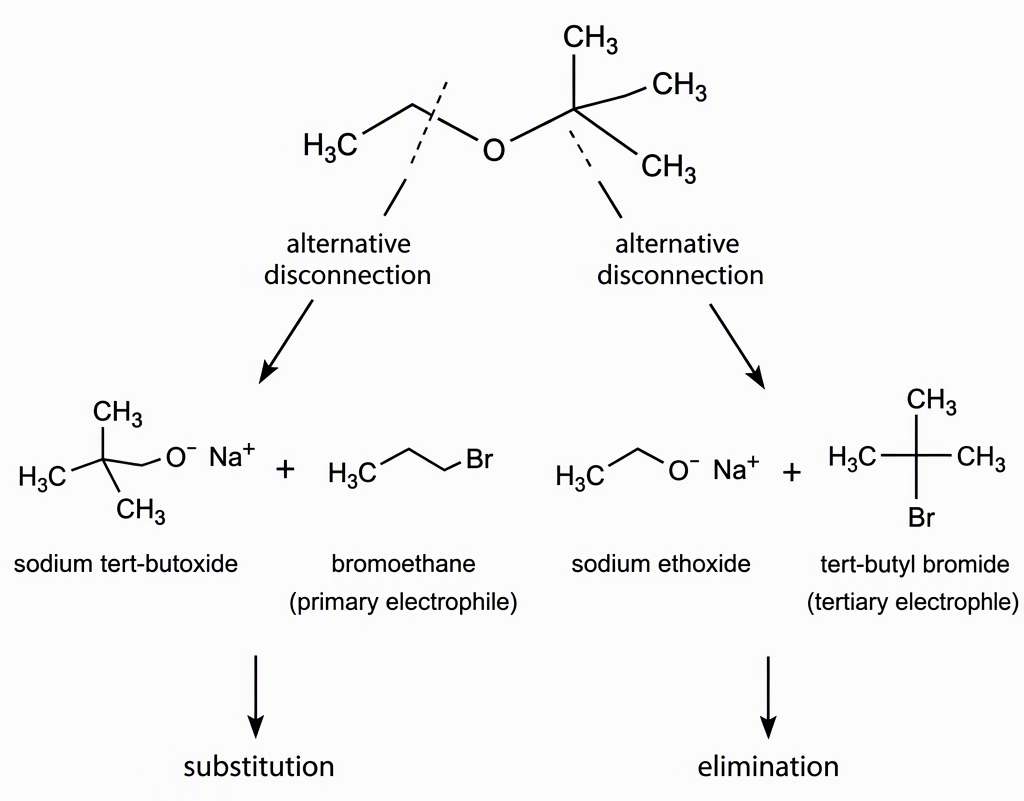
Williamson synthesis proceeds by the bimolecular nucleophilic substitution mechanism:
The alkoxide attacks the carbon bearing the halogen. Bromoethane offers a less hindered primary carbon:
B is the principal trap. Its fragments fit, but a tertiary halide blocks the required substitution pathway; the strong base favours elimination instead. C fails because bromobenzene does not undergo ordinary Williamson substitution at its aryl carbon. D lacks a suitable halide electrophile.
Inspect the halide-bearing carbon before accepting any fragment pair. The fragments must both match the target and support the required substitution.
What should I practise after checking my mistakes?
Choose questions from your error labels, not whichever exercise comes next. Start with NCERT structures, equations, examples and exercises, then attempt chapter-specific previous-year questions from a source that identifies the exam year and supplies a checkable answer. Use NEET Silly Mistakes: Find the Cause and Fix the Check to turn “careless mistake” into a specific repair.
- Structure errors: Practise phenol versus benzyl alcohol, primary versus secondary versus tertiary alcohols, and aryl versus alkyl ethers. Identify the carbon directly attached to oxygen.
- Reasoning errors: Practise acidity and physical-property comparisons. Explain conjugate-base stability for acidity; check hydrogen bonding, molecular mass and branching for boiling points.
- Reagent or condition errors: Practise oxidation endpoints, alcohol dehydration and phenol bromination. Bromine water gives 2,4,6-tribromophenol; bromine in a low-polarity solvent at low temperature gives mainly monobrominated ortho and para products.
- Route-selection errors: Practise Williamson pair selection. Inspect the halide-bearing carbon before matching fragments.
- Ether-cleavage errors: Retrieve anisole with hot HI giving phenol and methyl iodide. After oxygen protonation, iodide attacks the methyl carbon. Cleavage occurs at the methyl–oxygen bond, not the aryl–oxygen bond; an aryl carbon cannot undergo this ordinary backside substitution.
Include one closed-book retrieval pass on Kolbe’s and Reimer–Tiemann reactions. Write the starting material, reagents, conditions and product before checking NCERT; name recognition does not count.
Move from question-type blocks to a mixed chapter set. After checking, reproduce every missed reaction without looking and explain why your chosen distractor fails.
Readiness check: Close the reaction sheet and explain an acidity order, predict a condition-dependent product and defend an ether-preparation route. If one explanation fails, practise that question type next.
Next step: daily practice problems on NEET JEEnius AI and get a fresh set on a topic every day (20 free attempts a month).
Frequently asked questions
How should I study Alcohols, Phenols and Ethers for NEET?
Revise resonance, inductive effect, conjugate-base stability and nucleophiles, then study alcohols, phenols and ethers in NCERT in that order. Build a four-column sheet recording substrate, reagent, condition and product. Reconstruct it from memory, solve MCQs and classify mistakes as structure, reagent, condition or reasoning errors.
Why is phenol more acidic than ethanol?
Phenol forms phenoxide on losing a proton, while ethanol forms ethoxide. Phenoxide is stabilised by resonance involving the aromatic ring; ethoxide lacks this resonance stabilisation. The more stable conjugate base makes phenol more acidic than ethanol.
What is the difference between PCC and acidified dichromate oxidation of primary alcohols?
PCC in an anhydrous medium converts a primary alcohol to an aldehyde. Excess acidified potassium dichromate under reflux oxidises it to a carboxylic acid. For propan-1-ol, the products are propanal and propanoic acid, respectively.
How do I choose the correct reagent pair for Williamson ether synthesis?
Split the target ether into an alkoxide and an alkyl halide, then inspect the halide-bearing carbon. Choose a suitable unhindered halide that supports SN2 substitution rather than matching fragments alone. For ethyl tert-butyl ether, choose sodium tert-butoxide with bromoethane; sodium ethoxide with tert-butyl bromide favours elimination instead.