What is the final product in the hydrocarbons NEET 2007 question?
Option D is correct in the hydrocarbons NEET 2007 question: chlorine and iodine finish on the same carbon. Complete the HCl addition first, then apply HI to intermediate B. Do not treat the two reagents as one combined addition.
Determine the final product when but-1-yne first reacts with HCl to form B, and B then reacts with HI to form C:
The supplied archive labels this a NEET 2007 Hydrocarbons question on successive Markovnikov additions. Its hard classification and 90-second expected solving time belong to the question bank, not to measured student performance.
How does HCl form intermediate B from but-1-yne?
Hydrogen adds to the terminal carbon, while chlorine adds to the carbon attached to the ethyl group. This produces 2-chlorobut-1-ene, not a saturated compound. The triple bond becomes a double bond, which undergoes the second addition.
Number the reacting carbons from the terminal alkyne end. C1 is the hydrogen-bearing terminal carbon; C2 is the adjacent triple-bond carbon attached to the ethyl group. Keep these labels fixed throughout the solution.
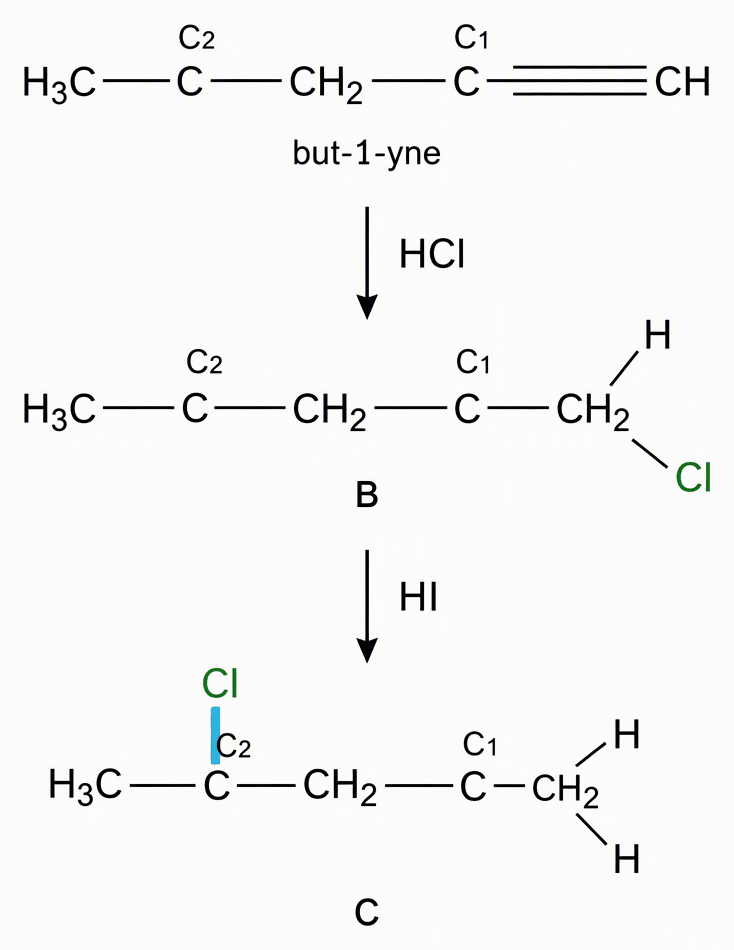
Following the supplied solution’s Markovnikov rule, place the incoming hydrogen on C1 and chlorine on C2:
C1 now carries two hydrogens. C2 carries chlorine and remains double-bonded to C1; the ethyl group has not changed.
B is 2-chlorobut-1-ene. Record the checkpoint before proceeding: the C2–Cl bond is now present. The stated second addition retains that bond.
How does HI react with B to give option D?
HI adds across B’s remaining double bond, putting hydrogen on C1 and iodine on C2. Start from 2-chlorobut-1-ene, not from the original alkyne. C2 already bears chlorine, so the incoming iodine joins chlorine on that same carbon.
The terminal carbon changes from a methylene group to a methyl group. The double bond becomes a single bond:
Product C matches option D:
Track each reacting carbon separately to verify the result:
- C1: Starts with one hydrogen, gains one from HCl, then gains another from HI.
- C2: Gains chlorine first and iodine second. It receives no hydrogen.
- Carbon skeleton: All four carbons remain connected in their original order.
The hydrogen progression at C1 is:
Final C2 has four single bonds: one to the ethyl group, one to the terminal methyl group, one to chlorine and one to iodine. Its valency is satisfied.
This is a geminal dihalide, meaning both halogens occupy the same carbon. Halogens on neighbouring carbons give different connectivity, not another way of writing this answer.
Why is option C wrong if it contains both chlorine and iodine?
Option C places chlorine on a different carbon from where the first addition installed it. Having the correct carbon count and both halogens does not make it the correct reaction product.
The supplied wrong option C is:
In B, chlorine is bonded to C2. In this wrong structure, chlorine is bonded to terminal C1. Reaching it requires relocating the chlorine already installed during the HCl step.
This wrong route treats the sequence as though the two halogens must be spread across the formerly triple-bonded carbons, rather than carrying B into the second step. That is a reasoning error: the official HI-addition step neither breaks nor moves the existing carbon–chlorine bond.
Use this corrective check:
- Copy B before adding anything.
- Retain the C2–Cl bond.
- Change the carbon–carbon double bond to a single bond.
- Add only the incoming hydrogen to C1 and iodine to C2.
How do you solve three related Hydrocarbons practice questions?
Track the incoming hydrogen and halogen separately, then check the remaining bond order. These are original same-chapter practice questions, not verified past-paper questions. Each uses ordinary ionic-addition conditions.
What forms when propyne reacts with one equivalent of HBr?
The product is 2-bromoprop-1-ene. Hydrogen adds to the hydrogen-bearing terminal carbon, while bromine adds to the internal carbon attached to the methyl group:
The triple bond becomes a double bond. One equivalent produces the first-addition product, not a saturated compound.
What forms when that intermediate receives a second equivalent of HBr?
The product is 2,2-dibromopropane, a geminal dihalide. Hydrogen again adds to the terminal carbon, and the second bromine joins the first on the internal carbon:
For 0.10 mol of this intermediate, assume complete second addition. The equation gives a one-to-one mole ratio:
Thus, 0.10 mol of HBr produces 0.10 mol of 2,2-dibromopropane. This counts only the second step because the starting sample is already the intermediate.
What forms when but-1-ene reacts with HCl?
The product is 2-chlorobutane. Hydrogen goes to the terminal carbon, while chlorine goes to the adjacent internal carbon:
This starting compound has only a double bond to consume. One addition therefore gives a saturated product.
Before selecting an option, check the bond order: one HX addition to an alkyne leaves a double bond; the second addition consumes it.
Next step: the past-paper archive on NEET JEEnius AI and search past NEET papers by year, subject or chapter, each with a worked solution (100 free searches a month).
For a worked example of the same idea, see Escape Speed NEET 2026: Half-Radius Ratio Explained.
Frequently asked questions
What is the final product in the Hydrocarbons NEET 2007 question?
The final product is CH3CH2C(I)(Cl)CH3, matching option D. Chlorine and iodine occupy the same carbon, so the product is a geminal dihalide.
What is intermediate B when but-1-yne reacts with HCl?
Intermediate B is 2-chlorobut-1-ene, CH3CH2C(Cl)=CH2. Hydrogen adds to the terminal carbon and chlorine to the adjacent internal carbon. The first addition changes the triple bond into a double bond.
Why do chlorine and iodine end up on the same carbon?
The first HCl addition places chlorine on C2, the reacting carbon attached to the ethyl group. HI then adds across the remaining double bond, placing hydrogen on terminal C1 and iodine on C2. The existing C2–Cl bond remains intact.
Why is option C wrong in the Hydrocarbons NEET 2007 question?
Option C, CH3CH2CH(I)CH2Cl, places chlorine on the terminal carbon. The HCl step installed chlorine on the adjacent internal carbon, and the stated HI addition does not move it. Having both halogens and four carbons is not enough; their connectivity must match the reaction sequence.