
How should I study carboxylic acids for NEET in five steps?
To study carboxylic acids for NEET, check conjugate-base stability, carbon count and reagent conditions before choosing an answer. Build a compact NCERT-based reaction map, then use these checks to eliminate options in acidity, product and conversion questions.
- Repair only the prerequisite you cannot explain.
Check resonance, inductive effect, conjugate-base stability, functional-group identification and identification of the alpha carbon. You should recognise acids, esters, aldehydes and nitriles, and locate the carbon immediately next to the carboxyl carbon.
Explain why spreading a negative charge can stabilise a conjugate base. If that explanation fails, revisit resonance, not the whole organic chemistry syllabus. If locating the alpha carbon fails, practise structures before learning alpha-halogenation.
- Read NCERT with a compact sheet beside you.
Read the carboxylic-acid portion of the current NCERT chapter on aldehydes, ketones and carboxylic acids. Divide your sheet into preparations, acidity, physical-property explanations and reactions. Record the chemical reason or transformation rather than copying paragraphs.
Link hydrogen bonding to molecular association, including dimers, and relatively high boiling points. Link the growing hydrocarbon portion to the general decrease in water solubility along the lower homologous series: the nonpolar part grows while the carboxyl group stays the same.
- Build one acidity decision rule.
Remove the acidic proton on paper and compare the resulting conjugate bases. Greater conjugate-base stability means a stronger acid. Check electron-withdrawing or electron-donating effects and their distance from the carboxyl group.
For comparable structures, electron withdrawal generally stabilises the carboxylate, and the inductive effect weakens with distance. Do not treat this as a complete rule for substituted aromatic acids. Resonance and ortho effects can change that comparison.
- Turn reactions into a map with conditions and carbon counts.
Give every arrow a substrate, reagent, condition and product. Count carbons in the acid-derived chain; for esterification, track the alcohol-derived carbons separately.
- Oxidation: a primary alcohol or aldehyde gives an acid with a suitable oxidant, such as acidified potassium dichromate on heating. The carbon count stays unchanged.
- Chain extension: suitable haloalkanes with alcoholic potassium cyanide give nitriles, adding one carbon.
- Nitrile hydrolysis: a nitrile gives an acid with aqueous acid and heat. Its nitrile carbon becomes the carboxyl carbon, so hydrolysis retains the count.
- Esterification: an acid and alcohol give an ester with concentrated sulfuric acid and heating. Neither carbon skeleton loses a carbon.
- Reduction: lithium aluminium hydride in dry ether, followed by work-up, converts an acid to a primary alcohol without carbon loss.
- Decarboxylation: heating a sodium carboxylate with soda lime gives an alkane, removing the carboxyl carbon.
- HVZ: in an acid with an alpha hydrogen, bromine and red phosphorus, followed by hydrolysis, replace that hydrogen with bromine. Carbon count stays unchanged.
- Bicarbonate test: ordinary carboxylic acids release carbon dioxide with sodium hydrogen carbonate; ordinary phenols do not.
Use this map for retrieval alongside NCERT. It does not replace the textbook’s explanations and examples.
- Run the checks before selecting an option.
Label the task, mark the reactive site and any alpha hydrogen, count carbons, then apply the stated conditions. Eliminate incompatible options before choosing.
How do I rank acidity when chlorine is at different positions?
Compare the carboxylate ions first: chlorine stabilises their negative charge more strongly when it is closer to the carboxyl group. Here, the carbon skeletons are comparable, so distance provides a useful decision rule.
Original practice MCQ: Rank the following in decreasing acidity.
- Option 1:
- Option 2:
- Option 3:
- Option 4:
Remove the hydrogen attached to oxygen to obtain the corresponding conjugate bases. All three ions have carboxylate resonance:
Chlorine withdraws electron density inductively and stabilises the carboxylate. Its effect is stronger in A than in B because it is closer. C has no chlorine substituent, so it lacks this extra stabilisation.
Option 1 is correct:
In names, the order is 2-chloropropanoic acid, then 3-chloropropanoic acid, then propanoic acid, from strongest to weakest. The trap is treating every chlorine substituent as equally effective regardless of position, which wrongly removes the distinction between A and B.
Transfer check: decreasing pKa reverses the order because stronger acids have lower pKa.
How do I count carbons through a conversion sequence?
Track the carbon introduced by cyanide separately: it becomes the carboxyl carbon and is later removed by soda lime. This makes ethane the final product in the sequence below. Give carbon accounting priority over recognising a familiar-looking final formula.
Original practice MCQ: Bromoethane reacts with alcoholic potassium cyanide, followed by acidic hydrolysis on heating. The acid is converted to its sodium salt and heated with soda lime. What is the final organic product?
- Option 1: Methane.
- Option 2: Ethane.
- Option 3: Propane.
- Option 4: Ethene.
Write every intermediate before checking the options:
The carbon ledger is:
Cyanide substitution adds one carbon. During hydrolysis, the nitrile carbon becomes the carboxyl carbon; it does not disappear. Neutralisation changes the acid into a salt without changing its carbon skeleton.
Soda lime is sodium hydroxide with calcium oxide, used on heating:
The carbon check is:
Option 2, ethane, is correct. Eliminate the distractors by identifying their failed checks:
- Propane: ignores carbon loss during decarboxylation.
- Methane: miscounts the remaining ethyl group.
- Ethene: confuses cyanide substitution with elimination.
Equal starting and final carbon counts do not mean no chemistry occurred. The carbon added through cyanide is subsequently removed.
For fresh topic questions after this exercise, NEET JEEnius AI’s daily practice problems provide a new set every day, with 20 free attempts a month.
How do I check whether an acid undergoes HVZ alpha-bromination?
Look for a hydrogen on the carbon immediately next to the carboxyl carbon. Propanoic acid has this required alpha carbon–hydrogen site and undergoes the usual Hell–Volhard–Zelinsky reaction. The acidic hydrogen attached to oxygen does not satisfy this condition, even though every option below contains that hydrogen.
Original single-correct MCQ: Which acid undergoes HVZ alpha-bromination with bromine and red phosphorus, followed by hydrolysis?
- Option 1: Propanoic acid.
- Option 2: Benzoic acid.
- Option 3: Methanoic acid.
- Option 4: 2,2-Dimethylpropanoic acid.
In propanoic acid, the middle carbon is the alpha carbon and carries two alpha hydrogens. One is replaced by bromine in the usual product prediction.
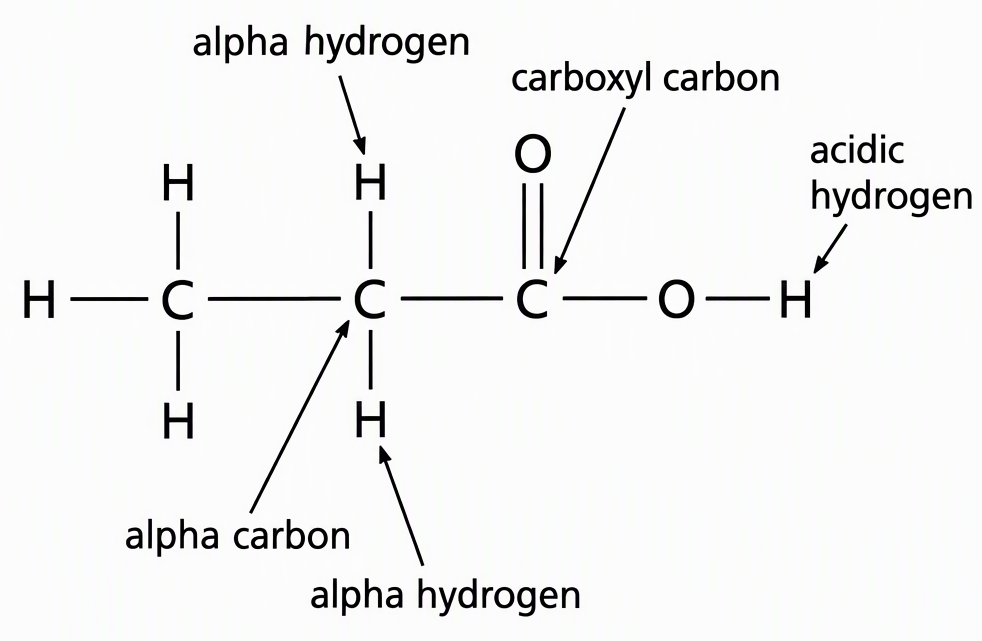
Option 1 is correct, giving 2-bromopropanoic acid. Reject the other substrates by structure, not by trying to remember four separate reactions:
- Benzoic acid: lacks the required alpha carbon–hydrogen site for this reaction. Ring hydrogens are not substitutes for it.
- Methanoic acid: has no alpha carbon.
- 2,2-Dimethylpropanoic acid: its alpha carbon is bonded to three methyl groups and the carboxyl carbon, leaving no hydrogen on it.
Check substrate eligibility before predicting the product. Recalling an acid-halide mechanism cannot rescue an answer that overlooks the missing alpha hydrogen.
What should I practise after these three worked examples?
Rebuild the reaction map from memory first, then check missing reagents, conditions and products against NCERT. Keep the skills separate initially, then combine them once you can explain each step.
- Start with acidity. Practise electron-withdrawing versus electron-donating substituents, substituent distance, and acidity order versus pKa order. State which conjugate base is more stable before selecting.
- Move to single-step products. Cover oxidation, esterification, reduction, the bicarbonate reaction, decarboxylation and HVZ eligibility. Write the condition beside every answer.
- Build conversion chains. Mix those reactions and place a carbon count under every intermediate. Do not jump straight from starting material to final product.
- Cover the rest of NCERT. Include nomenclature, hydrogen bonding and solubility questions. These three worked types are not the whole chapter.
- Correct errors before repeating them. Record the failed check: conjugate-base stability, carbon count, reagent conditions or structural eligibility. Write a one-line correction, then reattempt without notes.
Use relevant NCERT chapter exercises and genuine past-paper questions. Treat these as practice material, not a basis for promising a fixed number of carboxylic-acid questions.
For the mixed-practice stage, NEET JEEnius AI’s practice mode offers topic sets that skip questions already seen, with 60 free sets a month. Keep your own error record beside the set and correct each failed check before moving on.
Next step: daily practice problems on NEET JEEnius AI and get a fresh set on a topic every day (20 free attempts a month).
Read next: Haloalkanes Practice Questions NEET: 6 Worked MCQs.
Frequently asked questions
How should I study carboxylic acids for NEET?
Check your understanding of resonance, inductive effect, conjugate-base stability and alpha-carbon identification first. Read NCERT and build a compact reaction map showing substrates, reagents, conditions and products. Practise acidity, single-step reactions and conversion chains, checking carbon counts and structural eligibility before selecting an answer.
How does chlorine position affect carboxylic acid strength?
For comparable carbon skeletons, chlorine stabilises the carboxylate ion through its electron-withdrawing inductive effect, which weakens with distance. Therefore, 2-chloropropanoic acid is stronger than 3-chloropropanoic acid, and both are stronger than propanoic acid. Do not apply distance alone to substituted aromatic acids, where resonance and ortho effects can change the comparison.
How do I count carbons in KCN and soda-lime conversions?
Reaction of a suitable haloalkane with alcoholic KCN adds one carbon by forming a nitrile. Acidic hydrolysis retains that carbon as the carboxyl carbon, while subsequent soda-lime decarboxylation of the sodium carboxylate removes it. For bromoethane, the sequence runs through propanenitrile, propanoic acid and sodium propanoate to give ethane.
Which carboxylic acids undergo the HVZ reaction?
The usual HVZ alpha-bromination requires a hydrogen on the carbon immediately next to the carboxyl carbon. Propanoic acid meets this condition and gives 2-bromopropanoic acid with bromine and red phosphorus, followed by hydrolysis. Benzoic acid, methanoic acid and 2,2-dimethylpropanoic acid lack the required alpha carbon–hydrogen site.