What is the correct answer to the NEET 2026 placentation matching question?
Option D is correct for the NEET 2026 placentation matching question: marginal–pea, axile–tomato, parietal–Argemone and free central–primrose. The source is NEET UG 2026, held on 21 June 2026, Code-50. “Medium difficulty” is the question bank’s classification, not an official exam-wide rating.
The task is to assign the correct plant example to each of four ovule arrangements inside the ovary. Keep the type identifiers separate from the answer-option letters:
- Placentation types: A marginal; B axile; C parietal; D free central.
- Plant examples: I Argemone; II tomato; III primrose; IV pea.
The supplied options are:
Where do the ovules attach in each placentation type?
Attachment site and true partitions distinguish these four types. NCERT Class 11 Biology, Morphology of Flowering Plants, defines placentation as the arrangement of ovules inside the ovary. Use that structure to establish each plant’s match.
In this question, ovules may attach along a ventral ridge, to a partitioned central axis, to the inner ovary wall, or to an unpartitioned central column. These correspond to marginal, axile, parietal and free central placentation, respectively.
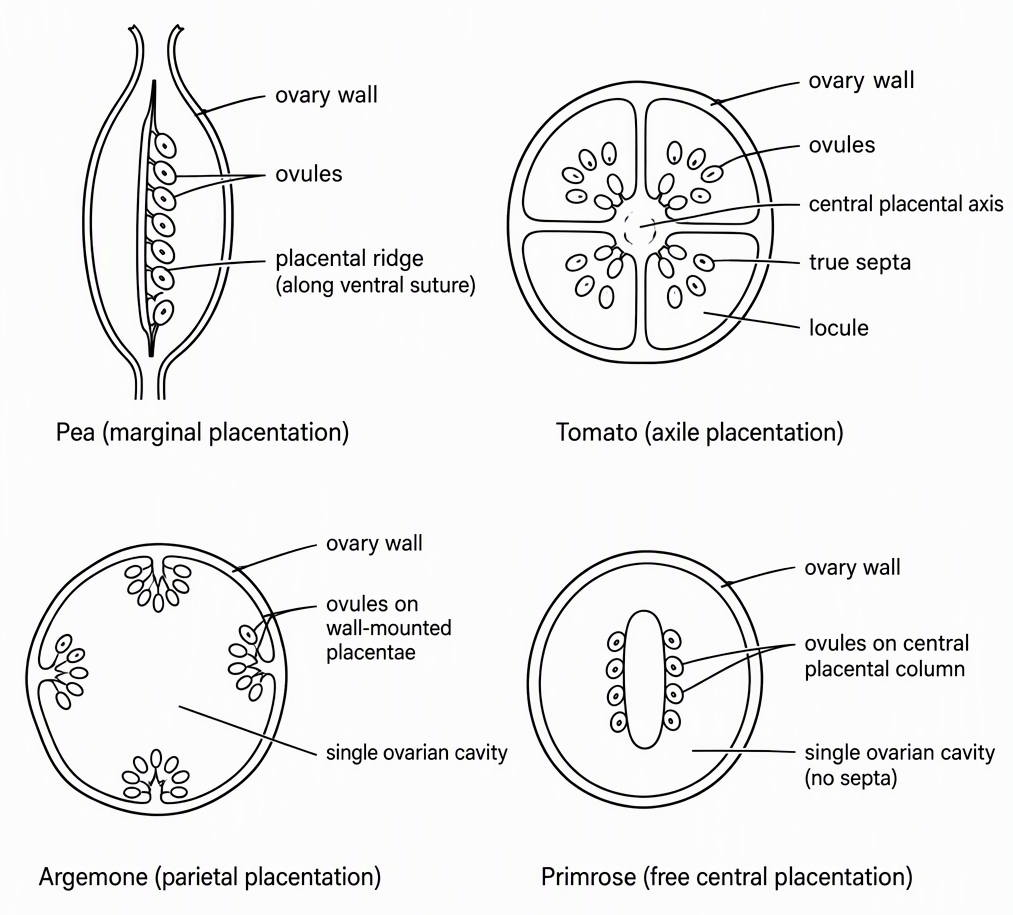
The drawing is schematic: use the attachment site and presence or absence of true partitions, not a memorised ovary outline. Locules are the chambers inside the ovary; septa are the partitions separating them.
Both axile and free central placentation have central attachment, but only axile has septa dividing the ovary into locules. “Ovules in the centre” is incomplete evidence until you check for partitions.
How do the NCERT examples establish every pair in option D?
The direct NCERT examples give A-IV, B-II, C-I, D-III. Identify the attachment, establish each plant pair, then compare the completed sequence with the options. Use elimination only as a check, not as a replacement for biological evidence.
Step 2: Marginal matches pea, A-IV. Ovules occur on a ridge along the ventral suture of a monocarpellary ovary, meaning an ovary formed from one carpel. Pea is the NCERT example and carries identifier IV.
Step 3: Axile matches tomato, B-II. Ovules attach to a central axis within a multilocular ovary. Tomato is II; China rose is another NCERT example with this arrangement.
Step 4: Parietal matches Argemone, C-I. Ovules attach to the inner wall of a unilocular ovary. Argemone is I, and mustard is another NCERT example.
A parietal ovary can become apparently bilocular through a false septum. This partition does not move the placentae from the wall onto a central axis, so the placentation remains parietal, not axile.
Step 5: Free central matches primrose, D-III. Ovules occur on a central column without septa. Primrose is III; Dianthus is another NCERT example.
Step 6: Check the full sequence. A-IV, B-II, C-I, D-III agrees exactly with option D. No algebra is needed to establish this biological matching.
Why does option A fail even though two pairs are correct?
Option A swaps pea and tomato, while keeping Argemone and primrose correct. It assigns marginal placentation to tomato and axile placentation to pea. Its printed mapping does not swap parietal and free central placentation.
The method error is assigning examples without checking their attachment sites. A ventral-suture ridge is not a central axis inside a multilocular ovary:
- Pea: ventral-suture ridge, therefore marginal, A-IV.
- Tomato: central axis with partitioned locules, therefore axile, B-II.
For scoring, option D earns four marks and option A earns minus one. The difference is:
Read back all four biological pairs before selecting the option letter. Two correct pairs do not validate a complete matching option.
Can you solve three related placentation questions from structure alone?
Use attachment site first, then check the partitions. These are original NCERT-based practice questions from Morphology of Flowering Plants, not additional verified NEET PYQs. Apply the structural evidence rather than recalling the matching sequence alone.
Question 1: An ovary has ovules attached to a central column and no septa. Which placentation fits?
Answer: D, free central. Central attachment alone is insufficient because axile placentation also has central attachment. The absence of septa distinguishes free central from axile; primrose and Dianthus fit this structure.
Question 2: Which pair shares parietal placentation?
Answer: B, mustard and Argemone. Both have ovules attached to the inner ovary wall. The other pairs combine different arrangements:
Question 3: Ovules remain attached to the inner ovary wall, but a false septum divides the cavity. What is the placentation?
Answer: D, parietal. Apparent chamber number must not override the attachment-site evidence. The false septum divides the cavity, but the ovules remain attached to the wall rather than a central placental axis.
Before choosing an option, check: marginal: ventral ridge; axile: central axis with septa; parietal: inner wall; free central: central column without septa.
Next step: the past-paper archive on NEET JEEnius AI and search past NEET papers by year, subject or chapter, each with a worked solution (100 free searches a month).
Keep going with Equilibrium NEET 2007: Combining Equilibrium Constants.
Frequently asked questions
What is the correct answer to the NEET 2026 placentation matching question?
Option D is correct: marginal–pea, axile–tomato, parietal–Argemone and free central–primrose. The complete mapping is A-IV, B-II, C-I, D-III.
What is the difference between axile and free central placentation?
Both have ovules attached centrally, but axile placentation has septa dividing the ovary into locules. Free central placentation has a central column without septa. Tomato is an axile example, while primrose has free central placentation.
Does a false septum make parietal placentation axile?
No, a false septum does not change parietal placentation to axile. The ovules remain attached to the inner ovary wall rather than a central axis, even if the ovary appears bilocular.
Why is option A wrong in the NEET 2026 placentation question?
Option A swaps pea and tomato, incorrectly matching marginal placentation with tomato and axile placentation with pea. Its Argemone and primrose matches are correct, but all four pairs must be correct for the option to be valid.