What is the correct answer to the electromagnetic induction NEET 2026 solenoid question?
Option A is correct. In this electromagnetic induction NEET 2026 question, the given winding density means turns per unit length, not total turns. A long solenoid has axial length labelled l, circular radius labelled r and winding density labelled n. Find its self-inductance using the free-space permeability.
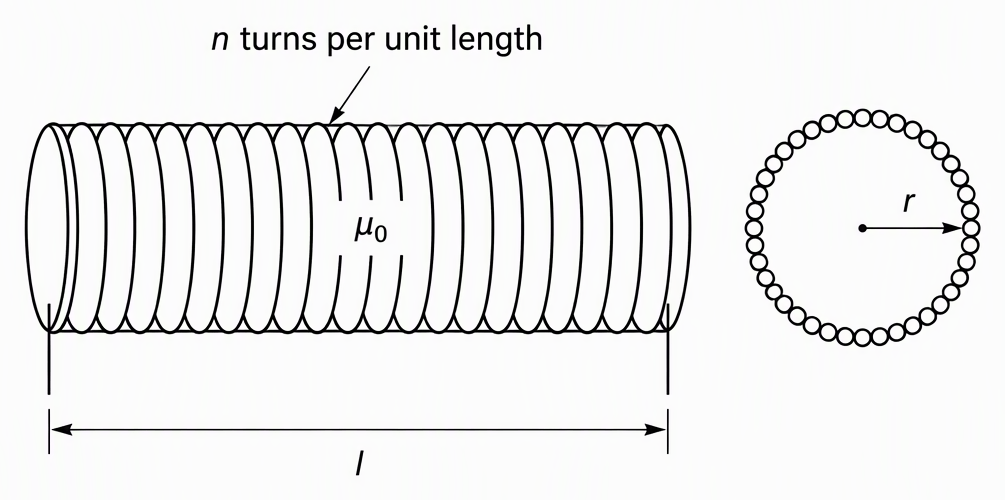
The four supplied choices are:
- A)
- B)
- C)
- D)
This NEET 2026 Physics question belongs to Electromagnetic Induction and Alternating Currents, under self-inductance of a solenoid. The question bank classifies it as medium difficulty and assigns an expected solve time of 45 seconds. That is a question-bank target, not measured student performance. To select the answer, convert turn density to total turns and use the circular cross-sectional area.
How do you distinguish total turns from turns per unit length?
This supplied long-solenoid formula uses total turns, represented by uppercase N. The question gives turns per unit length, represented by lowercase n. They are not interchangeable: convert the density to a total count before substitution.
The symbols mean:
- L: self-inductance, measured in henry.
- N: total number of turns along the solenoid.
- A: circular cross-sectional area, not the answer label A.
- l: full axial length of the solenoid.
- μ₀: free-space permeability.
Convert turn density into total turns:
In words, turns per unit length multiplied by the full length gives total turns. Use compatible length units for the density and axial length.
The area comes from the circular cross-section:
Here, lowercase r is the circular radius. Use this area, not the curved surface area of the coil. The formula applies within the supplied long-solenoid, free-space-permeability model.
How does the substitution give option A without losing a length factor?
Squaring the total turns introduces two powers of length; the denominator removes only one. Following the official substitution method, insert the converted turn count and circular area together. Expand the square before cancelling any length factor.
Direct substitution gives:
Expand the square explicitly:
The intermediate expression is:
Cancel one power of length:
This gives:
Correct answer: option A. For a quick unit check, turns are a count, so turn density has inverse-length units:
The resulting unit is henry:
This confirms dimensional consistency, but dimensions cannot distinguish the four supplied choices. Their differing factors are dimensionless:
Use this compact exam sequence:
- Write the long-solenoid formula.
- Replace total turns by turn density multiplied by length.
- Replace cross-sectional area by pi times radius squared.
- Cancel one power of length.
Why does dropping pi give the incorrect option B?
Option B follows from substituting radius squared for the circular area instead of pi times radius squared. The turn-count conversion can be correct while the area substitution still produces the wrong answer. This is the incorrect calculation:
That expression matches option B. Radius squared has the correct dimensions of area, but it is not the area of a circle.
Compare it with the correct result:
Option B is smaller by a factor of pi. A unit check cannot detect this missing geometric factor because both expressions still have units of henry.
Use a fixed method rule: write the turn-count and area substitutions on separate lines before inserting either into the inductance formula.
How does changing length or radius affect solenoid inductance?
Doubling length doubles inductance at fixed turn density but halves it at fixed total turns. Doubling radius gives four times the inductance when length and turn density stay fixed. These three original practice variations are not additional verified NEET PYQs. Each retains the long-solenoid approximation and the same free-space permeability, μ₀.
What happens if length doubles at fixed radius and turn density?
The inductance doubles. Two long solenoids have the same radius and turns per unit length, but the second has twice the axial length. Find the ratio of their inductances.
With radius, turn density and permeability fixed:
What happens if length doubles at fixed radius and total turns?
The inductance halves. Now the two solenoids have the same radius and total number of turns, while the second has twice the length. Find the inductance ratio using the total-turns form:
Since total turns, area and permeability are fixed:
There is no contradiction with the first variation. At fixed turn density, doubling length also doubles total turns. At fixed total turns, doubling length instead halves turn density.
What happens if radius doubles at fixed length and turn density?
The inductance becomes four times its original value. Find the inductance ratio when radius doubles but length and turn density remain unchanged. Total turns are therefore unchanged; only the circular cross-sectional area changes:
Therefore,
Before using proportionality, list which quantities are held constant.
Next step: the past-paper archive on NEET JEEnius AI and search past NEET papers by year, subject or chapter, each with a worked solution (100 free searches a month).
If that step was the hard part, work through How to Study Carboxylic Acids NEET: A Five-Step Plan.
Frequently asked questions
What is the answer to the electromagnetic induction NEET 2026 solenoid question?
Option A is correct: L = μ₀πn²r²l, where n is turns per unit length, r is radius and l is axial length. For a long air-core solenoid, substitute N = nl and A = πr² into L = μ₀N²A/l.
What is the difference between n and N in the solenoid formula?
Uppercase N is the total number of turns, while lowercase n is the number of turns per unit length. They are related by N = nl, where l is the solenoid's axial length. Use compatible length units before multiplying.
Why is option B wrong if its units are correct?
Option B omits π by using r² instead of the circular cross-sectional area πr². Its value is 1/π times the correct inductance. Dimensional analysis cannot detect the error because π is dimensionless.
Does doubling a solenoid's length double its inductance?
For a long solenoid at fixed radius and permeability, doubling length doubles inductance only when turns per unit length stay fixed. If total turns stay fixed instead, doubling length halves inductance. Identify which turn quantity is constant before using proportionality.