What is the Bohr model of hydrogen atom NEET 2026 question asking?
An electron moves in a circular excited-state orbit around the proton in hydrogen; its supplied speed determines the orbital radius through electrostatic force balance. For this Bohr model of hydrogen atom NEET 2026 question, that gives D, option (4), whose value is 1.
The supplied speed is:
Only 25.6 is under the square root. Find the dimensionless coefficient in the stated orbital radius:
Use these supplied constants:
The answer choices are:
- A, option (1): 4
- B, option (2): 3
- C, option (3): 2
- D, option (4): 1
The question bank labels this medium difficulty, with an expected solving time of 90 seconds. That is the question bank’s target, not a measured student average.
How does electrostatic attraction give the orbital radius?
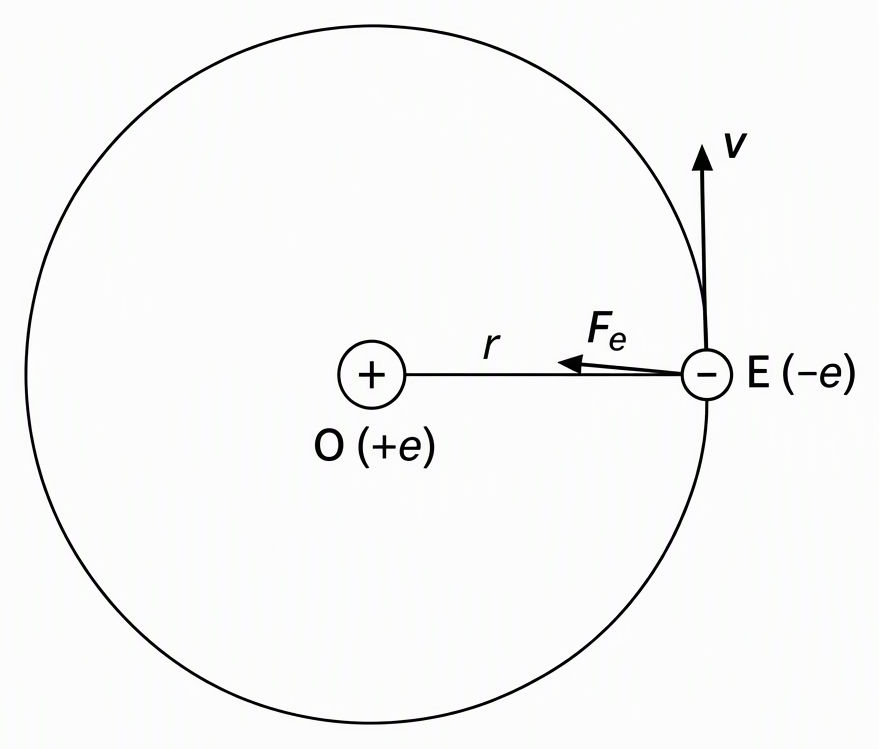
Electrostatic attraction supplies the entire inward force needed for circular motion. “Centripetal force” names this required inward resultant, not an extra force acting alongside the electric force. Use force magnitudes, so the electron’s negative charge does not produce a negative radius.
The charge magnitude is:
Opposite charges establish attraction. The magnitude of their charge product is:
Equate the required centripetal force to electrostatic attraction:
Multiply both sides by the square of the radius:
Then divide by the mass and squared speed:
The supplied speed and constants are sufficient. Calculating a principal quantum number adds work that the official method does not need.
How do you square the speed without a power-of-ten error?
Square both factors in the supplied speed: the square root disappears, and the power of ten is squared. Keep the decimal factors and powers separate until the final division so each exponent step stays visible.
Square the charge magnitude separately:
Substitute every factor into the radius expression, using SI units:
Cancel the common factor 9 from numerator and denominator. Then combine the numerator powers and denominator powers separately:
This matches the official solution’s intermediate expression:
Do not move the speed’s power-of-ten factor under the radical. Do not leave that factor unchanged when squaring: its exponent must double from 5 to 10.
How do you obtain the coefficient and check the correct option?
The radius is one nanometre, so the requested coefficient is 1. The answer is D, corresponding to option (4). The option number is its position in the list, not the coefficient’s value.
Finish the decimal and exponent divisions separately:
Therefore:
Compare with the requested form:
Check the dimensions:
The radius carries units of length. The coefficient is dimensionless, because the metre units cancel when extracting it.
How can a radius–diameter mix-up produce option C?
Doubling the correctly calculated radius gives the diameter, not the requested quantity. This is a possible route to C, option (3), even when the force equation and exponent arithmetic are correct.
Incorrectly matching this diameter to the requested radius form produces:
The error is in identifying the requested quantity, not in force balance. In the figure, the radius is OE, the centre-to-electron distance, not the distance across the whole orbit.
Before matching an option, underline whether the question asks for radius, diameter, or a coefficient multiplying a specified unit scale.
How do you solve related Atoms and Nuclei questions with the same method?
Use the same radius expression for a changed speed, and the force equation to check kinetic energy. These are original practice questions from the same chapter, not additional verified NEET PYQs. Neither requires finding an orbit number.
What happens to the radius if the electron’s speed is halved?
The new radius becomes four times the original radius. Question 1: Within the same hydrogen Bohr-model calculation, find the radius when the electron’s speed becomes half the supplied value.
Start with:
Since the mass, charge and electrostatic constant remain unchanged:
Hence:
Halving the speed makes its square one-quarter as large. The radius becomes four times as large because squared speed is in the denominator.
What is the electron’s kinetic energy at the original speed?
Use half the product of the supplied mass and squared speed. Question 2: Calculate the electron’s kinetic energy at the original speed, then check it using the original orbital radius.
Force balance gives a second route:
Using the original radius gives the same energy:
Now cover the working and reproduce the speed square, radius calculation and coefficient comparison. Use the question bank’s 90-second target to time your attempt.
Next step: photograph a doubt on NEET JEEnius AI and photograph any question you are stuck on and get a step-by-step solution across Physics, Chemistry and Biology (20 free a month).
If that step was the hard part, work through How to Study Cell Biology NEET: NCERT Recall and Practice.
Frequently asked questions
How do I find the orbital radius of hydrogen from electron speed?
Equate electrostatic attraction to the required centripetal force: mv²/r = ke²/r². Rearranging gives r = ke²/(mv²), where e is the magnitude of the electron's charge. The supplied speed and constants are sufficient; calculating the principal quantum number is unnecessary for this question.
How do I square v = (√25.6) × 10⁵ without an exponent error?
Square both factors separately: (√25.6)² = 25.6 and (10⁵)² = 10¹⁰. Therefore, v² = 25.6 × 10¹⁰ m² s⁻². Only 25.6 is under the square root in the supplied speed.
What is x if the orbital radius is written as x × 10⁻⁹ m?
Using the supplied speed and constants gives r = 1 × 10⁻⁹ m, so the dimensionless coefficient x is 1. The correct answer is D, option (4), because the option number is not the coefficient's value. Using the diameter instead would incorrectly give x = 2.
What happens to the orbital radius if the electron speed is halved?
For the same hydrogen calculation, r = ke²/(mv²), so radius varies inversely with squared speed. Halving the speed makes the radius four times as large. Starting from r = 1 × 10⁻⁹ m, the new radius is 4 × 10⁻⁹ m.