What must you match in the cell organelles NEET 2026 question?
The cell organelles NEET 2026 question tests structural identity and location, not simply whether something contains a membrane. Assign each named structure or membrane constituent to the description that identifies it. The source is NEET UG 2026, held on 2026-06-21, Code-50. “Medium” is the question bank’s difficulty classification, not an official exam rating.
List I
List II
- I: flattened membrane-bound sacs within chloroplast stroma
- II: folds of the mitochondrial inner membrane
- III: the plasma membrane surrounding the cell
- IV: disc-like sacs making up the Golgi apparatus
Answer choices
Attempt the match before reading the solution. Choose the option whose complete mapping works, not one with just a single correct pair.
How do cristae and cisternae give the first two matches?
Cristae are mitochondrial inner-membrane folds, giving A-II; Golgi cisternae are disc-shaped sacs, giving B-IV. This follows the supplied solution’s four-pair method, anchored in NCERT Class 11 Biology, Chapter 8, Cell: The Unit of Life. The distinction is structural: cristae are infoldings of a membrane; Golgi cisternae are flattened sacs.
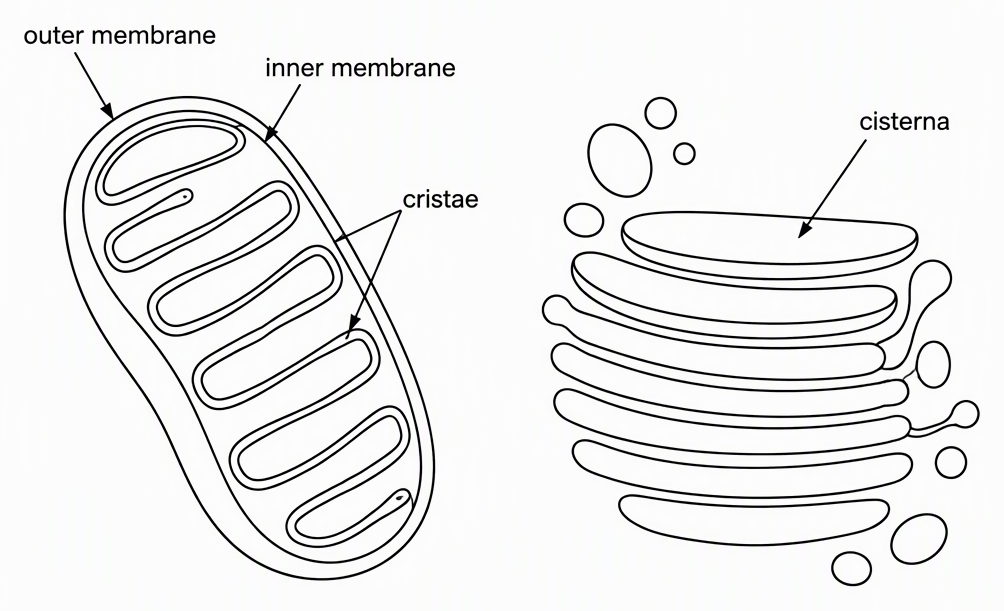
Step 1: Identify the mitochondrion. Its inner membrane forms extensive infoldings called cristae. These folds increase the inner-membrane surface area available for ATP synthesis, fixing A-II.
Step 2: Identify the Golgi apparatus. Its stacked, disc-shaped sacs are called cisternae, fixing B-IV. The term cisternae is not exclusive to Golgi; the supplied description of disc-shaped Golgi sacs fixes the match here.
How do thylakoids and phospholipids complete the match?
Thylakoids match the flattened sacs within chloroplast stroma, giving C-I; phospholipid matches the plasma-membrane description, giving D-III. A thylakoid names a structure, while a phospholipid names a chemical constituent of membranes. The last two pairs therefore require different kinds of identification.
Step 3: Locate the chloroplast structure. Within the stroma are flattened, closed membranous sacs called thylakoids. The light reactions occur on thylakoid membranes. The chloroplast-sac description identifies thylakoids, not a general membrane ingredient, establishing C-I.
Step 4: Identify the membrane constituent. Under the fluid mosaic model, the plasma membrane is a phospholipid bilayer containing embedded proteins. This establishes D-III in the given matching set.
Phospholipids also occur in organelle membranes, so D-III does not mean they occur only in the cell membrane. Their presence alone cannot distinguish a thylakoid membrane from the plasma membrane; the structure’s name and location do that.
Why is answer option B correct?
Correct answer: option B. The independently established matches, in order, are A-II, B-IV, C-I, D-III. Every pair in that option agrees with the worked reasoning:
- A-II: cristae are mitochondrial inner-membrane folds.
- B-IV: Golgi cisternae are disc-shaped sacs.
- C-I: thylakoids are flattened sacs within chloroplast stroma.
- D-III: phospholipids form the plasma membrane’s bilayer framework.
List-I label B means cisternae, while answer option B contains the complete correct mapping. Do not confuse an item label with an answer choice.
Revision line: mitochondrion → cristae; Golgi → cisternae; chloroplast → thylakoids; plasma membrane → phospholipid bilayer.
What reasoning error leads to option C?
Option C keeps the cristae and cisternae matches correct but swaps the last two assignments: A-II, B-IV, C-III, D-I. It assigns thylakoids to the cell membrane and phospholipid to chloroplast sacs. The error is treating the shared property “membrane-related” as sufficient identification.
Thylakoid membranes contain phospholipids, but phospholipid is not the name of those sacs. Composition tells you what a membrane contains; structural identity tells you which structure it is. A shared ingredient does not justify swapping the matches.
Use this corrective check: decide whether the item names a fold, a sac or a chemical constituent, then identify its organelle or membrane context. Check identity before composition.
If the marking scheme awards four marks for a correct answer and deducts one mark for an incorrect answer, the score difference between choosing option B and option C is:
Can you solve three related questions from Cell: The Unit of Life?
Use the same checks here: identify the membrane, distinguish a sac from a stack, and separate composition from structural identity. These are original chapter practice, not verified NEET PYQs. Cover each answer while attempting its question.
For a related next read, use Cell Structure and Function NEET 2026: Matching Answer.
Which mitochondrial membrane forms cristae, and what advantage do the folds provide?
Answer: the inner mitochondrial membrane forms cristae. Folding increases the surface area available for ATP synthesis. Identify the membrane first, then connect its folded shape to its function.
“Mitochondrial membrane” alone leaves the location incomplete. A mitochondrion has both an outer and an inner membrane.
How is one thylakoid different from a granum, and where do the light reactions occur?
Answer: a thylakoid is an individual flattened membranous sac; a granum is a stack of thylakoids. The light reactions occur on thylakoid membranes. These are different levels of organisation, not interchangeable names.
One stack is a granum; multiple stacks are grana. “Chloroplast” identifies the organelle, but “thylakoid membrane” identifies the reaction site precisely.
Does the presence of phospholipids in chloroplast sacs justify changing the match?
Answer: no. Composition is not structural identity. The chloroplast sacs are thylakoids, even though their membranes contain phospholipids. The given plasma-membrane description matches the phospholipid bilayer.
The proposed change mistakes an ingredient for the structure containing it. Cover the original choices and reproduce all four matches, adding “fold,” “sac” or “constituent” beside each List-I term before selecting the answer.
Next step: the past-paper archive on NEET JEEnius AI and search past NEET papers by year, subject or chapter, each with a worked solution (100 free searches a month).
Frequently asked questions
What is the correct answer to the cell organelles NEET 2026 matching question?
Option B is correct: A-II, B-IV, C-I, D-III. Cristae match mitochondrial inner-membrane folds, cisternae match Golgi sacs, thylakoids match chloroplast sacs, and phospholipid matches the plasma-membrane description.
What is the difference between cristae and cisternae?
Cristae are folds of the inner mitochondrial membrane that increase the surface area available for ATP synthesis. Golgi cisternae are flattened, disc-shaped sacs. The term cisternae is not exclusive to the Golgi apparatus, but the Golgi-sac description fixes the match in this question.
What is the difference between a thylakoid and a granum?
A thylakoid is an individual flattened membranous sac within chloroplast stroma, while a granum is a stack of thylakoids. The light reactions occur on thylakoid membranes. Multiple stacks are called grana.
Are phospholipids found only in the plasma membrane?
No, phospholipids also occur in organelle membranes. In this matching question, phospholipid matches the plasma membrane because its framework is a phospholipid bilayer containing embedded proteins. The presence of phospholipids in chloroplast sacs does not change the sacs' structural identity: they are thylakoids.