What is the series LCR circuit NEET 2026 question and its answer?
In this series LCR circuit NEET 2026 question, an AC source drives a resistor, an inductor and a capacitor in one series loop. The task is to find the peak current: 2.2 A, option A, because the two reactances cancel, leaving the resistor to limit the current.
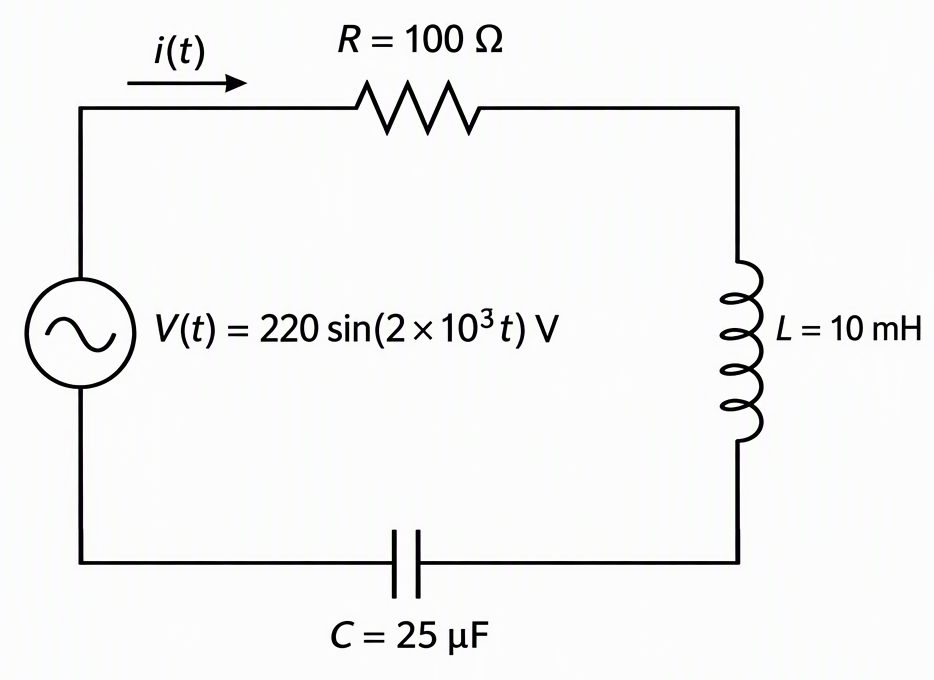
The supplied source voltage is:
The inductance is 10 mH, capacitance is 25 μF and resistance is 100 Ω. Find the current amplitude:
This is NEET 2026, Code-50, Physics, from Electromagnetic Induction and Alternating Currents. The question bank classifies it as medium difficulty and gives an expected solve time of 90 seconds, not a measured student average.
How do you identify the voltage amplitude and convert the units?
Start with the official relation: current amplitude is voltage amplitude divided by impedance. The voltage amplitude is 220 V; the sine argument supplies the angular frequency.
Compare the supplied expression with the standard form:
Therefore:
220 V is the amplitude because it is the coefficient of the sine function. Do not treat it as RMS voltage just because 220 V looks familiar.
Convert the component values to SI units:
The coefficient of time is angular frequency, not ordinary frequency. Multiplying it by another factor of two pi would be incorrect.
How do you calculate the reactances, and why do they cancel?
Both reactances are 20 Ω, so their difference is zero. Inductive and capacitive reactive voltages oppose each other in the series phasor sum; neither component has zero reactance.
First calculate the inductive reactance:
Now calculate the capacitive reactance:
Simplify the denominator:
Hence the net reactance is:
The inductor’s voltage leads the common current by a quarter-cycle; the capacitor’s voltage lags it by a quarter-cycle. Their voltage contributions point in opposite directions in the phasor sum, so equal magnitudes cancel rather than add.
This equality is series resonance. The numerical calculation establishes it without using a resonance shortcut.
How do you find the impedance and current amplitude?
The impedance is 100 Ω, giving a current amplitude of 2.2 A. Zero net reactance does not mean zero impedance: the 100 Ω resistor remains.
Use the full impedance expression:
Substitute the calculated values:
Then:
Option A is correct. Check it using the fact that the squared net-reactance term cannot be negative:
Equality holds here because the circuit is at resonance. All three distractors exceed this resistance-based upper bound:
- 5.5 A: above the maximum possible amplitude.
- 11.0 A: above the maximum possible amplitude.
- 22.0 A: above the maximum possible amplitude.
Why does dividing by 20 Ω give the wrong option C?
Dividing by 20 Ω incorrectly treats one component’s reactance as the impedance of the entire circuit. It is a circuit-modelling error, not an arithmetic error, and produces option C:
The source voltage acts across the complete series LCR combination, not solely across the inductor or capacitor. Neither individual reactance can replace the total impedance.
Return to:
Divide the source amplitude by this impedance, not by either individual reactance. The upper-bound check exposes the error:
This reasoning route produces option C even though the division itself is correct. Keep the resistance in the model, including when the reactive contributions cancel.
How do you solve two related alternating-current questions?
Use the same reactance-to-impedance method, then convert peak current to RMS only if asked. Both questions below are original related practice from the same chapter, not additional verified NEET PYQs.
What is the RMS current with the original source and circuit unchanged?
The RMS current is approximately 1.56 A, obtained by converting the known peak current. Question 1: Keep the original sinusoidal source, 100 Ω resistor, 10 mH inductor and 25 μF capacitor unchanged, and find the RMS current.
Alternatively, convert the voltage first:
Both routes agree because impedance is unchanged. 1.56 A answers an RMS-current question; the original MCQ asks for the 2.2 A amplitude.
What happens if the angular frequency is reduced to 1000 radians per second?
The peak current becomes approximately 2.11 A, and the circuit is net capacitive. Question 2: Retain the 100 Ω resistance, 10 mH inductance, 25 μF capacitance and 220 V source amplitude, but change the source to:
Find the current amplitude and whether the circuit is net inductive or capacitive. Recalculate both reactances because both depend on frequency:
Then:
The circuit is net capacitive because capacitive reactance exceeds inductive reactance. Retain the negative sign when identifying the circuit’s nature; square the net reactance when finding impedance.
Check your result against resonance: 2.11 A is below 2.2 A, because nonzero net reactance increases impedance.
Next step: photograph a doubt on NEET JEEnius AI and photograph any question you are stuck on and get a step-by-step solution across Physics, Chemistry and Biology (20 free a month).
If that step was the hard part, work through How to Study Chemical Kinetics NEET: A Six-Step Plan.
Frequently asked questions
What is the answer to the series LCR circuit NEET 2026 question?
The current amplitude is 2.2 A, so option A is correct. At the supplied angular frequency, inductive and capacitive reactances are both 20 Ω and cancel in the net reactance. The impedance is therefore the resistance, 100 Ω, giving I₀ = 220/100 = 2.2 A.
Is 220 V peak or RMS in V(t) = 220 sin(2000t)?
The 220 V coefficient is the peak voltage, not the RMS voltage. Its RMS value is 220/√2 V. For the given circuit at resonance, the peak current is 2.2 A and the RMS current is approximately 1.56 A.
Why do inductive and capacitive reactances cancel at resonance?
In a series LCR circuit, the inductor's voltage leads the common current by 90°, while the capacitor's voltage lags it by 90°. These voltage contributions oppose each other in the phasor sum. When X_L = X_C, the net reactance is zero, but the resistance remains.
Why is dividing 220 V by 20 Ω wrong in this LCR question?
The 20 Ω value is an individual component's reactance, not the impedance of the complete series circuit. The source voltage must be divided by Z = √(R² + (X_L − X_C)²), which is 100 Ω here. Dividing by 20 Ω gives the incorrect 11 A answer and ignores the resistor.