
How should I study Chemical Kinetics for NEET in six steps?
For Chemical Kinetics in NEET, choose the reaction model before substituting numbers. Use the given information to select the equation, then check the answer against units and physical behaviour. Build your revision sheet around this six-step routine.
- Read NCERT in dependency order. Start with reaction rate and stoichiometric normalisation, then factors affecting rate and experimental rate laws. Continue with order versus molecularity, zero- and first-order integrated equations, then temperature dependence, activation energy and collision theory.
Make notes as question cues, not copied paragraphs: “one concentration changes” means compare experiments. Order is determined experimentally, not generally from balanced-equation coefficients. Molecularity applies to an elementary step and is a positive integer.
- Identify the requested rate. Disappearance rate is not automatically the normalised reaction rate. For the reaction below, divide each species’ concentration-change rate by its stoichiometric coefficient.
For disappearance rate, use the magnitude of the reactant’s concentration change per unit time. Do not divide by its stoichiometric coefficient unless calculating the normalised reaction rate.
- Classify the given information. Match the question cue to the method below. A percentage alone does not establish first-order behaviour; the model must be stated or supported by data.
- Initial-rate data: compare experiments with one reactant held fixed.
- Concentration and time: use the appropriate integrated law.
- Fraction remaining: check for a stated first-order model.
- Temperatures and rate constants: use Arrhenius.
- Build a small formula-and-graph sheet. Connect each equation to its straight-line plot. Label both axes before using a slope, because natural-log and common-log plots give different slopes.
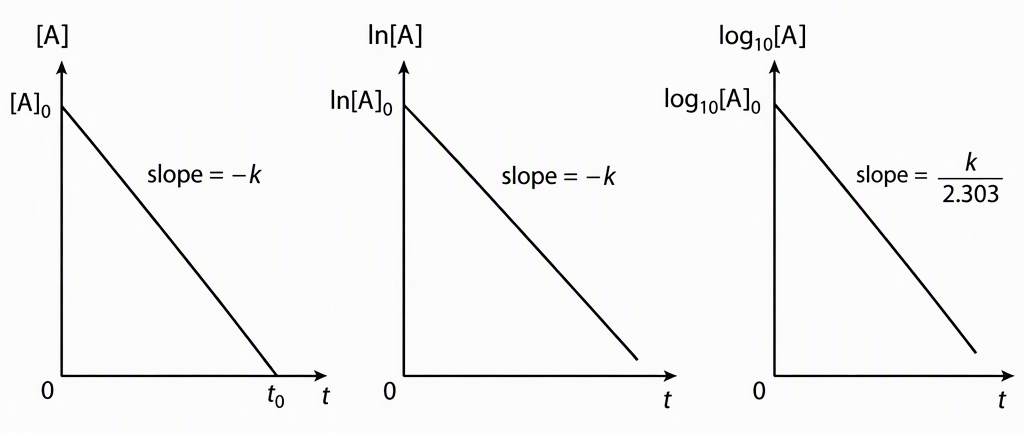
For zero order, while reactant remains:
For first order:
For an Arrhenius plot:
- Translate words before substituting. Convert percentage reacted into fraction remaining and temperatures into kelvin. Activation energy and the gas constant need compatible energy units. Use natural logarithms or the common-log form with its conversion factor consistently.
- Reject answers using units and behaviour. For overall order and time measured in seconds:
Zero-order half-life depends on starting concentration; first-order half-life does not. Under the Arrhenius model with a constant pre-exponential factor, positive activation energy predicts increasing rate constant with temperature. A catalyst provides a lower-activation-energy pathway without changing the equilibrium constant at a fixed temperature.
How do I find reaction order from an initial-rate table?
Hold one reactant’s concentration fixed and compare how the rate changes with the other. Find each exponent separately, then add them for overall order. The data below form an original teaching example, not a previous-year NEET question or evidence about chapter weightage.
Use the experimental rate law:
- Experiment 1:
- Experiment 2:
- Experiment 3:
Compare experiments 2 and 1 because the concentration of B is fixed:
Compare experiments 3 and 1 because the concentration of A is fixed:
Add the exponents for overall order, then use experiment 1 to calculate the rate constant:
Check dimensions by dividing rate units by concentration units raised to the overall order:
The trap: comparing experiments where both concentrations change requires accounting for both factors. Ignoring either can give the wrong order. Overall order three does not establish molecularity three.
Recognition line: initial-rate table → hold one reactant fixed → compare rate ratios → add exponents → check rate-constant units.
How do I convert percentage completion into first-order half-lives?
Convert completion into the fraction remaining, then count halvings if the reaction is first order. Choose this shortcut over logarithms when the remaining fraction is a simple power of one-half.
Original problem: A first-order reaction is 75% complete in 20 minutes. Find its half-life, rate constant and time required for 87.5% completion.
At 75% completion, 25% remains:
Two half-lives have elapsed:
Retain minutes throughout. At 87.5% completion, 12.5% remains, so three half-lives have elapsed:
This is 30 minutes from the start, not an additional 30 minutes. Verify with the integrated equation:
Starting concentration cancels because the remaining amount is given as a fraction of it. Equal successive half-lives belong to first-order kinetics, not every model; zero order instead gives:
For optional ongoing practice, NEET JEEnius AI’s daily practice problems provide a fresh set on a topic every day, with 20 free attempts a month.
How do I solve an Arrhenius question without sign or unit errors?
Write the rate-constant ratio and reciprocal-temperature difference in matching order before substituting. With the hotter rate constant in the numerator, subtract the hotter reciprocal temperature from the colder one.
Original problem: A reaction’s rate constant doubles between 300 K and 330 K. Estimate its activation energy, assuming Arrhenius behaviour with temperature-independent activation energy and pre-exponential factor over this interval.
Use:
Write the equation before inserting numbers:
Simplify the reciprocal difference before multiplying:
Then calculate activation energy:
Dividing the gas constant’s units by reciprocal kelvin leaves energy per mole. Convert joules to kilojoules only after finishing the calculation.
Physical check: the rate constant increased with temperature, so activation energy in this model must be positive. A negative result means the ratio and temperature ordering are inconsistent.
Natural logarithms need no conversion factor. With common logarithms, use:
Do not replace Arrhenius with a universal “rate doubles every 10 degrees” rule. This problem supplies its own temperature interval; the doubling cannot be transferred to another interval or reaction.
What should I practise after learning these methods?
Start with a suggested round of 12 questions, then choose follow-ups from your actual errors. These counts are a practice prescription, not exam weightage. Correct the failed decision rather than repeat an entire lecture.
- 3 questions: reaction-rate definitions, order and molecularity.
- 3 questions: experimental rate laws and rate-constant units.
- 4 questions: zero- versus first-order equations, graphs and half-life.
- 2 questions: Arrhenius and catalyst concepts.
For every question, write the question cue, selected model and expected answer unit before calculating. After marking, label each error as concept, model selection, percentage translation, logarithm or unit conversion.
- Wrong rate-table answer: practise fixed-concentration comparisons.
- Wrong completion time: write fraction remaining before choosing an equation.
- Wrong graph answer: label both axes and write the slope.
- Wrong activation energy: check kelvin, ratio direction and joules versus kilojoules.
After a conceptual error, return to the relevant NCERT paragraph, then solve an unseen question testing that distinction. Include collision theory: effective collisions require sufficient energy and suitable orientation, so collision count alone does not determine reaction rate.
Before a mixed set, rebuild your formula-and-graph sheet on a blank page. A completed lecture or a remembered answer from a repeated question is not proof of independent solving.
As an optional next route, NEET JEEnius AI’s practice mode provides topic sets that skip questions already seen, with 60 free sets a month. Choose the next set around your most frequent error label.
Next step: daily practice problems on NEET JEEnius AI and get a fresh set on a topic every day (20 free attempts a month).
Read next: Kinematics Practice Questions NEET: 6 MCQs With Solutions.
Frequently asked questions
How should I study Chemical Kinetics for NEET?
Read NCERT in sequence: reaction rate, experimental rate laws, order versus molecularity, integrated equations and temperature dependence. Build a formula-and-graph sheet that connects each equation to its question cue, axes and slope. Before calculating, identify the model and expected answer unit; after marking, classify your errors and practise the failed decision.
How do I find reaction order from an initial-rate table?
Compare experiments where one reactant's concentration stays fixed, then use the rate ratio to find the exponent of the changing reactant. Repeat for the other reactant and add the exponents to obtain the overall order. Calculate the rate constant from one experiment and check that its units match the overall order.
How do I calculate half-life from percentage completion?
First confirm that the reaction is first order, then convert percentage completion into fraction remaining. At 75% completion, one-quarter remains, so two half-lives have elapsed; if this takes 20 minutes, the half-life is 10 minutes. Equal successive half-lives are a first-order property and should not be assumed for every reaction.
How do I avoid sign and unit errors in Arrhenius questions?
Use temperatures in kelvin and write ln(k2/k1) = (Ea/R)(1/T1 − 1/T2) before substituting. Keep activation energy and the gas constant in compatible energy units, and include the factor 2.303 if using common logarithms. Under the stated constant-parameter Arrhenius model, an increasing rate constant with temperature requires positive activation energy.