
What order should I follow to study Chemical Bonding for NEET?
To study Chemical Bonding for NEET, choose the model before doing the calculation. Identify the property asked, select the model, then write the smallest representation that can answer it. Repeated reading alone does not practise that choice.
Step 1: Check your prerequisites with small tasks. Write oxygen’s valence-shell configuration, count chloride’s valence electrons, and state the electronegativity trend across a period. Check your answers:
Electronegativity generally increases from left to right across a period. Repair these basics before attempting molecular structures.
Use this study order:
- Lewis structures and formal charge.
- Resonance.
- VSEPR and hybridisation.
- Polarity.
- Molecular orbital theory.
- Ionic bonding, hydrogen bonding and their property questions.
Step 2: Study each block actively. Read the relevant NCERT explanation, close the book, reproduce its diagram or rule, and immediately solve a question using it.
Reconstruct electron counts and formal charges rather than memorising individual answers. Retain standard geometries, applicable MO orderings and NCERT exceptions with their conditions.
Step 3: Route by the property asked.
- Formal charge or equivalent bonds: Lewis structures and resonance.
- Shape or hybridisation: central electron domains.
- Dipole moment: geometry and vector addition.
- Bond order or magnetism: MO occupation.
- Ionic or hydrogen-bonding properties: the relevant interaction model.
No single shortcut, including a hybridisation formula, solves every Chemical Bonding question. A formula that counts domains cannot establish whether bond dipoles cancel.
What should I write before looking at the options?
Write only what decides the answer: an electron count, a structure, a domain label or an orbital occupation. Derive the property before matching an option.
Step 4: Write the minimum representation. Choose a Lewis structure, a dipole sketch, an MO occupancy diagram or a VSEPR label:
For Lewis structures, add electrons for negative charge and subtract them for positive charge. Verify that formal charges sum to the overall charge:
Formal charge splits bonding electrons equally. Oxidation number assigns them to the more electronegative atom, so the two need not agree.
For VSEPR, a multiple bond counts as one domain. Electron-domain geometry includes lone pairs; molecular shape names the arrangement of atoms. Use conventional NCERT hybridisation labels when asked.
For MO questions, calculate bond order from electron occupation. Determine magnetism from unpaired electrons, not bond order:
Step 5: Derive, then match. Equal polar bonds cancel only if their vector arrangement permits cancellation.
Step 6: Audit the likely trap. Check ionic charge, central lone pairs, the complete resonance set, MO ordering and any assumed trend.
Property comparisons need conditions. Distinguish intermolecular from intramolecular hydrogen bonding; lattice enthalpy and boiling point do not follow one universal rule.
For fresh topic-wise questions after this routine, NEET JEEnius AI’s practice mode offers sets that skip questions already seen, with 60 free sets a month.
Why are all three nitrogen–oxygen bonds in nitrate equivalent?
They belong to one resonance hybrid, not to a molecule with a fixed double bond. Use Lewis structures and resonance, then inspect the whole set of equivalent contributors.
Original single-correct MCQ: Which statement about nitrate is correct?
- A: One nitrogen–oxygen bond remains permanently shorter.
- B: Nitrogen’s formal charge equals its oxidation number.
- C: All three nitrogen–oxygen bonds are equivalent.
- D: The ion has three unequal nitrogen–oxygen bonds.
Count the valence electrons:
One valid contributor has one double bond and two single bonds.
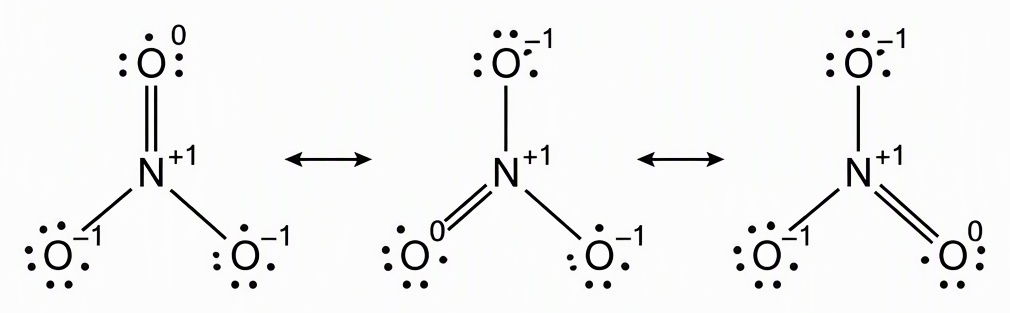
Calculate formal charges in one contributor:
Nitrogen’s oxidation number is different:
The three equivalent contributors give an average bond order:
Answer: C. Nitrate neither switches between structures nor contains one permanently localised double bond. Check the whole resonance set before comparing bond lengths.
Why does sulfur tetrafluoride have a seesaw shape?
Its central sulfur has four bonding domains and one lone pair. Five domains give trigonal-bipyramidal electron-domain geometry, but the molecular shape is seesaw because shape describes only atomic positions.
Original MCQ: Choose the molecular shape and conventional NCERT hybridisation of sulfur tetrafluoride.
Count electrons, form four single bonds, then complete the fluorine octets:
Those two electrons form one lone pair. Four sulfur–fluorine sigma bonds plus one central lone pair give:
The lone pair occupies an equatorial site, leaving two axial and two equatorial fluorine atoms.
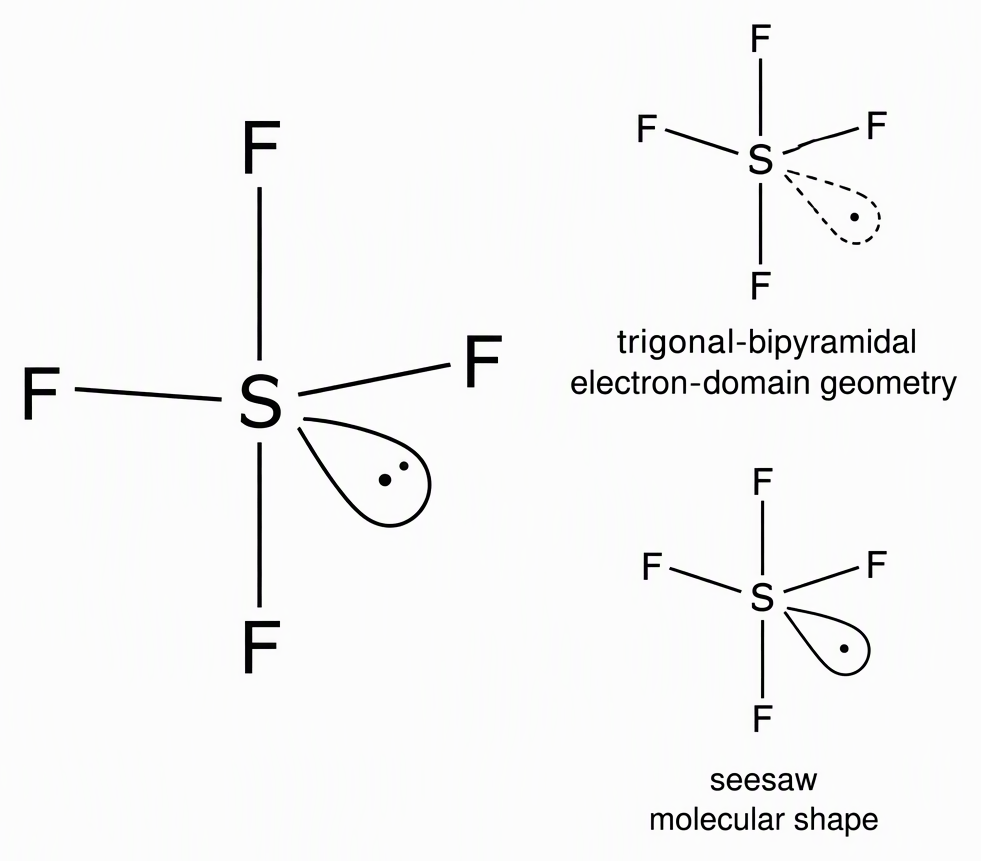
An equatorial lone pair has two right-angle interactions with bonding domains; an axial lone pair would have three. The equatorial position therefore reduces these stronger repulsions.
Answer: A. The nonsymmetric bond arrangement prevents complete dipole cancellation, giving a nonzero molecular dipole moment. Count central lone pairs before naming the molecular shape.
How can one oxygen MO diagram solve questions about its ions?
Keep the MO ordering fixed for the oxygen series and change only the electron occupation. Adding or removing electrons here changes antibonding occupation, so one diagram gives bond order and magnetism for all four species.
Original single-correct MCQ: Which species is diamagnetic?
Use this valence MO ordering, taking the bond as the z-axis:
Neutral oxygen has this occupation:
The two degenerate antibonding pi orbitals are singly occupied:
- Oxygen cation: removing one antibonding electron leaves one unpaired electron.
- Neutral oxygen: two unpaired electrons remain.
- Superoxide: adding one electron pairs one orbital but leaves the other singly occupied.
- Peroxide: adding two electrons fills both antibonding pi orbitals, leaving no unpaired electrons.
Answer: D. Both odd-electron ions remain paramagnetic because each retains an unpaired electron.
Within this series, higher bond order is expected to mean shorter bonds because greater net bonding holds the nuclei more tightly. The expected bond-length order is:
Do not extend that comparison blindly to unrelated molecules. Do not copy oxygen’s ordering for boron, carbon and nitrogen diatomics: their bonding pi orbitals lie below the corresponding bonding sigma orbital:
What should I practise after each kind of mistake?
Repair the failed step, then test it in a mixed set. Choose question-routing practice over another complete lecture when you know individual rules but select the wrong model.
I recommend separate first-round blocks:
- Electron counting, formal charge and resonance.
- VSEPR and hybridisation.
- Polarity.
- MO bond order and magnetism.
- Ionic bonding and hydrogen bonding.
Use these comparisons:
- Carbon dioxide versus sulfur dioxide: shape and polarity.
- Ammonia versus nitrogen trifluoride: dipole directions.
- Nitrogen versus oxygen: MO ordering.
For ionic properties, identify charge, ion size and polarisation before predicting a trend. For hydrogen bonding, distinguish intermolecular association from intramolecular bonding before predicting the property.
Follow topic-wise work with mixed questions. The mixed set must force you to choose the model without a topic label giving it away.
Keep an error log with exactly three fields:
- The exact failed step.
- The corrected rule, including its condition.
- One fresh question testing that correction.
Choose revision by error:
- Electron-count errors: repair prerequisites.
- Shape errors: check central lone pairs.
- Inconsistent mixed-set performance: practise routing rather than automatically repeating a full lecture.
This routine is a recommendation, not an evidence-backed score guarantee. For the fresh-question step, NEET JEEnius AI’s daily practice problems provide a fresh topic set every day, with 20 free attempts a month. Use the next set to test the corrected rule without reopening your notes.
Next step: practice mode on NEET JEEnius AI and practise a topic in sets that skip questions you have already seen (60 free sets a month).
Read next: Hydrocarbons Practice Questions NEET: 6 Solved MCQs.
Frequently asked questions
In what order should I study Chemical Bonding for NEET?
First check valence-electron counting, electronic configurations and electronegativity trends. Then study Lewis structures and formal charge, resonance, VSEPR and hybridisation, polarity, molecular orbital theory, and finally ionic bonding and hydrogen bonding. After each block, reproduce the relevant diagram or rule without notes and solve a question using it.
Is reading NCERT enough to prepare Chemical Bonding for NEET?
Repeated NCERT reading alone does not practise choosing the right model for a question. Read the relevant explanation, close the book, reconstruct its diagram or rule, and immediately apply it to a question. Follow topic-wise practice with mixed questions that require you to identify the model yourself.
What is the difference between electron geometry and molecular shape?
Electron-domain geometry includes bonding domains and central lone pairs, while molecular shape describes only the arrangement of atoms. In sulfur tetrafluoride, four bonding domains and one lone pair give trigonal-bipyramidal electron-domain geometry but a seesaw molecular shape. Count central lone pairs before naming the shape, and count a multiple bond as one domain.
How do I reduce mistakes in Chemical Bonding MCQs?
Identify the property asked, choose the relevant model and write the smallest representation needed before checking the options. Keep an error log with three fields: the exact failed step, the corrected rule with its condition, and one fresh question testing the correction. Repair that step, then attempt mixed questions to check whether you can select the model without a topic label.